Posted on 4 Comments

The Ones Worth Keeping

The past few weeks have been a whirlwind of excursions to gather photo reference. Rather than spread it out over the summer, I decided to group several trips together while the venues were quieter and before school let out.

In that short span, I’ve visited Discovery Wildlife Park, Heritage Park, and Butterfield Acres, gathered plenty of photos of bear cubs, and a lot of barnyard animals for a domestic series I’m planning. You can see those posts and pictures by clicking on the venue names above.

Last week, I headed south to Coaldale, just outside of Lethbridge.
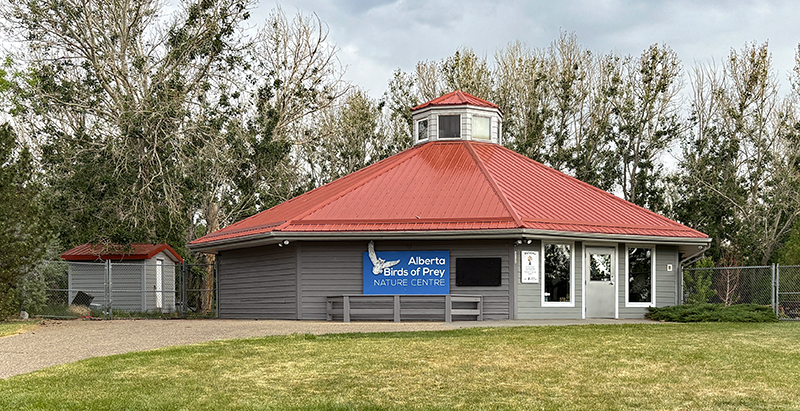
I’ve been supporting the Alberta Birds of Prey Centre for several years now with a monthly donation, and I’ve enjoyed getting to know the owner/operator, Colin Weir. He’s a very nice man, completely dedicated to his purpose, and has turned what was once a barren gully in the 80s into one of the most beautiful wetland sanctuaries you’re likely to see anywhere.

The centre is home to temporary rescues and permanent residents, while migrating wild birds return to its ponds every year. There’s even a pair of wild Great Horned Owls that nest on the property, and their offspring come and go from the centre as they please.

On this trip, one of the staff pointed out this year’s young owls perched in a tree, watching one of the school presentations.

Every time I visit, I not only marvel at the improvements and Colin’s vision for the future of the facility, but I’m continually impressed with how well cared for the birds are, both those slated to be released back into the wild and the permanent residents.
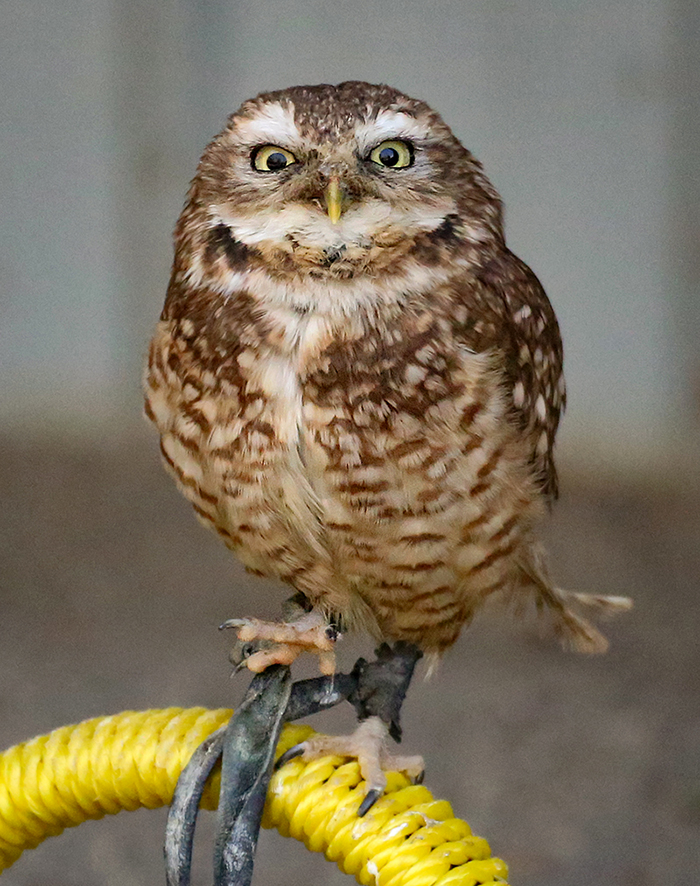
With all the photos I’ve taken the past few weeks, I have to get them weeded and sorted as soon as possible. If I don’t, they’ll sit in my “Photos to be Sorted” folder for far too long and become one more thing I need to get to.

I consider myself a decent photographer, but not a good one. Because I know so many professional wildlife photographers, my metric is very high. I’m not on their level, but nor do I want to be. I don’t make my living selling photos, but on the paintings I create inspired by the pictures I take. So while I like them to be good enough to share with all of you, they’re a means to an end, not the final product.

That also means I’m a spray-and-pray photographer. With my camera set on burst mode, I’ll take ten shots in rapid fire just to hopefully get one worth keeping. I usually come home with 1,000 to 1,500 shots from a day of critter photography, depending on what I see. Most of those are discarded on the first pass.
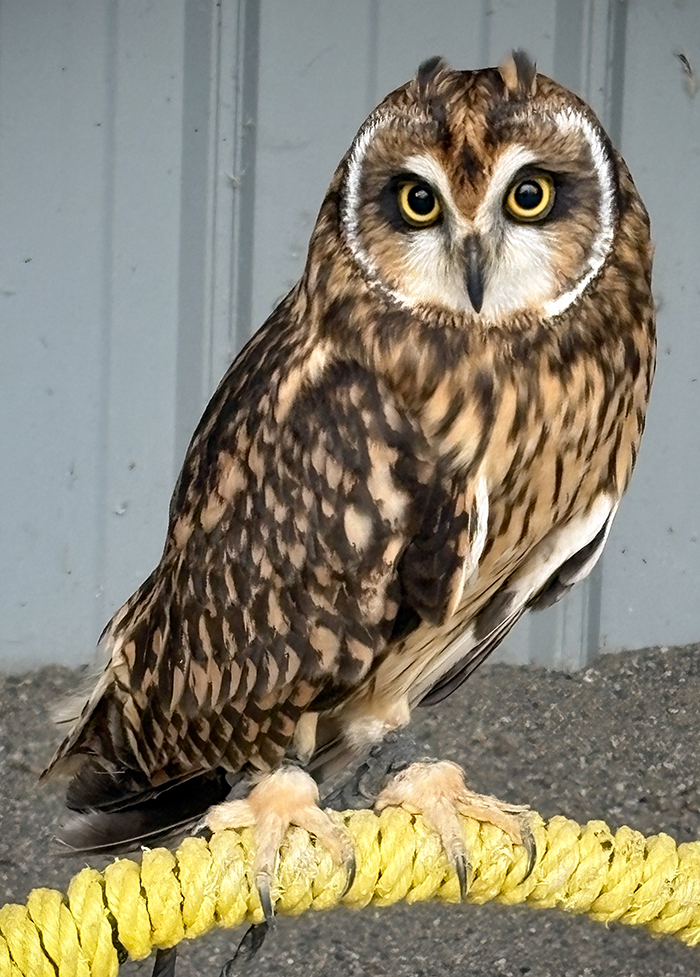
When I’m sorting photos, the first thing I’m looking for is whether they’re in focus. If they don’t show crisp detail, I usually delete them.

The second thing I’m looking for is expression. Is there something there that’s unique, that would help me find the personality in the subject?
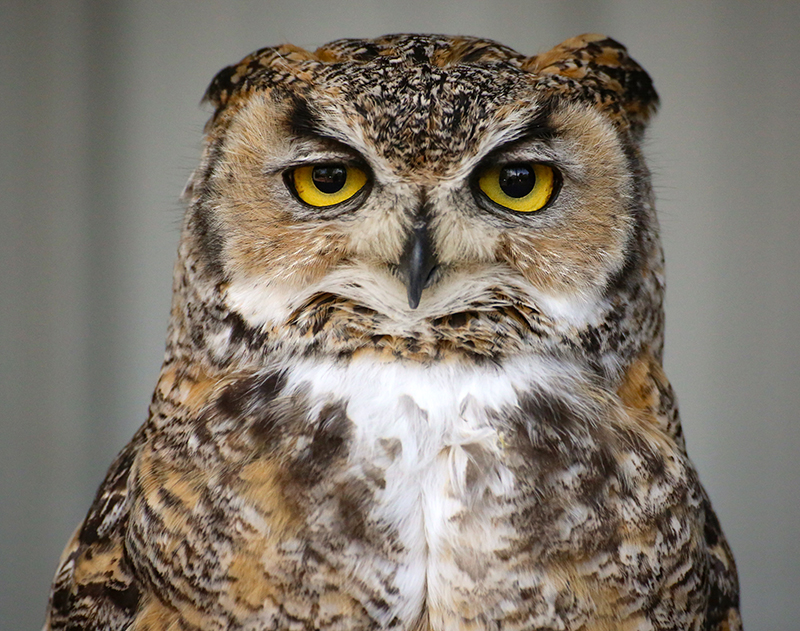
The third thing is, does it make me feel something? If it makes me laugh, or I think it’s cute, sassy, or any number of emotions, that means there’s probably a painting there, or at least the potential.

Sometimes what saves a photo that isn’t technically perfect is the second or third criteria. Because most people never see most of my reference, I’ve used bad photos to inform some of my best paintings.

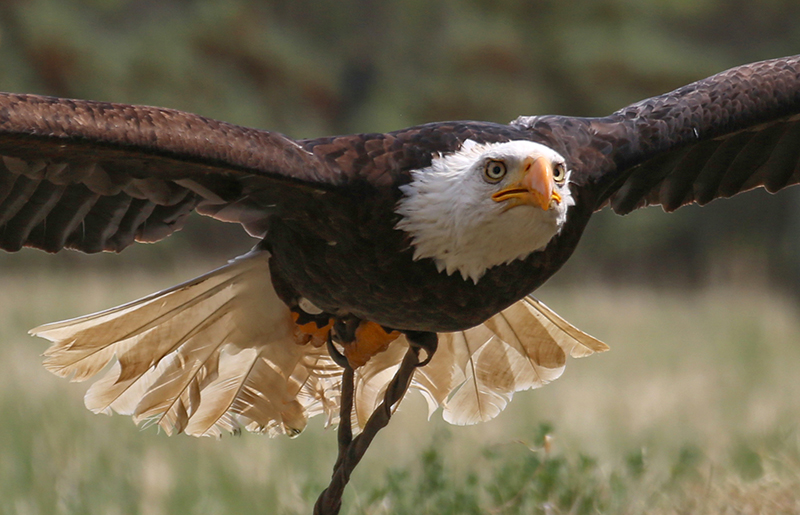
On this recent trip to Coaldale, I took a lot of photos. Because I’ve been there many times, what I would have kept on the first trip, I threw away from this latest one. I’ve already got plenty of bald eagle photos in my archive. Anything new worth keeping must bring something special to the party. Not just good light or sharp detail, but something that inspires. A personality shot.
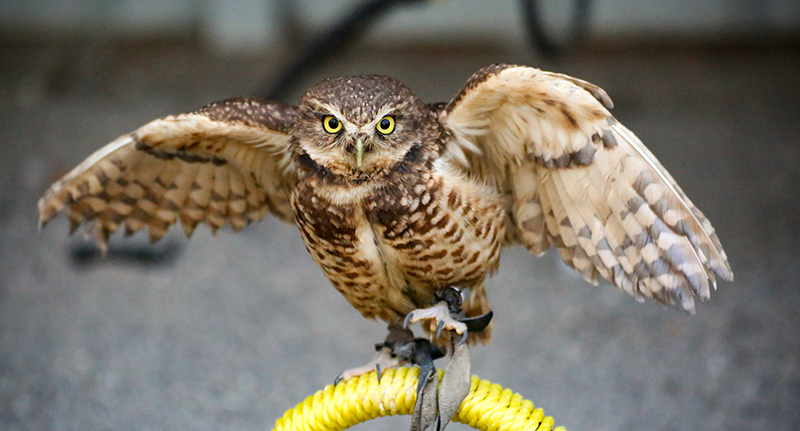
If I keep every good shot, I’ve just got a folder full of the same kind of head-and-shoulders bald eagle photos taking up space.

The first pass, I’m pretty forgiving. If it’s a good shot, I’ll keep it. Then I let the keepers sit for a couple of days and look through them again. That’s when a bunch more go to the recycle bin. On the final pass, I ask myself, “Will I ever paint from this? Is this a photo I would choose as reference for a painting or a sketch?”

If the answer is a hard no, it’s gone.

So when I sorted photos from this recent trip, I deleted about thirty photos of the same eagle. They were good shots, but they were all the same. Basically anatomy photos, nothing special.

But then I came across one where the eagle had stretched up straight, pulled his head back, was looking off camera, and it made me smile. It looked to me like he was saying, “You talking to me? Are YOU talking to ME?”
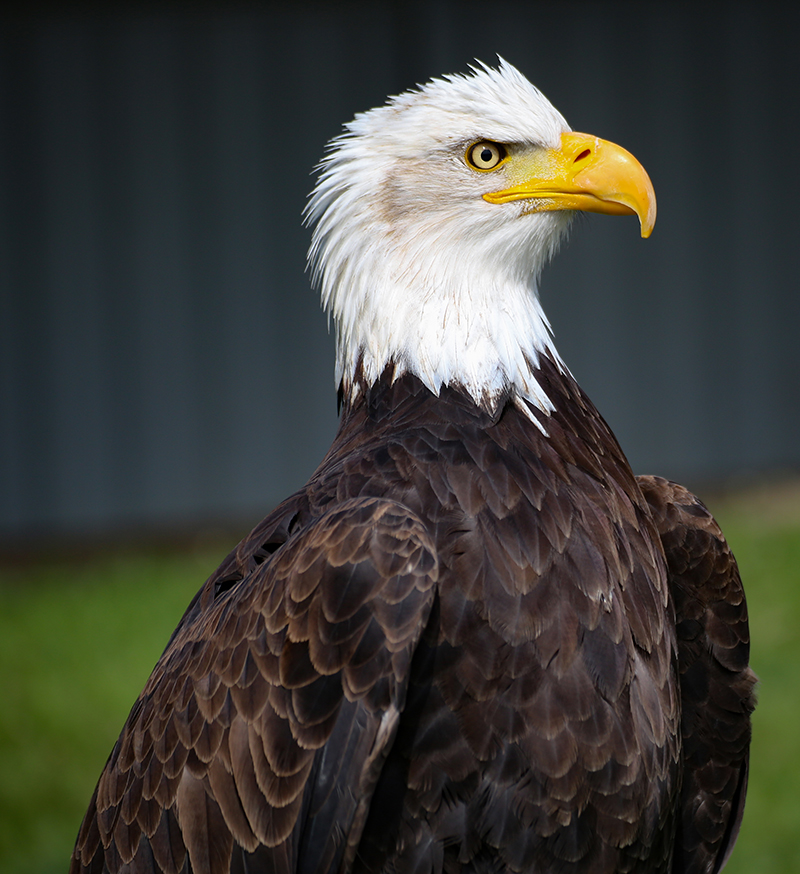
So that’s a keeper.

Will I paint from it? Maybe.

The photos I keep provide me with options months or years down the road.

With all the photos I took recently at Discovery Wildlife Park, Heritage Park, Butterfield Acres, some osprey shots here in Canmore, and the Birds of Prey Centre trip, it’s taken several days of sorting and culling photos to figure out what I wanted to keep.

I can’t always take my own photo reference, especially when the animal is one I don’t have access to, like a sea turtle, cheetah, or African elephant. I’ve had generous photographer friends offer their images from time to time. But taking my own photo reference has become one of my favourite parts of painting my critters.

The experience of spending time with the animals, seeing the expressions and personalities, adds a flavour to the painting experience that’s missing with stock photos.
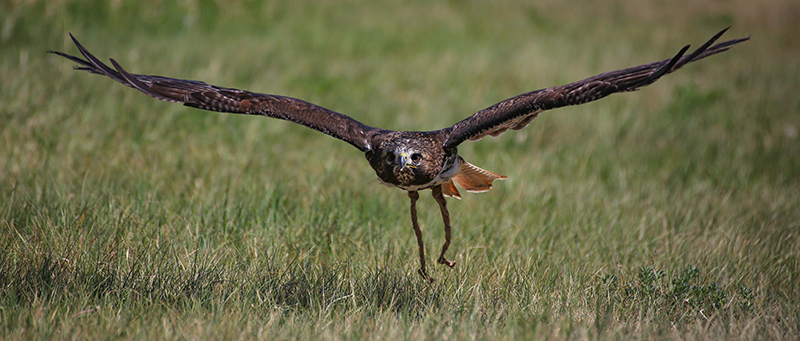
There is one final category of photos I’ll keep, but won’t likely ever use for reference, and that’s the memory of the experience.

If I’ve been able to interact with an animal in an unusual situation or had a special moment with a critter, those photos are priceless, and often taken by the caretaker I’m with. They help me tell the stories behind the paintings, and they remind me why I make the effort in the first place. These moments, where I’ve had a bear cub crawl onto my lap or been granted a feeding session with an owl, are so fleeting. They’re over before I know it.

The photos help me remember them and push me to get out there to find the next experience.
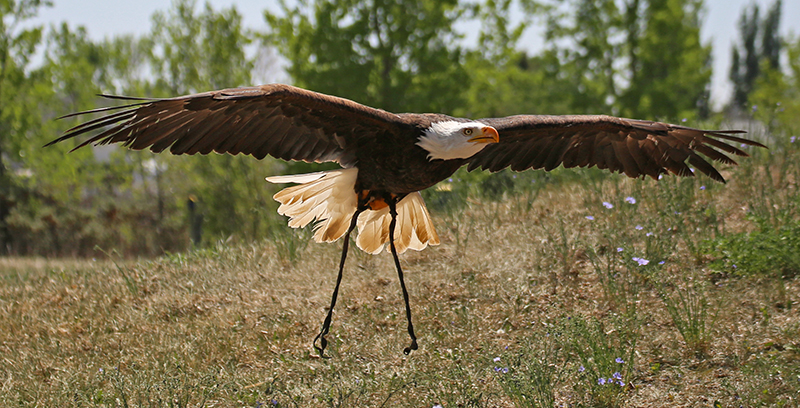
I always learn new things about the birds while talking to Colin and his knowledgeable staff. And frankly, they’ve spoiled me with some incredible animal encounters over the years. This trip was no different.

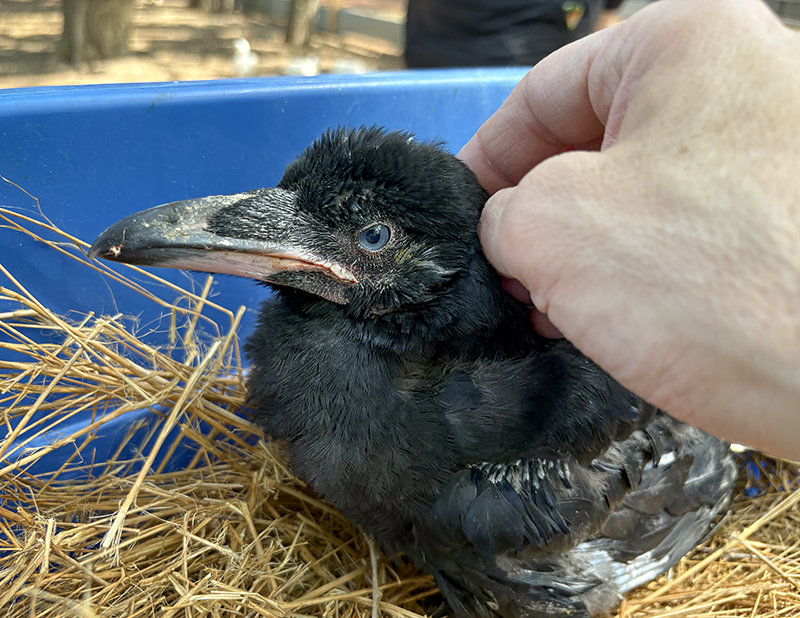
As much as I enjoyed coming home with new reference, the highlight of this visit wasn’t the photographs. I’ll be sharing more on that once I edit and publish a video in the coming week. That story deserves a post of its own.

Here’s a sneak peek, and yes, that’s a baby raven.
Cheers,
Patrick

Posted on 2 Comments

Levelling Up

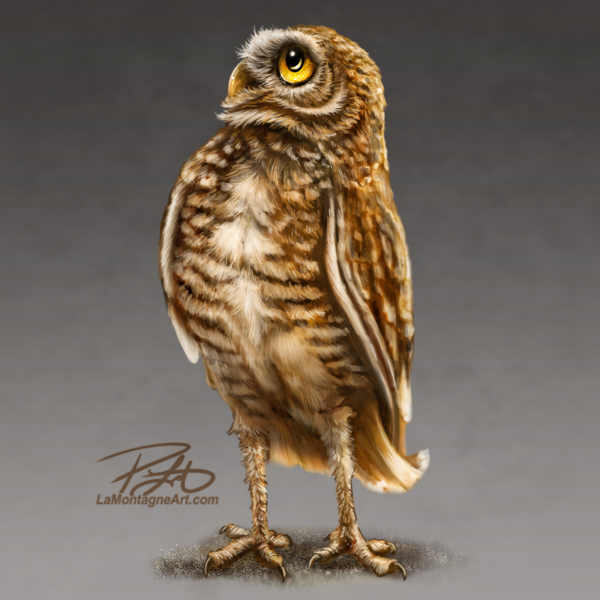
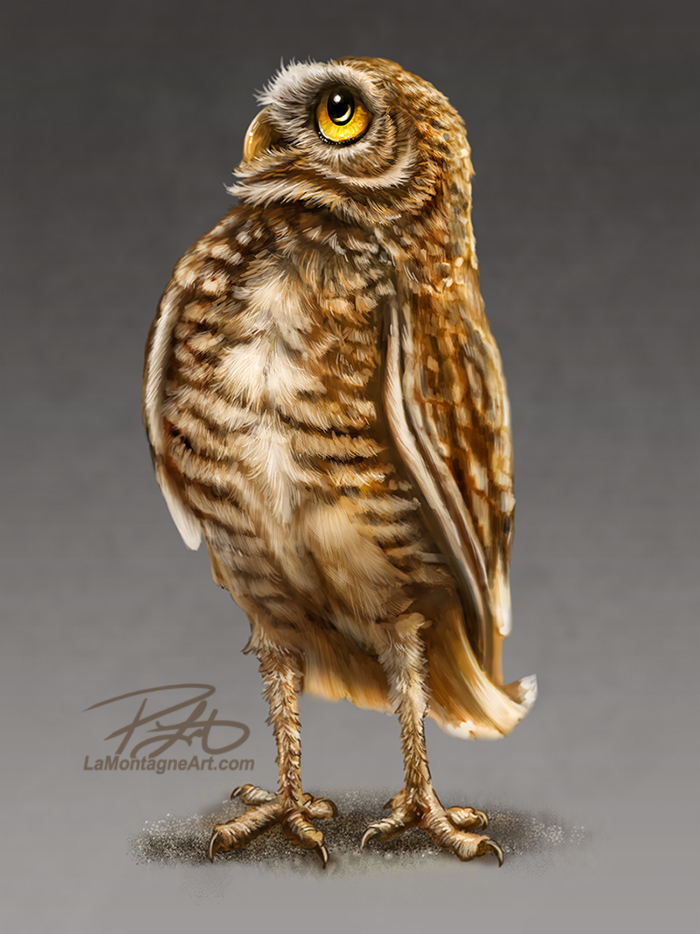
Here’s the fourth burrowing owl in the series, which will be part of a larger piece featuring multiple owls in different poses. I don’t know how many owls yet, and I only have a rough vision of it.

Though I’ve only been to the Alberta Birds of Prey Centre in Coaldale a couple of times, spending two days on each visit, I’ve also seen them on several occasions here in Canmore.

Before the pandemic, The Town of Canmore used to host a WILD event at the Civic Centre. It featured everything from hikes, art activities, educational talks about the environment, etc. Colin Weir and his daughter Amy would bring their ambassador birds to the event, featuring four different owl species and a golden eagle named Sarah.

It allowed the public to get up close and personal with these owls, learn about the Alberta Birds of Prey Foundation’s great work and raise funds for the non-profit organization.

I’ve taken thousands of photos of these birds over the years, and even though I’ve only kept the best of these shots, I still have hundreds in my well-organized archive. Every time I go through these photos looking for my next painting, I often think it a waste to have so much reference that I’ve yet to use.

While most of my whimsical wildlife paintings are single animals in a portrait-type pose, I enjoy the challenge of putting multiple animals in a composition and creating a scene.

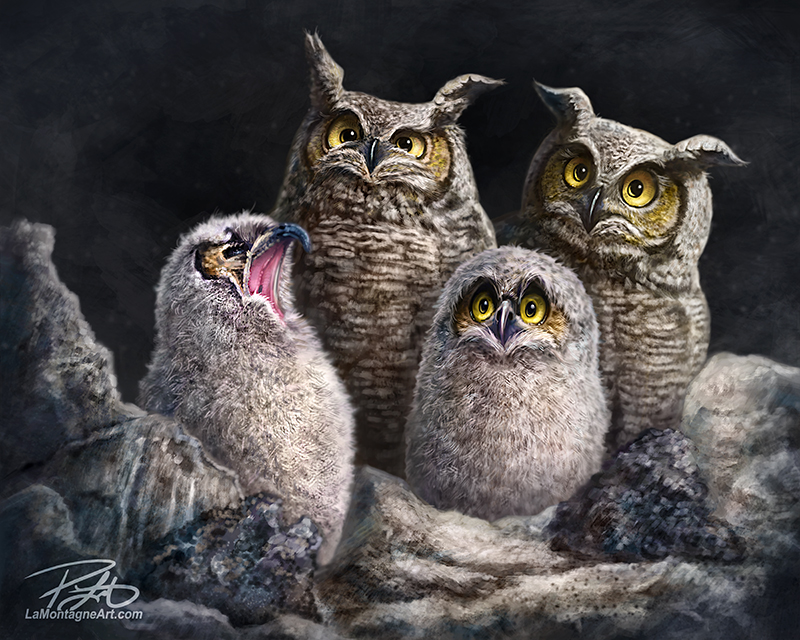
There’s the Two Wolves painting where it looks like they’re sharing an inside joke. Another is the three cougar cubs laughing together in Snow Day. One of my favourites and still a very popular painting is One in Every Family, a scene I painted in 2014 featuring four great horned owls.
Part of the reason I love that painting is the story behind it. That painting won the Best of Show award at Photoshop World that year, but the prize for that win was my Canon 5D Mark III camera that has become like an old friend. I baby that thing because it has helped me take the reference that allowed me to paint my best work in the years since.

That owl piece began as a practice experiment. I took several photos of the family up at Grassi Lakes over multiple days, and the experience was more about seeing these wonderful birds in the wild than creating a painting.

I did some individual sketch paintings from better shots than I expected to get. Eventually, I put those rough paintings together and invested the time to render the finished piece above.

Having painted more than 100 production pieces since 2009, I’ll often go through my photo archive and have difficulty deciding what to paint next. Lion? I’ve painted a few of those. Wolf? Several of those. Eagle? Raven? Black Bear? Many of each.

I could quite happily paint Berkley the brown bear repeatedly for a year, and I have more than enough references. But a variety of popular animals is more desirable, to find something new that will be appealing to me and be of interest to my customers and licensing clients.

There’s the difference between art for a hobby and art for a living.

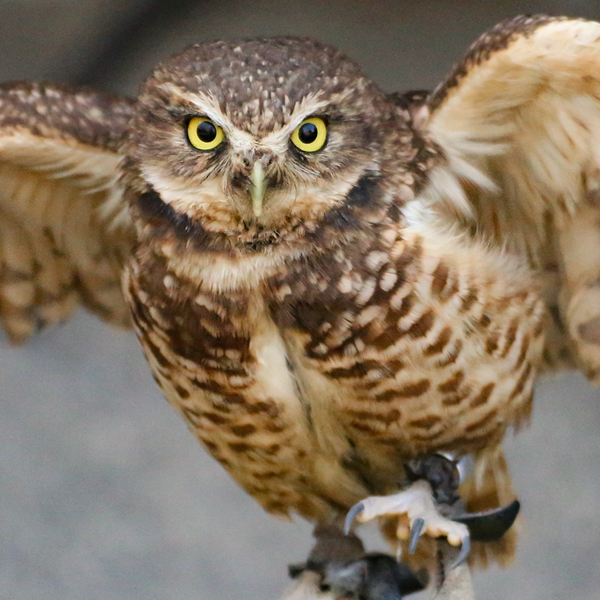
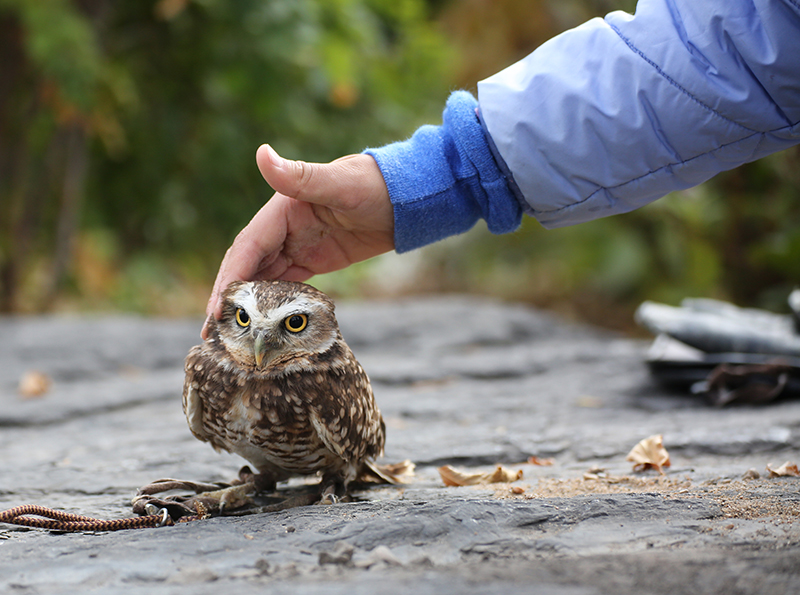
So, when I repeatedly came across dozens of burrowing owl photos, many of which are the same owl, this little fella named Basil, I wondered what I could do with them.
And that’s how I ended up creating a folder called Next Level Projects. About a year ago, I spent a whole weekend going through my photos looking for animals for which I had plenty of reference; that would also look good in a painting featuring a group of them.

The first is going to feature these burrowing owls. I’ll paint several of them individually, like the one at the top of this post. Then, when I have enough, I’ll move them around on a larger digital canvas, come up with a scene, and spend time painting over them, ensuring the light matches up and they look like they belong together.

From a business perspective, each one of the owls will lend itself to an individual painting on different items. For example, Pacific Music & Art could have a set of six burrowing owl coasters, all of which are also part of the same painting in a print. It would work for stickers and magnets as well. But the larger painting, featuring all of them, would work well on a coffee mug, as it’s a longer horizontal layout.

Because I’ve been painting these animals for thirteen years, many in the same popular format of the headshot composition, the routine has started to creep in, and it’s a little concerning. I’m not tired of this work; I still enjoy it immensely. But as the recent commission piece taught me, and the latest elephant painting, it needs to continue to be challenging, or I’ll get bored of my work.

Paintings featuring multiple animals feels like the next step, and I’m focusing on creating more of those this year.

I’ve long wanted to do a painting featuring several meerkats. There’s one I keep coming back to with multiple ring-tailed lemurs, too. I’ve already got titles for both and a lot of reference. And I have so many baby pictures of Berkley and the new cubs at Discovery Wildlife Park that I’ve long wanted to put multiple brown bear cubs in one painting.

I’ll still paint the single animal pieces because I have several in mind as well, but these multiple-animal pieces will present an ongoing challenge to keep me excited about painting.

So instead of sharing as many finished paintings with you this year, I’ll likely be sharing pieces of finished paintings and the stories behind these next-level projects.

In the meantime, I’m always open to suggestions. So, if there’s an animal you’d like to see me paint, let me know in the comments. There is always the chance you’ll come up with something I haven’t considered. Or if you’d just like to tell me which one of my many paintings is your personal favourite(s), that helps me decide on future paintings, too.

Cheers,
Patrick

Posted on

The Great Grey Hunter

With the brilliant fall colours and abnormally warm October temperatures, the timing couldn’t have been better for some R&R in Central Alberta ranch land with a good friend of mine. For five days, we caught up, reminisced, ate good food, tipped back a few drinks, played Scrabble and cards like old men, and enjoyed the slower pace.

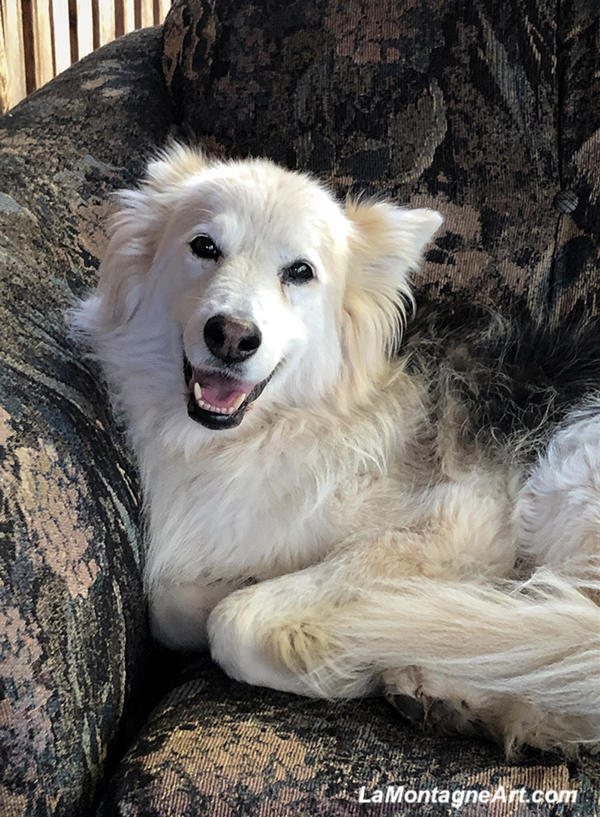
As usual, I took plenty of photos, mostly of horses, cows and Jingles, the most good-natured dog you’ll ever have the pleasure to meet.

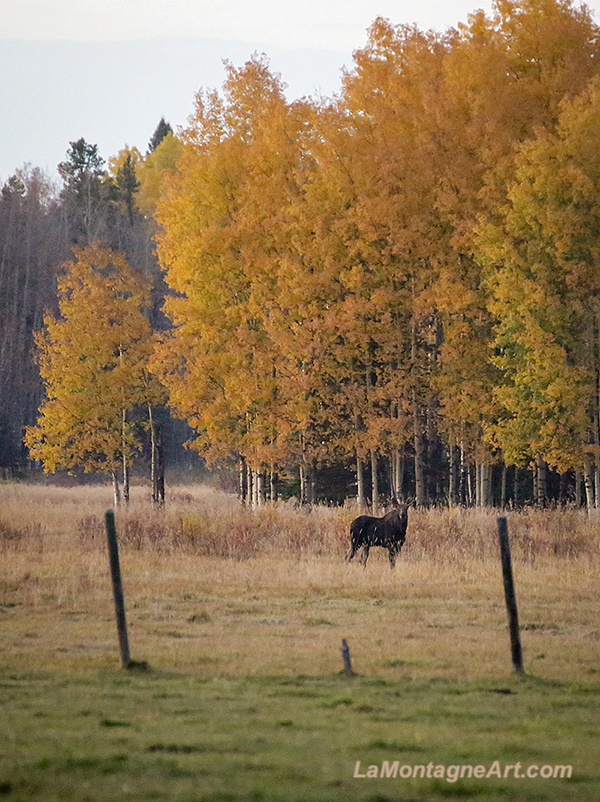
I even caught sight of a moose one evening, though too far away for reference. But anytime I see wildlife is a win.

In my regular day to day, I get up at 5am, even on weekends. For anyone who is self-employed, weekends often don’t mean much anyway. So when I do take time off and sleep in, I’m still an early riser.

On our last morning, I woke just after 7 to an eerie warm light coming through my window. I got out of bed, pulled the curtain back and thought it looked like that strange hazy glow of forest fire smoke. Since we haven’t had any of that in a few weeks around here, it took me a minute to realize it was just the light bouncing off the yellow leaves on the trees and ground.

I quickly dressed, grabbed my camera, and snuck out the back door of the cabin. I didn’t want to go past my buddy’s bedroom and possibly wake him. My photography skills just weren’t adequate to figure out how to capture the weird light I was seeing, so I resigned myself to simply appreciating the moment. The three previous mornings had been pretty, but this was much more intense.

Since I was up already, I wandered out to the road to see if there might be some deer or a coyote around. I knew that anything I might encounter would take off as soon as I saw it, so the best I might hope for would be a few quick snapshots.

When I emerged from the lane onto the road, I spotted a large shape on a fence post. At first, I thought it might be a hawk. I’ve long been trying to get photos of a red-tailed hawk in the wild, but each time I see one, it’s usually while I’m driving with nowhere to pull over.

At the same time, a little way down the road, there were two white-tailed deer. They spotted me just as I raised my camera. I got one shot before they bolted into the trees, but it isn’t worth sharing.

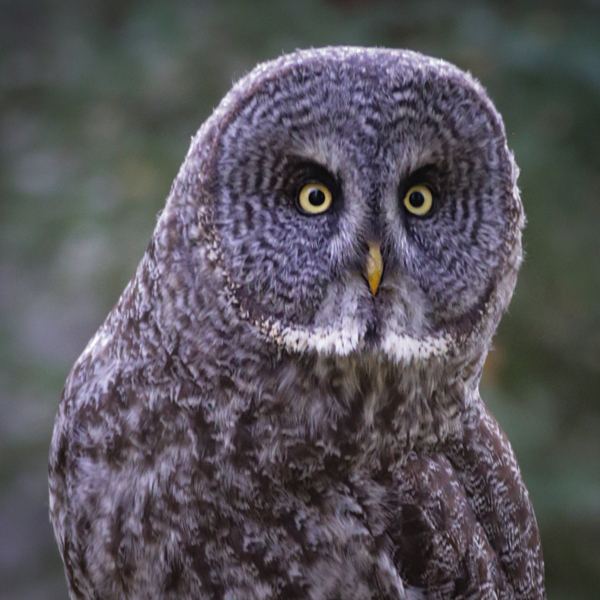
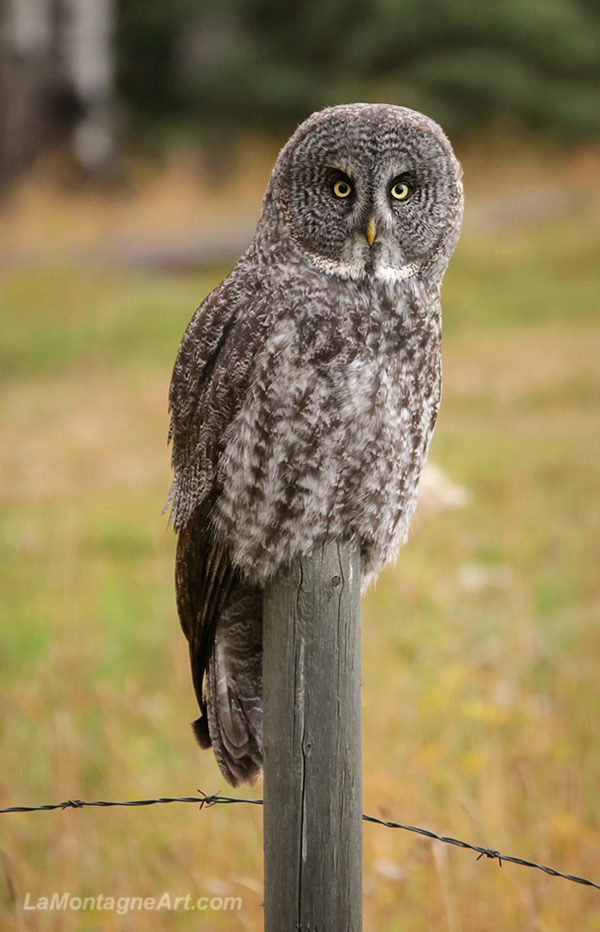
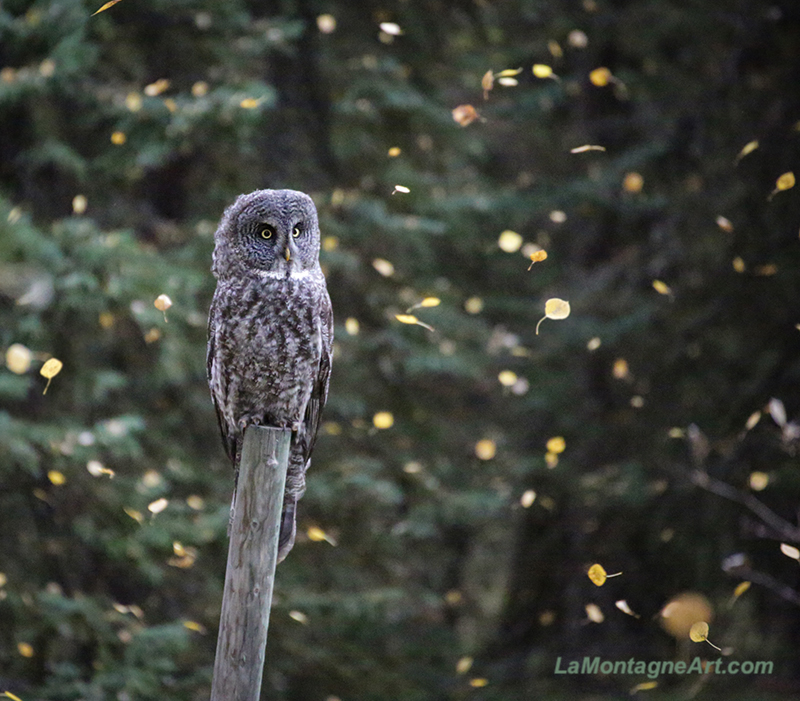
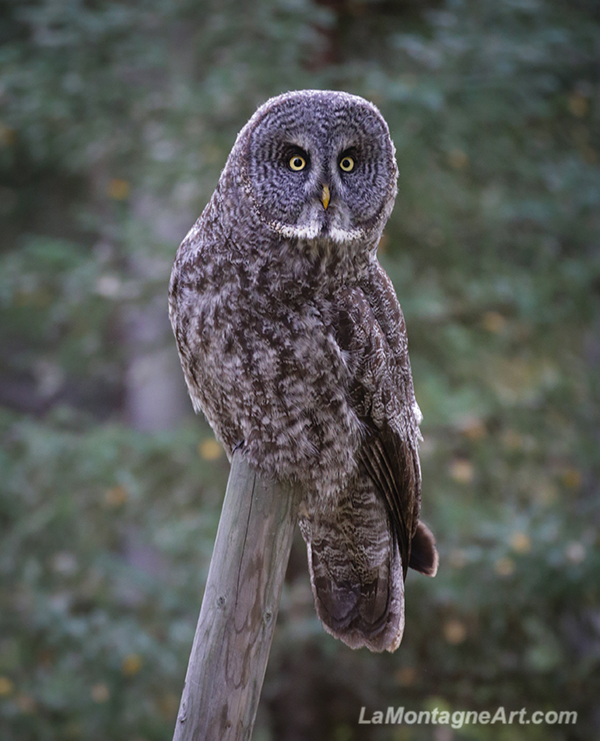
My attention quickly returned to what I now realized was a Great Grey Owl. A common species in Alberta, but I’ve never seen one in the wild. I thought I might get a few quick shots before it took off, especially since it looked right at me, but my presence didn’t seem to be a problem.

Female Great Grey Owls are larger than males but there’s no other way to easily tell their gender. As this was a single and quite large, I’m going with she.

With each step I took, I expected her to fly away, but she seemed more interested in finding her breakfast than worrying about me. I crept closer and moved a little farther down the road around her to get the best light, continuously taking shots.

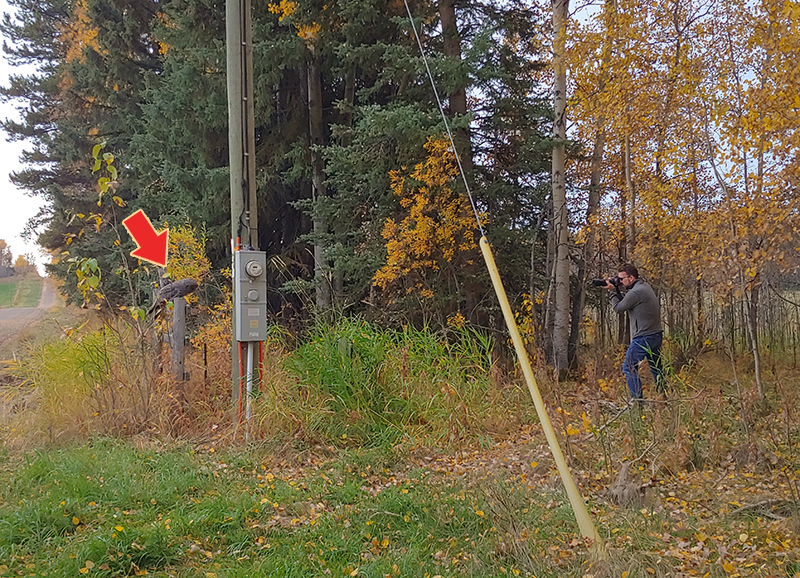
Eventually, I got to within 8 or 10 feet and figured that was close enough. I didn’t want to crowd her. With a 70-300 mm lens, I knew I’d still capture plenty of detail.

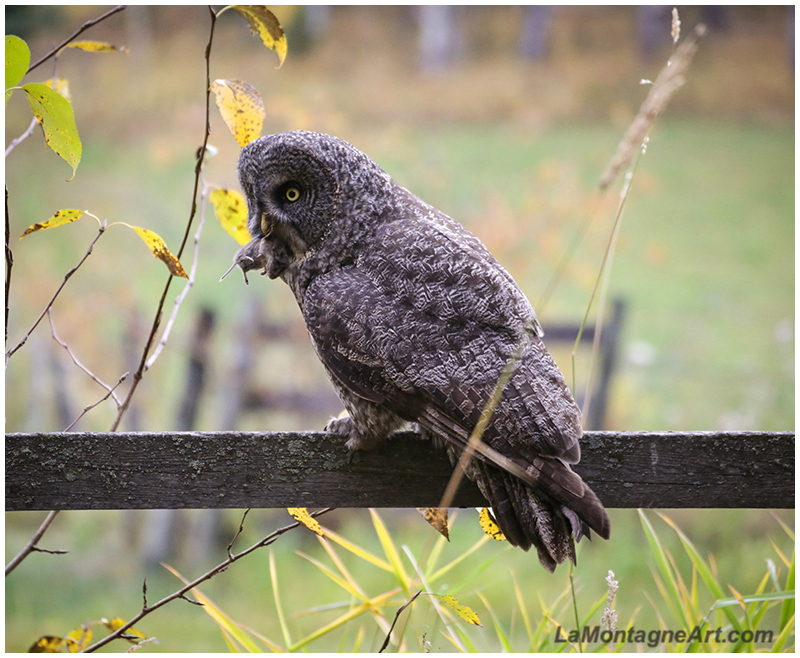
Finally, after watching her snag a mouse and eat part of it on the next post, she gracefully dropped from the post and silently flew down the fence-line. Having taken a few dozen photos, I thought that was it, and I was grateful for the gift.

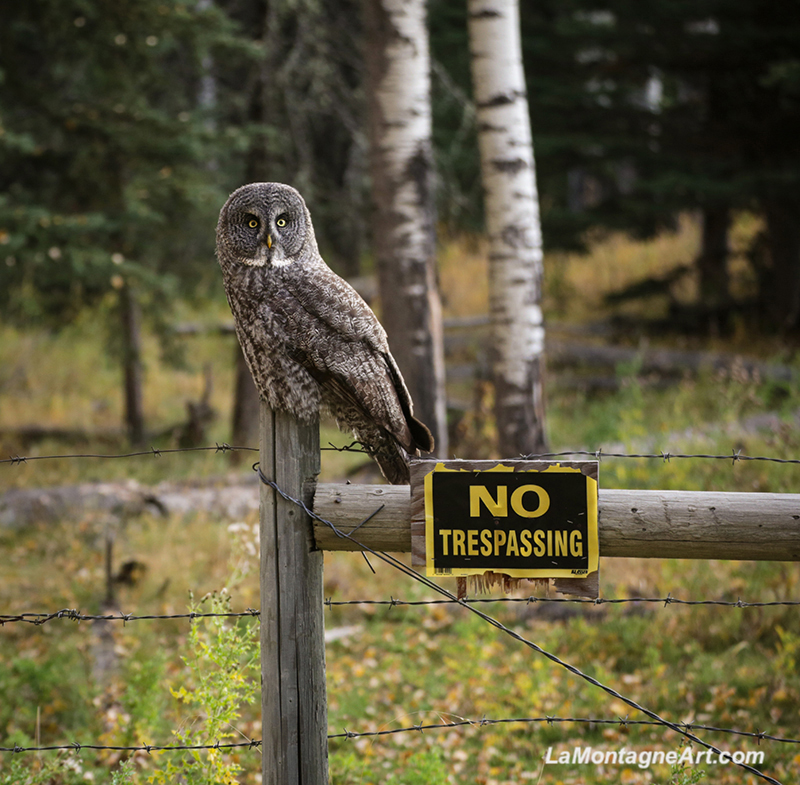
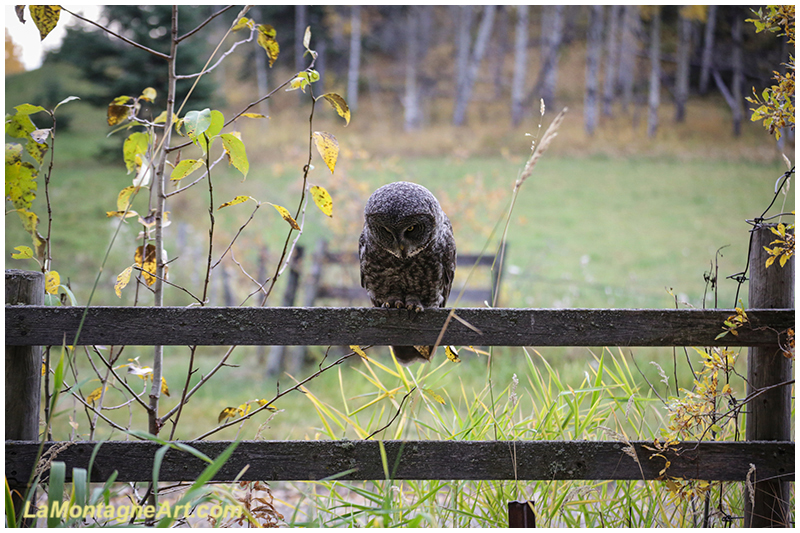
But she didn’t go far. Her next perch was even closer to the cabin than the first. I wandered back the way I came, again expecting her to take off, but she stayed put. I enjoyed her implied audacity at ignoring the No Trespassing sign, coupled with the fact that the sign colour matched her eyes.

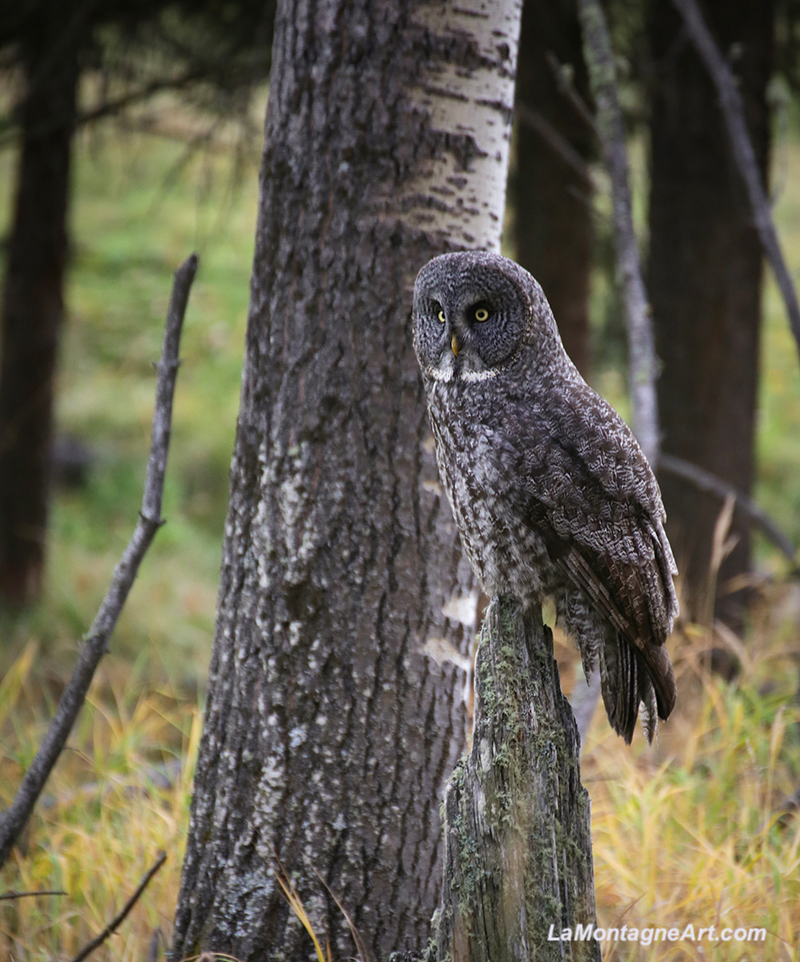
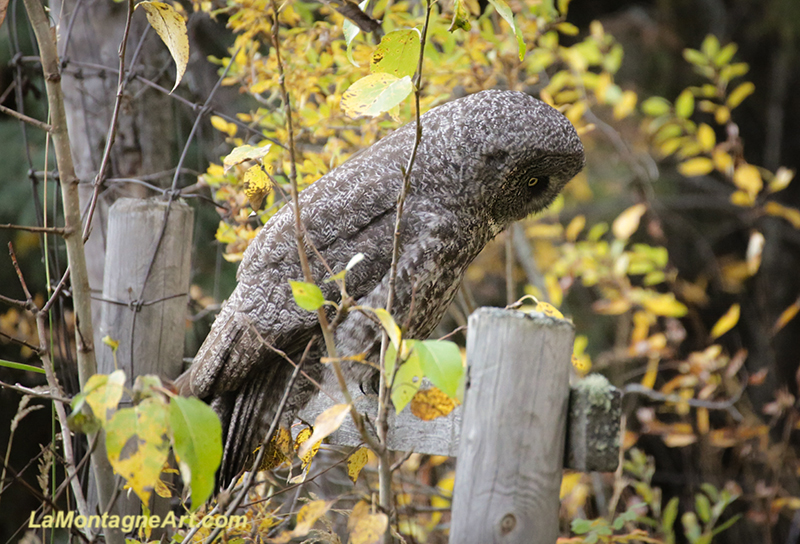
Eventually, she flew into the trees, but still close to the property line. I took even more photos because her perch this time clearly showed the incredible camouflage of her feathers against the nearby tree bark.

Since Darrel is also an early riser and I didn’t want him to miss out on this privilege, I walked back to the cabin to tell him. I knew she might be gone before we returned, but I’d already taken plenty of shots and thought it worth the risk. He was eager to see her as well, and by the time we got back, she was in the same spot.

We watched her move between three different perches. We were so close that Darrel could still get some nice shots with his phone. He took some video as well, but it also captured the sound of my camera shutter on rapid fire.

At one point, a brief gust of wind came up, throwing clouds of yellow leaves around her. It was such a treat to take photos of her in multiple environments, almost like she was a model for hire.

Finally, we decided we’d invaded her space enough and I didn’t want to ruin her chances of getting a meal, even though I’d seen her catch one mouse already.

I thanked her for her patience, and we walked back to the cabin, looking through the shots we’d taken.

After we’d eaten a small breakfast, Darrel saw movement out the window and said, “She’s back!”

Now perched on the fence on our side of the road, she still didn’t seem to care that we were there.

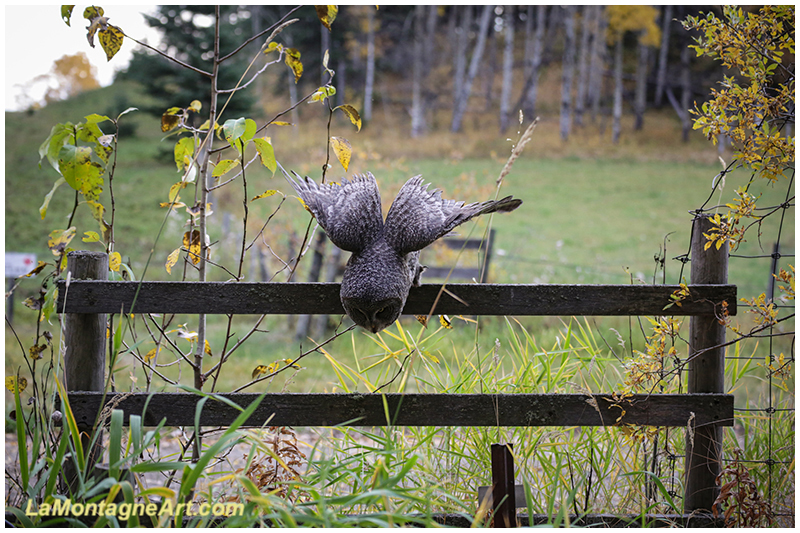
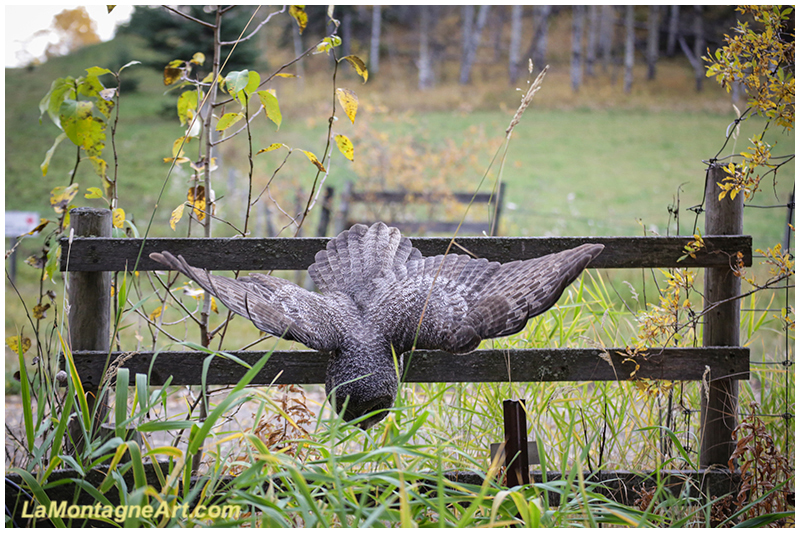
We watched her jump down into the grass to catch a mouse, hop back up on to the same perch, eat it down whole and repeat the process. Here’s a time-lapse of the Great Grey hunter in action. Not a good day to be a mouse.

I’ve taken photos of Great Grey Owls before, at the Calgary Zoo Aviary and at the Alberta Birds of Prey Centre in Coaldale. In those cases, they’ve been orphans and rescues that can’t be released back into the wild. I’ve even painted a closeup of a Great Grey before.

But to see one this close, at eye level in the wild, going about her morning, so tolerant of our visit, was a truly special experience for which I’m grateful.

As the cold weather will no doubt be fast upon us, and with nowhere to go, I plan to spend a lot of time painting. Much like the squirrels and other critters storing up food for the winter, I’ve been stockpiling reference photos for new pieces and have a few already planned.

I believe I’ll add a Great Grey Owl to that list.
If you’d like to support these beautiful birds and others like them, please donate to the Alberta Birds of Prey Foundation. They do great work for wildlife conservation and education.

___

© Patrick LaMontagne
Follow me on Instagram @LaMontagneArt
Sign up for my newsletter which features blog posts, new paintings and editorial cartoons, follow this link to the sign up form.

Posted on

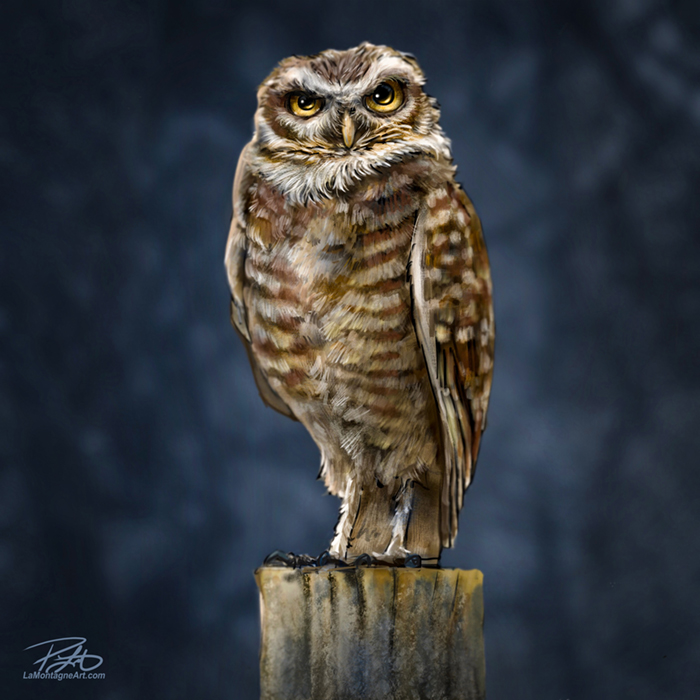
Burrowing Owl – iPad Painting


This little guy was painted on the iPad Pro in the Procreate app using an Apple Pencil. I took the reference for this painting while visiting the Alberta Birds of Prey Centre in June. For their small size, they certainly do cop an attitude. But then again, my perception of expression and personality in the animals I encounter just might be a little skewed toward the comical and caricature.

Burrowing owls are an endangered species in Canada and there are a number of conservation groups working to protect them, including the Alberta Institute for Wildlife Conservation and The Alberta Birds of Prey Centre, both of which I’m proud to support.

From the latter’s website…“Offspring from our Burrowing Owl breeding program have been released in all four western provinces.”

While my more finished work is painted in Photoshop on my Wacom Cintiq display, I’ll often sketch or begin a painting on the iPad Pro, using an Apple Pencil and the Procreate app. The advances in both hardware and software in recent years has come so far that the portable device experience now far exceeds the desktop painting I was able to do when I was first starting out.

Having been a digital artist for the past twenty years, I’m very comfortable with the desktop tools I’ve been using. I’ve been forcing myself to draw more with the iPad Pro and Procreate lately because I feel there’s a lot of room to improve my painting skills using the portable tools. The more time I spend working with these tools, the greater the detail and painting quality I’m able to achieve, which only makes sense. It’s also nice to be able to take them with me when I want to work at the tattoo shop, or draw at the cabin or on vacation.

An impressive feature of the Procreate app on the iPad Pro is that it will record every brush stroke you make, allowing you to play it back at high speed to see an image from start to finish. While I edited this one myself, the video below gives you a look at the progress behind the painting.

Cheers,
Patrick

If you’d like to receive my newsletter which features blog posts, new paintings and editorial cartoons, follow this link to the sign up form.  Cheers!