I’ve been working on a commission of three cats, and it’s coming along well. The client has provided some valuable feedback on the images I’ve shared so far. I’ve also recorded a bunch of the process, written the video narrative, and I’m still working on that video and the painting itself.
Usually, I sit down, open a Spotify playlist, and start painting. When I’m recording a painting, however, I need to position the camera above my display, adjust the lighting so the viewer can see my hand, record for five or six minutes, move the camera away, paint some more, and then record another segment a half hour or so later. It can take me out of the groove of painting because I’m thinking about something else rather than getting lost in the work.
Once I finish recording, I need to export the files to an external hard drive, format them for ease of use, and bring them into my editing software. I then speed up the footage to prevent the viewer from getting bored. Next, I will record a ‘talking head’ portion, write the narrative to go along with it, possibly source and add some music. It involves several hours of technical work in addition to the painting.
Now, as I become more proficient, that process will become smoother and take less time. However, it’s a bit clunky right now. I don’t have a workflow yet. But I’m getting there.
Lately, I’ve been feeling a bit trapped by the work-for-hire stuff—both the editorial cartoons and the commissions. Don’t get me wrong, I’m grateful that I am able to make a living in a profession that often pairs the word starving with artist. But sometimes I need to remind myself of the reason I got into this in the first place, for the love of drawing.
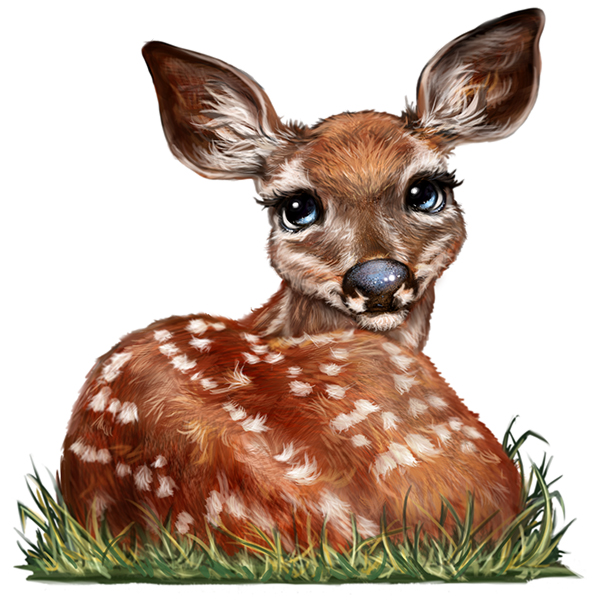
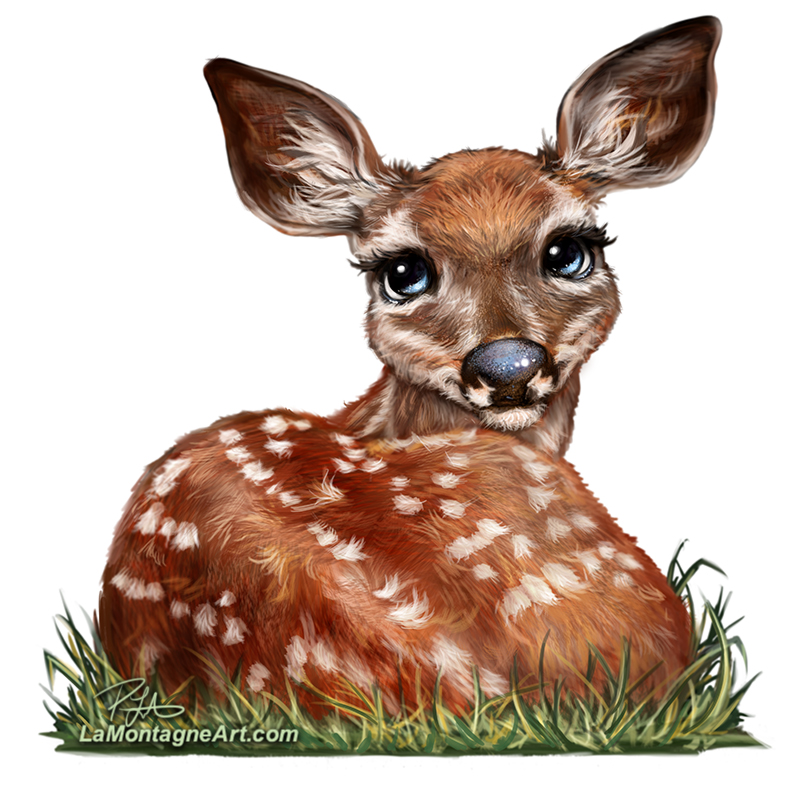
So, I took a reset break and painted something just for fun. I based this little fawn on reference I shot at Discovery Wildlife Park about three years ago. It’s still rough around the edges. I could add more detail and background, but for now, I’ll leave it and return to the commission.
Whenever I’m deep into one of these big paintings and hit a point where I’m not feeling it, it usually means it’s time to step away. A few days’ break lets me come back with fresh eyes, and I can see what’s missing. That pause-and-return approach has worked for almost every painting I’ve ever done.
This little one would make a cute vinyl sticker as-is, and I’ll likely add it to my new releases before the Banff Christmas Market. And who knows—after some time away from it, I may return with new inspiration to add more detail, a background and turn it into a print.
As always, I’d love to hear your thoughts. Feel free to share them in the comments.
Most of the time, I enjoy writing posts for my site and email subscribers—truly. But sometimes, it feels like just one more thing on a never-ending to-do list. And right now, that list is long.
I take A Wilder View seriously. People signed up to get what I promised: the stories behind the paintings, insight into the business of being a working artist, and honest updates about the ups and downs. I try to deliver on that. But now and then, I wonder if I should skip writing anything at all when the tone isn’t upbeat. Is it better to go quiet for a few weeks—or even months—or to acknowledge the elephant in the room?
Because creating art for a living is still a job. And like anyone with a job, sometimes I get tired of it.
I’ve often thought, wouldn’t it be easier to just go back and get a “real” job? One where I clock in, clock out, and maybe even have weekends. Sure, working for yourself has its rewards, but the hours are brutal. 10-12 hour days, seven days a week, is the norm. If I’m home, I’m working.
Shonna and I haven’t had a real vacation in a few years. She’s working long hours, too, and it’s wearing on both of us. Travel feels more like another chore than a break, especially with everything costing more.
So this year, we’re staying close to home.
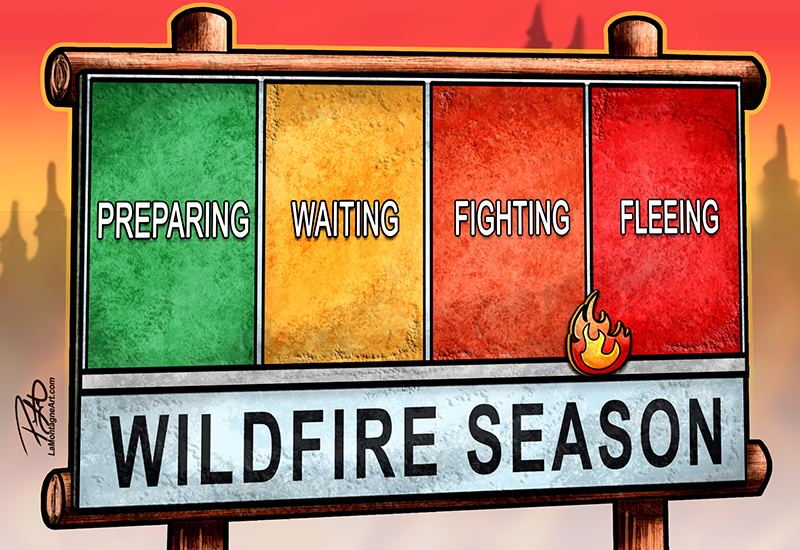
But even that’s not as comforting as it used to be. The wildfire threat has been weighing heavy. After Jasper’s nightmare last year, it feels like everyone in our part of Alberta is bracing for our turn. Banff and Canmore have done prescribed burns for years, but now they’re also logging to create larger fire breaks. Nobody’s complaining.
The story now feels like “not if, but when.” From June to September, we’re supposed to be ready to evacuate on short notice. It’s hard to enjoy your home when each sunny day feels like a threat.
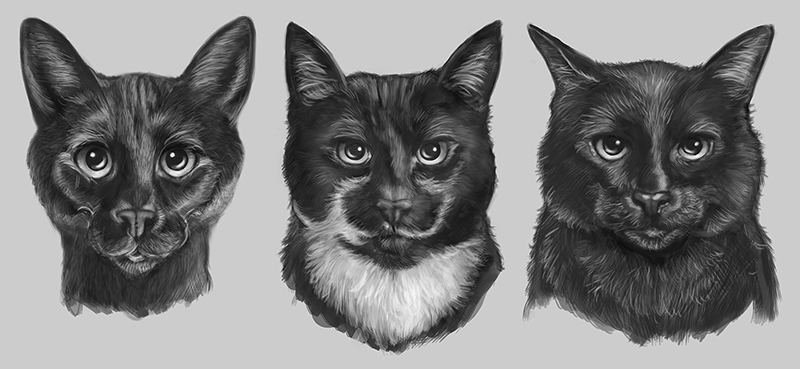
Back in June of 2013, we had to evacuate for a flood none of us saw coming. Evacuate from your home once, and you never quite regain the same sense of security, false though it was. They’ve built a lot of flood protection since then, so I wouldn’t complain about a solid month of rain right now. I’ve been working on a big commission of three cats. It’s going well—I’m finding the personalities—but it’s a slow process. The client has been wonderful and said there’s no rush, but that can be a trap. If someone trusts me with their money and their story, I take that seriously. I tend to put more pressure on myself than anyone else does. And other clients are waiting patiently.
I sent her these latest pics yesterday morning, something I don’t normally do for commissions. While critique at this stage is often premature, she knows my work and offered some helpful insight into how their personalities differ from each other. Since my work is all about the character, I welcome that sort of thing. I want my clients to love their paintings.
For example, I shared that I intended to make Fable (left) look a little less worried as I develop it, but she told me he actually looks like that, so what I gleaned from reference was accurate. I’m making changes to all three based on her feedback. Then I’ll draw the bodies and start putting them together into a composition.Meanwhile, I haven’t finished a new wildlife piece in a while, and that’s eating at me. The Banff Christmas Market is just five months away. I need new work ready to print, and it’s already June.
Editorial cartooning continues to take more time than I’d like. More energy, too. Keeping up with the news is exhausting and it’s hard to stay creatively engaged when everything feels so heavy. Sometimes I wonder if people subscribed for the fun wildlife stuff and didn’t expect posts like this. But many of you have told me you appreciate the honesty, so here it is:
I’m burnt out. And I don’t know what to do about it.
Like most people, I don’t feel like there’s enough time. I’ve been getting up at 5 a.m. for nearly thirty years. I like working early mornings, and get a lot more done. But even if I watch a couple hours of TV in the evening, I feel guilty. That voice that says “you should be working” never shuts up.
I shipped a big wholesale order of prints and stickers to the Toronto Zoo on Friday. It’s their largest order yet. My printer in Victoria came through as always, and I spent all day Thursday signing and packaging the order to send it by UPS. I still can’t trust that Canada Post will get stuff delivered while they’re negotiating their labour dispute. Yet another small business uncertainty to navigate.
By all rights, I should have felt great about the order. But honestly? Just relief. One less thing to worry about.
No satisfaction. Just… done.
I’ve also been learning video production. And I’ve made it harder than it needs to be—not because the tools are so complex, but because I’ve convinced myself I have to get it perfect. I’ve got the gear. I’ve recorded a ton of footage. I even wrote the narration. But I’ve stalled on recording it, because I know once I start, I’ll feel like I have to keep it up. And video takes a lot of time.
Still, I know it’s necessary. Video is the only marketing that moves the needle anymore. So I’m trying to get over myself and find a workflow I can manage and replicate.
People sometimes suggest I hire an assistant, virtual or otherwise. But that’s not really a solution for me. I can’t hand off my writing, painting, emails, or videos. I don’t have the extra money to offload the marketing. And managing someone else? That’s more work, not less, at least at the start.
What I really need is to streamline. Figure out what’s essential. Because I can’t keep piling more on top of what I’m already doing.
Where do you get your ideas? As anyone who owns or runs a business knows, most software platforms have gone to subscription model, meaning if you stop paying, you can no longer use it. Not an option for most people, so they can charge whatever they want. In the space of less than two months Microsoft Office 365 (admin), Adobe (design), Quickbooks (accounting), and Google (gmail isn’t free for business) have increased their prices. And the original cartoon idea used the term ‘Subscription model’ but I changed it to ‘death by monthly fees’ because my cartoons run in newspapers, and they sell ‘subscriptions.’ Not the same thing, but people are weird.
Let me be clear—I’m not fishing for sympathy. I’m healthy. The bills get paid. I have meaningful work and people who support me. I know a lot of others are dealing with far heavier loads—health problems, job losses, financial pressure. You never really know what someone else is carrying.
And I know some of you reading this are always working long hours, too, in harder jobs requiring long commutes, with kids and responsibilities that don’t stop. I’m not suggesting I’ve got it worse.
I’m just telling you where I’m at. If my emails are a little less frequent or a bit quieter, it’s not because I’m slacking. It’s because I’m working. I’m doing what I can with the energy I’ve got—and trying to figure out how to do that without burning all the way out.
Thanks for reading. Your support makes more of a difference than you probably realize.
I’m still here, still working, still figuring it out.
After a lifetime of saying I’d never get one, something my buddy Darrel has delighted in reminding me since, I woke up on a September morning in 2017, wanting a tattoo. It was my design, and I figured I’d get it somewhere like my shoulder. Rather than object, and much to my surprise, Shonna suggested that if it meant that much to me, I should get it where I could see it.
It was great advice, and I enjoy seeing it on the inner forearm of my drawing hand. It still has profound meaning for me and has become the logo for my business. People often ask what it means. If I’m that solitary dot in the middle, my best chance of connecting with others is through my artwork, represented by the bear claws. But just as important is the reverse, where nature, wildlife and the world around me deliver the inspiration to create more art.
A fortunate byproduct of getting that tattoo, and probably the best part, was my introduction to the tattoo art world and making new friends with some incredibly talented people. My friend Derek, one of the most skilled and generous creatives I know, has helped me become a better artist. Several of his clients have become my customers.
Tattoo art fans will wait years for an opportunity to have their favourite artist use their bodies as a canvas. Hanging out at the tattoo shop, I’ve met people who have travelled from all over the world to Electric Grizzly for Derek’s artwork. Many tattoo artists have such fans. Sometimes, their wait list becomes too much, and the artist can’t keep track. When that happens, they often post on their website or social media that Books are closed.
That means they’re trying to manage their time, serve the clients they’ve already booked, and prevent their schedule from getting out of hand. Their books may stay closed for months or open briefly to fill a cancellation. I have been frustrated the past few years that it seems I can never get as much done as I would like to, still failing to find traction. I have too many ideas, too much ambition, and little time to do it all. As fiction writers need to aggressively edit and ‘kill their darlings’ to make for a better story, I must abandon some things to make progress on the ones that mean the most to me.
Editorial cartoons remain a daily commitment, along with sales and marketing. I need to write posts, maintain my website, communicate with clients, pursue licensing opportunities, package and ship online sales and do my bookkeeping. That stuff doesn’t often change.
But it’s the long-game projects where I’m failing, and the only way to correct that is to decide what’s important, at the expense of all else.
This week, I started on sketches for a commission of three cats. I recorded some more of a painting for an upcoming video. I shipped tote bags and print orders, and I drew cartoons. I resumed an online course on Adobe InDesign for Illustrators so I can try, try, try again to make some progress on the book, which is also why I made time for these bears this week. I haven’t painted anything in a month and needed to get back into the groove. These were supposed to be rougher sketches, but it’s difficult to stop once I get going. These are neither sketches nor finished paintings, but somewhere in the middle.
I have another commission for three dogs on deck and have agreed to paint another dog a little later for one of Derek’s clients, who became one of my collectors.
I did not get as many wildlife paintings done last year as I wanted, which bothered me. I have too many works-in-progress waiting for my attention. So, to borrow from tattoo parlance, my books are closed. I can’t take on any more commissions, projects, or distractions that hinder my progress on these priorities.
Hopefully, in the coming months, you will see more new pieces from me and a sharper focus on the work I want to do most.
The Calgary Expo is always exhausting but usually a positive overall experience.
This year, I went into it feeling burnt out, mainly because of how closely I’ve had to follow the rapidly changing news lately and how much it has personally bothered me. I think I foolishly thought Expo might fix that.
Many things that could have gone wrong in preparation and execution went as well as expected. I got my hotel and booth early, load-in went well, there were no problems with setup, and it seemed off to a good start. Even my new payment system worked flawlessly all four days.
But earlier in the week, I realized I wasn’t looking forward to Expo like usual. I went into it feeling a little desperate for a good show. So, when sales were slow, and the whole vibe felt off, I considered it might be my fault, that I was failing to project the right attitude.
Talking with other vendors throughout the weekend, however, with a noticeable drop in customer traffic, it quickly became apparent that it wasn’t just me.
We couldn’t help but speculate amongst ourselves — what was going on?
Was it the new layout? The events portion of the show moved to the second and third floors of the new BMO Centre. In previous years, attendees would end up in retail spaces while moving between panels and talks. When people left those scheduled events this year, it seemed like many just went outside or crowded the exterior aisles on their way to somewhere else.
Perhaps it was the economy. With all the bad news flooding across the border these past few months, people are nervous and watching their money. It seemed like many had less to spend, and I saw far fewer new people in my booth than I’m used to. I’ve never seen a quiet Saturday at the Calgary Expo; it’s usually a crazy busy day. My best sales day this year was Friday. That has never happened before.
I’m used to each year proving as good or better than the year before. I’ve never had a down year. My friend Ryan had a booth a couple of aisles away from me. He was right when he said, “Every year can’t break records.”
Because I keep meticulous records and inventory, I know that this year’s sales were down 16% over last year. That may not seem like much, but this is an expensive show. The price of my booth, electrical, insurance, parking and hotel all went up this year. So, depending on the year, the first 35% to 50% of sales cover that initial expense. That’s before I factor in the cost of my product.
For this show, 16% off the top is significant. I didn’t talk to one vendor who said their sales were good this year.
The show was still well worth my time and investment, and on the last day, I rebooked for next year as I always do. At the show’s end, tearing down took about an hour and a half. But the line-up of cars to access the loading docks was ridiculously long. I have a sturdy hand dolly that transforms into a robust cart. It was quicker for me to haul my booth out in three trips through two large halls to the other side of the building where I had parked my car. That took another hour, but it was better than sitting in a long line of vehicles for all that time.
I’ll admit that I felt a little sorry for myself on the drive home Sunday night, that the show wasn’t as good as I’d hoped or expected. But after some sleep and time to reflect, I have corrected my perspective.
While the goal is always to introduce my work to new people and find new subscribers, and there weren’t as many of those opportunities this year, the best part of Expo is all of you who keep coming back to see me year after year.
With a sincere hand-on-heart, I want to thank my many repeat customers, collectors, subscribers and supporters who showed up this year.
I met several people who came to the show just because they read about it in A Wilder View, some of whom I met for the first time. I often think what I write on my site and in my emails is self-indulgent drivel, but you keep telling me that you look forward to each email and enjoy what I share.
One enthusiastic subscriber who’s been buying my calendars from Australia for several years just immigrated to Canada and came to Expo to meet me for the first time. In an email exchange after the fact, he said, “You’re such a positive and inspiring person.”
Feroze, are you sure you’re reading MY emails?
I kid.
Even though this is precisely what I always wanted, I’ve never been comfortable with so many of you having my art on your walls or stickers on your cars, kayaks and water bottles and that you say such nice things about my work and writing.
Many of you have way more prints, stickers, magnets, coasters and other pieces than I thought you did. Though I saw them all weekend, Tracy and Sheldon took these photos of their collection Saturday night and shared them by text. They rotate their prints in what they call Critter Corner. When I saw these photos, I joked that I felt like a drug dealer and it might be time for an intervention, especially since they bought more prints and tote bags this weekend.
You two would be dangerous if you weren’t such lovely people.
I was reminded this weekend that so many of you have large collections. You know who you are, and I only refrain from listing all your names because I would forget somebody, and I don’t want to offend anyone. Long-time collectors also bought canvas, metal and acrylic prints this weekend. I have more of those orders to fill this week. I talked with former commission clients and ones whose paintings I’m just about to start. I got the usual gentle pressure about the book, which I never seem to gain traction on, and a few offered welcome suggestions on which animals I might consider painting next.
I can’t adequately express how humbling it is that you enjoy my artwork this much.
So perhaps I needed a lesson this year at Expo that even when sales are down, it is just one event in one year, and it comes and goes so quickly. All of you who continue to allow me to do this for a living, whether you can show up to Expo to show your support in person, were already here before the show, and you’re still here afterward.
I need to remember that it’s a gift that, once a year, I get to see so many of you in person. Because every time I do, you make me want to make more art.
If I were to give one piece of advice to aspiring professional artists, it would be to diversify. Find as many income streams as possible so that when one inevitably falters or fails, it doesn’t mean the end of your business.
At the peak of my editorial cartoon career, I had more than four dozen daily and weekly Canadian newspapers regularly running my cartoons in almost every province and territory. While it continues to be a valuable part of my business, today, it’s no longer the full-time income it was. But I’ve had time to pivot because I lost one or two papers at a time, with several clients instead of just one.
Thankfully, I developed another side to my business with my whimsical wildlife, which continues to grow. That revenue also comes from several different sources.
My online store is not a significant source of revenue, but my art sells well in person at the Calgary Expo and Banff Christmas Markets. Because of the work involved and the fact that I need to leave room for painting more wildlife, I only accept a few pet portrait commissions a year, but that’s also a reliable source of income.
Finally, I’m fortunate that my animals have commercial appeal, and my art style is attractive to licensing clients. Companies put my art on their products and pay a royalty percentage on sales.
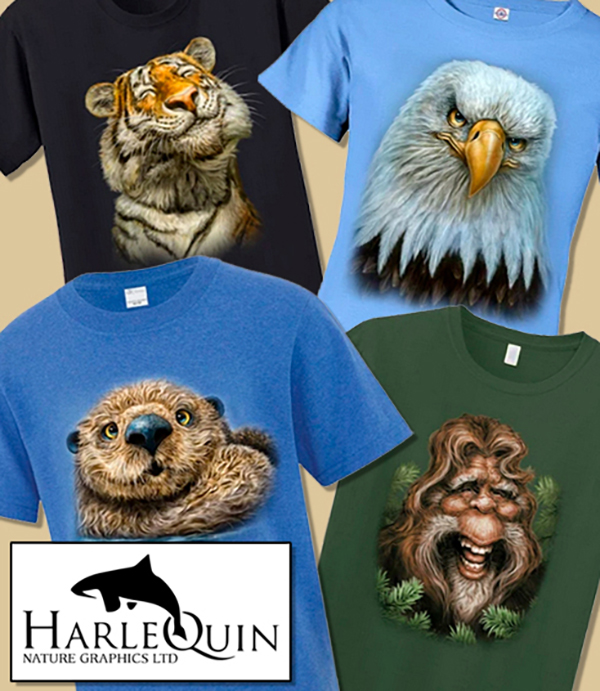
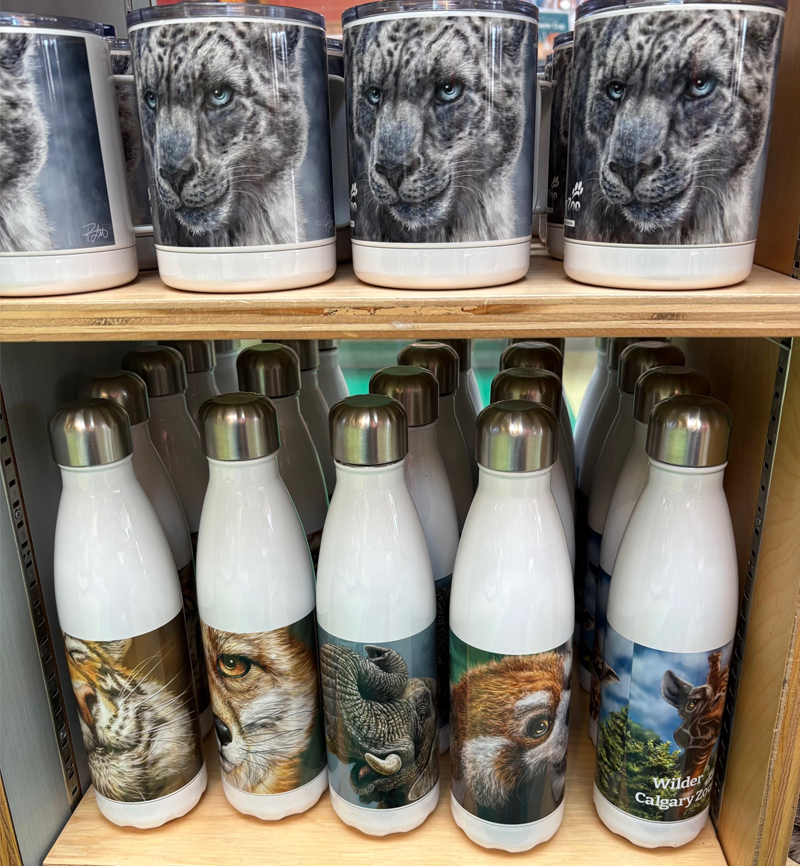
Harlequin Nature Graphics in Victoria has sold some of my images on T-shirts for many years. Pacific Music & Art adds my art to cards, water bottles, coasters, magnets, trivets and more. If you visit the Calgary Zoo gift shops, you’ll see my prints and stickers on shelves next to my art on Pacific products. Licensing allows me to reach a much bigger audience than I could handle myself. I already spend more time promoting and selling my animal art than I do creating it. If I tried to do the work my licensing clients do, I could never paint anything.
These businesses aren’t only in Canada. A company in Cyprus licensed my artwork for the Happy Color app, and clients in the UK and the US have licensed my work for several different products.
The current fabricated tension between Canada and the US threatens to devastate the economies of both countries. We all know why it’s happening and who is solely responsible. Whether you agree or disagree politically, you can’t argue against the evidence that this is devastating for the markets, cross-border trade and the formerly amicable and mutually beneficial business relationship between the two countries.
In acts of defiance against divisive tariffs and 51st state rhetoric, many Canadians are avoiding US products. Though it has long been our number one tourism destination, travel to the US for business and tourism has plummeted to the point where airlines have eliminated some routes to select American cities.
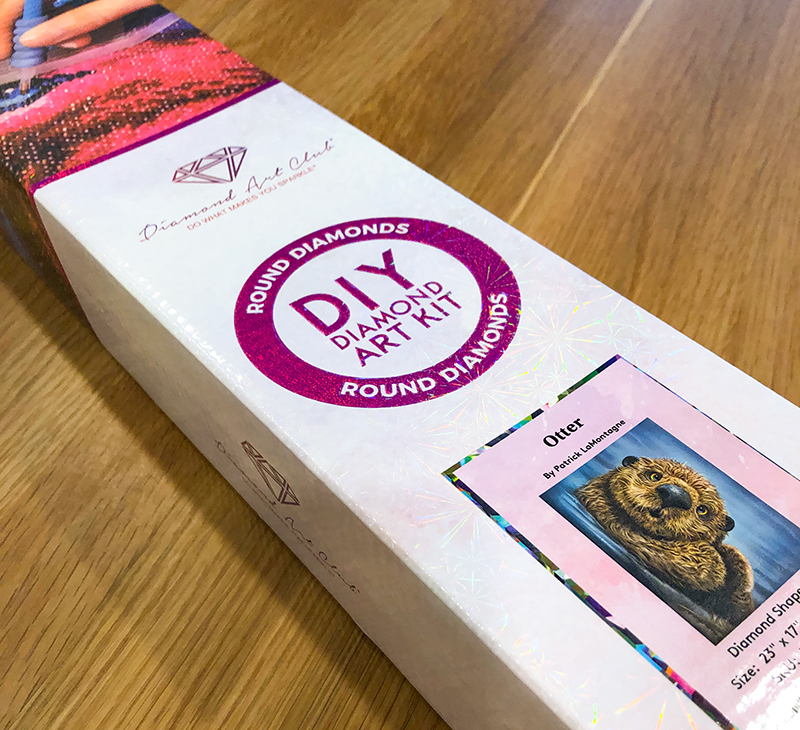
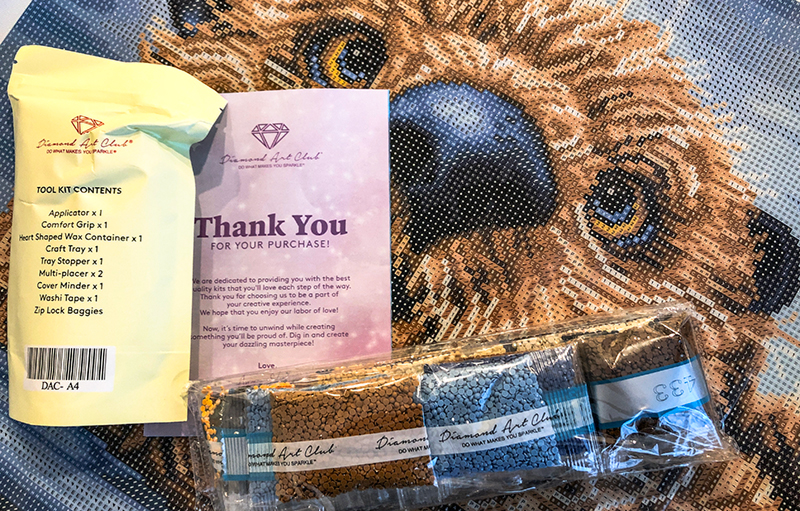
Every Canadian individual or company who works with or for US businesses is now in a difficult position. How do you promote these services and products while understanding and supporting the fact that Canadian customers aren’t buying from American companies right now? One of my favourite US licenses is Diamond Art Club. Before the pandemic, I had never heard of this hobby, but it has a massive and devoted following. The sample product they sent featuring my Otter painting impressed the hell out of me. I didn’t have time to assemble it, so I gifted it to one of my American subscribers.
Diamond Art Club has been friendly and professional, my images sell well, and they always pay me on time. I love working with this company. In addition to the six designs they’ve got on offer, I’ve recently found out two more paintings are in the design and production pipeline.
Many years ago, I was licensed with The Mountain, a T-shirt company out of Vermont. I especially liked the connection as my French last name, LaMontagne, directly translates to The Mountain.
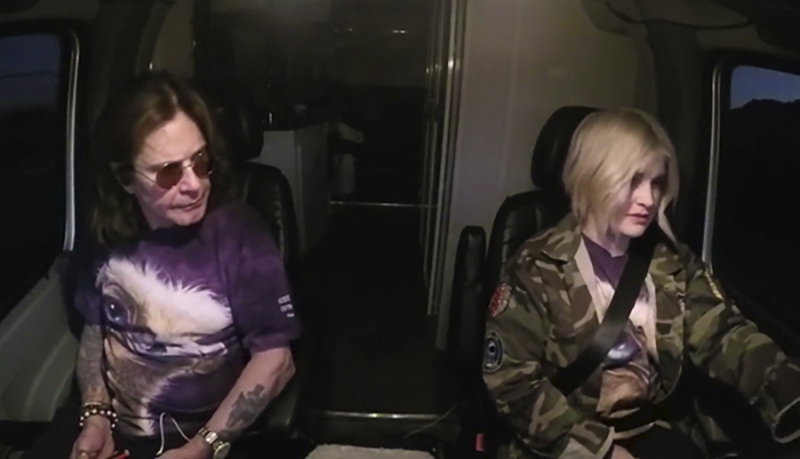
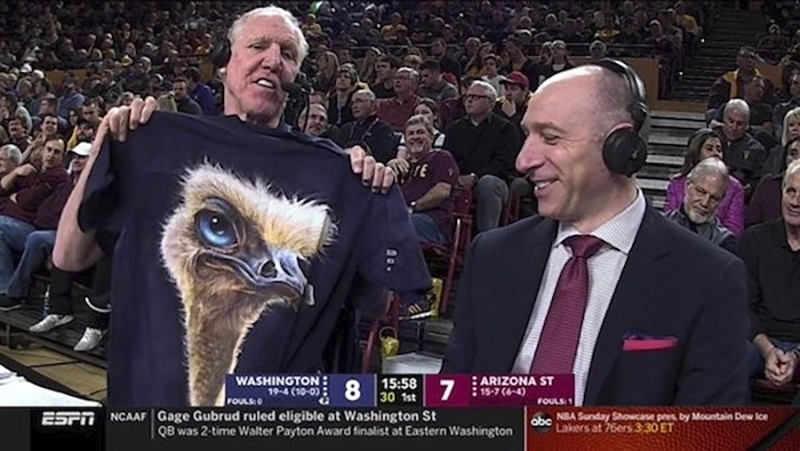
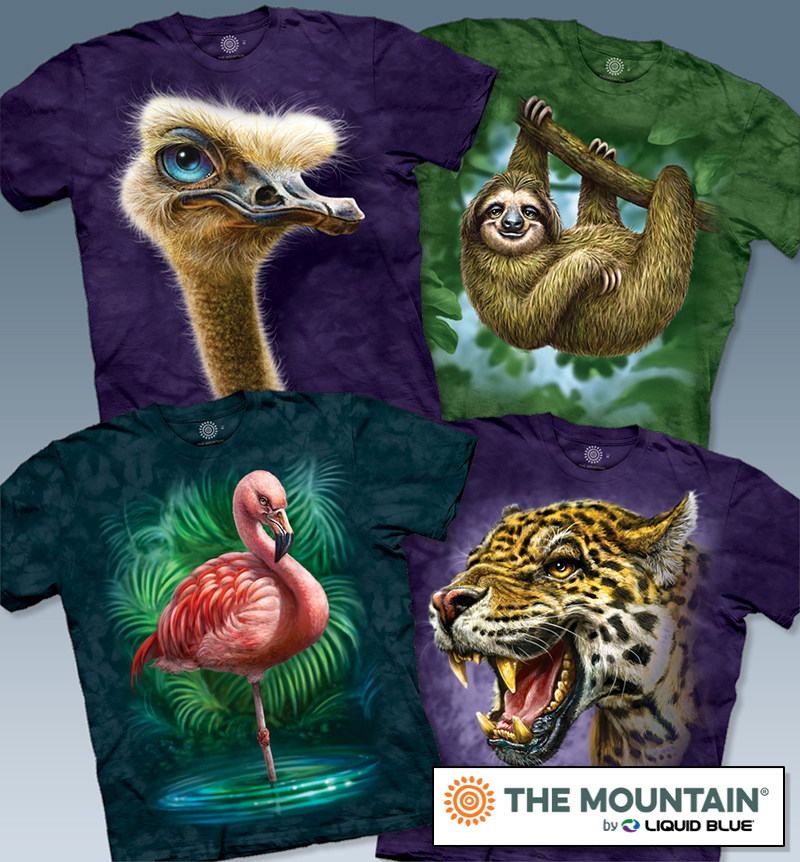
The owner, a talented artist in his own right, was great to work with. The Mountain sold my designs on shirts for several years. The relationship ended when the owner sold the company, but licensing contracts often only endure for a few years anyway. While not one of my bestselling prints, my Ostrich painting was very popular as a T-shirt, and it showed up in the strangest places. I saw Jack Black wear it a couple of times. Ozzy and Kelly Osbourne wore it on their show, as did a character in a Netflix series. Subscribers spotted the shirts and sent me screenshots from hockey and basketball games. A little over a year ago, many years since our previous contract, The Mountain contacted me about licensing the Ostrich again. An ostrich ranch in Arizona sold many of those shirts, and I suspect they might have been the reason for the request.
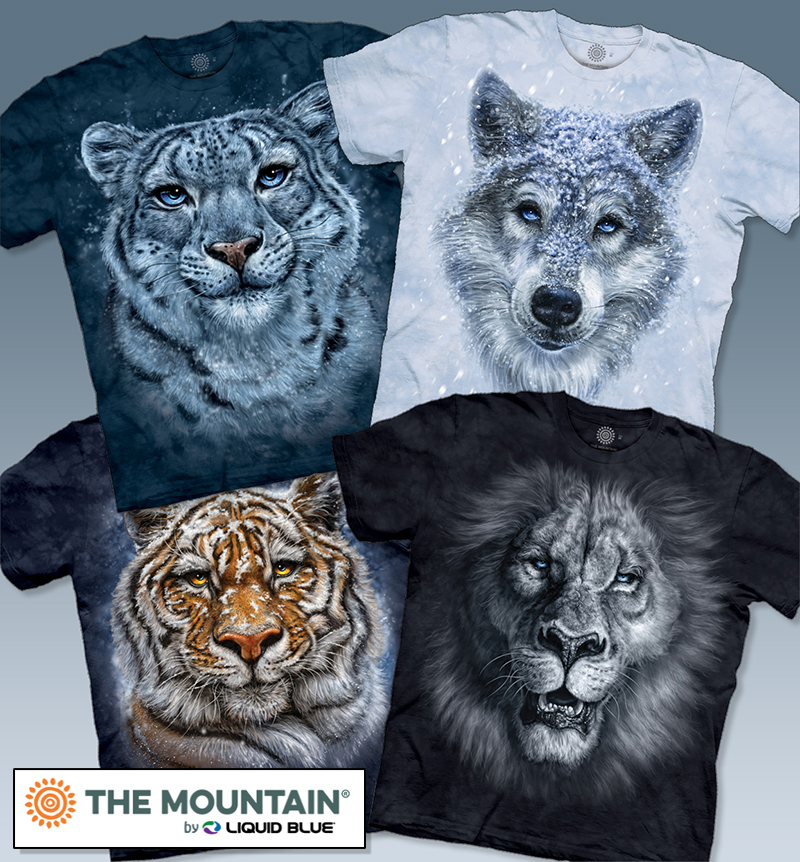
The Mountain was recently sold to Liquid Blue and was again under new ownership. I took the opportunity to suggest that they consider some new designs, and they were receptive. Licensing agreements can be exclusive, but many aren’t. Even then, a company that produces the same product won’t want to sell the same designs. In our online world, it doesn’t matter if they’re not in the same physical area because anybody can buy anything from anywhere.
So, the designs I submitted to The Mountain were different from those currently sold by Harlequin Nature Graphics in Canada. With licensing, contracts to negotiate and sign, and promotion schedules, product launches can take time. While a company plans how and when new designs are made available, it’s understood, if not explicitly laid out in the contract, that the artist doesn’t talk about it.
I have known these 8 new shirts have been coming for the past year. Their designer(s) did a great job adapting my images to their signature shirts, and they look even better than their previous designs.
But as bad luck would have it, these new T-shirts have launched in the middle of a trade war, where Canadian companies and consumers are actively avoiding US products, and the Canadian dollar has dropped. A year ago, I would have been excited to tell you about these designs and introduce them to my Canadian wholesale clients. But today, promoting these products to Canadians is rather pointless.
We know the situation, so I won’t go off on a political rant. We know how we got here. The fear is that there is too much damage done, and we won’t be able to get back, especially since none of this is close to finished. And just like during the pandemic, what the world looks like on the other side is anybody’s guess.
In the meantime, I will continue to adapt and diversify.
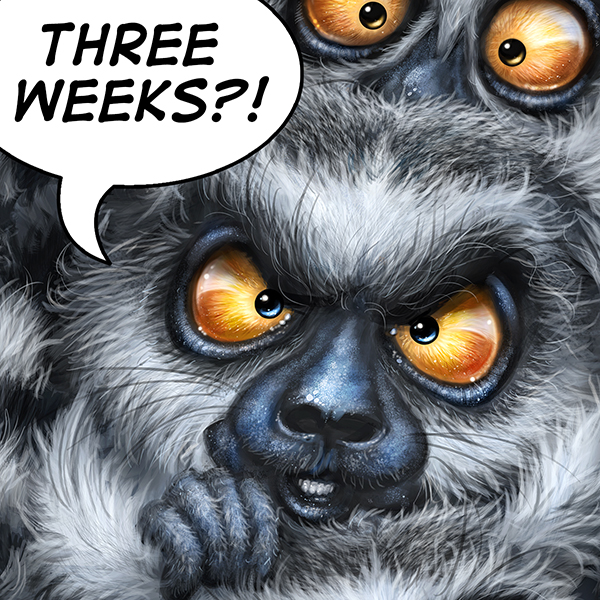
April, already. Where did the time go? The Calgary Expo is three weeks from today, and even though this will be my 10th year, I still obsess about the prep.
I keep detailed spreadsheets that allow me to look back on every show to see how much I sold of each item, which informs how much I order the next time. Knowing that my Smiling Tiger, Otter, and others are bestsellers is not enough. I need accurate numbers, otherwise I might order 20 of one print, though I only sold 10 the year before. Multiply that by dozens of paintings, and it soon gets costly.
Each year, I try to bring enough stock so I don’t sell out early, but not so much that I have a lot left to bring home. With tariff threats and an uncertain economy, people will still be there, but will they buy?
Late spring and summer aren’t big months for my online store, but they’re the busiest times for my wholesale clients. Because of my editorial cartoon commitments, I don’t do summer markets. So, if I have too many prints the Calgary Zoo, Toronto Zoo, or Discovery Wildlife Park don’t sell, they can sit in the closet for months. For example, none of those venues want a Raven, Orca, or Panda.
Immediately after this year’s Expo, I have two commissions on deck, one featuring three cats and another with three dogs. It’s bizarre they both arrived at the same time from different clients. Those are significant commitments and top priorities for the next few months. Both clients have been collecting my work for years and were willing to wait until May for me to start.
Sadly, I dropped the ball on a video assignment last month for a client I never want to disappoint. But I bit off more than I could chew and had to bow out. I’ve been learning a new camera setup and editing software, and editorial cartoon commitments have increased with the rapidly changing daily news, not to mention marketing efforts that have taken days away from productivity.
While the client understood and let me off the hook, it’s a professional failure I have not yet accepted.
There aren’t enough hours in the day right now, and I’m floundering. Fortunately, everything I need for Expo is already here or on the way. I placed a large print order earlier this week to fill orders for The Calgary Zoo, Discovery Wildlife Park and this event, which will arrive next week.
My stickers, magnets, coasters and metal prints are fully stocked for the show, but I’m waiting on tote bags. As with any new product, you learn the most from the first order.
While the first two tote bag samples arrived quickly, this much larger order took longer. It’s been five weeks, but they finally shipped a few days ago. Quality takes time, but that was unexpected. Thankfully, they’ll still arrive before Expo.
I didn’t anticipate the enthusiastic tote bag interest from all of you. Even though I asked for feedback before I ordered, inquiries have continued to come in. I checked with the company to see if I could add more to the order, and they said it wasn’t possible because they were already in production.
So, while it’s great that people are excited about them, it has presented a dilemma. I won’t have enough for the event if I offer them for sale before the Expo. The best sales are in person, and I can’t test a product at a live event if I don’t have enough to make it through the weekend. How the bags perform at Expo will determine how many I order for the four weeks of the Banff Christmas Market, which is a much more significant financial investment. Additionally, the next three weeks will be some of the busiest of my year, and the bags won’t even be here for another week. I don’t have the room to add hours and days of shipping and delivering tote bag orders on top of all the prep and drawing cartoons.
Creating the art is the easy part. Promoting and selling it is the work.
For those of you who have expressed interest in the tote bags, I greatly appreciate it, but I’m going to ask for your understanding and patience for a little longer. I need to take the whole order to Expo.
After the event, I’ll immediately put any remaining stock in the store and let all of you know when they’re available. If I don’t have enough to fill the demand, I’ll launch a preorder for subscribers and do what I can to add a little bonus incentive to reward your patience.
Three months into the year, I have yet to find my groove. I’m always working, but it doesn’t feel like I’m getting anywhere. Something has to give, because if there were a report card that listed all the plans, projects, and paintings in progress, there would be a big INCOMPLETE next to most of them.
I need to figure that out.
In the meantime, I’m focused on Expo. It really is a good time, and I look forward to it every year. There are so many subscribers and collectors I only see in person at this event, which is what makes it so much fun.
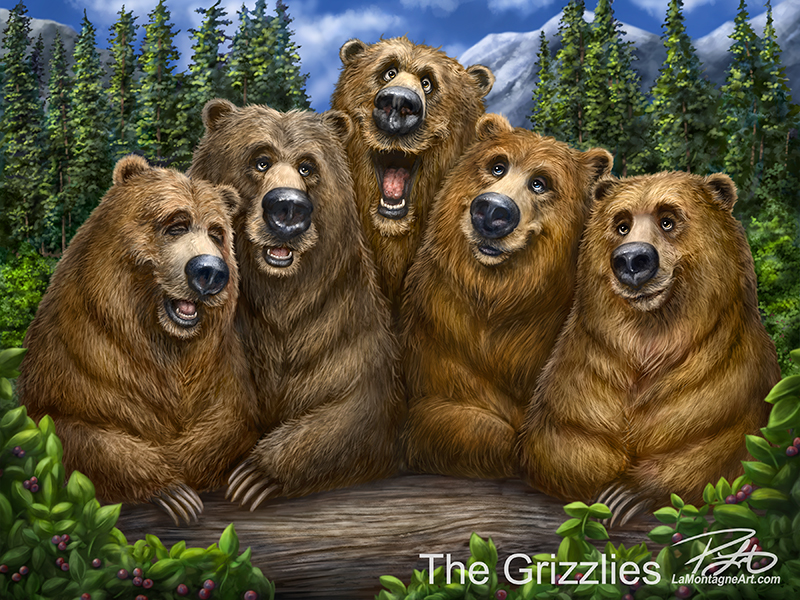
I’ve painted seven new paintings since the last Expo, which isn’t as many as I would have liked. But two of these paintings were a lot more work than any before, so it’s understandable. Those Grizzlies and Lemurs felt like several paintings in one. And since I will still have 39 other available images at the show, I won’t worry about it.
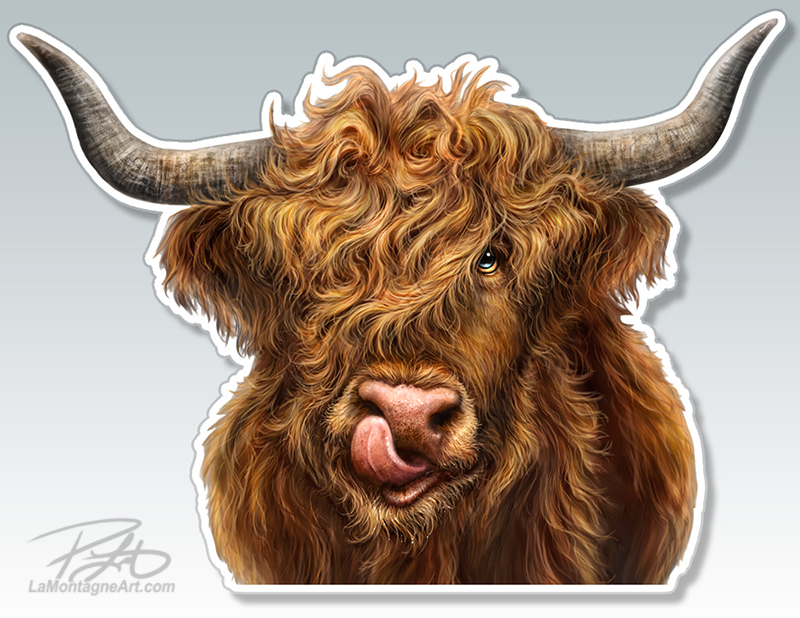
Stickers do well at Expo, and because so many asked for it at this event and the Banff Christmas Markets, I’m looking forward to introducing my new Highland Cow sticker. But every year, even if they follow A Wilder View, people always ask, “What’s new this year?”
So, if you’re coming to the Expo but haven’t come to the Banff Christmas Markets or ordered anything online, here’s a refresher of the paintings you most likely don’t have yet. Of course, I’ll be happy to remind you in person.
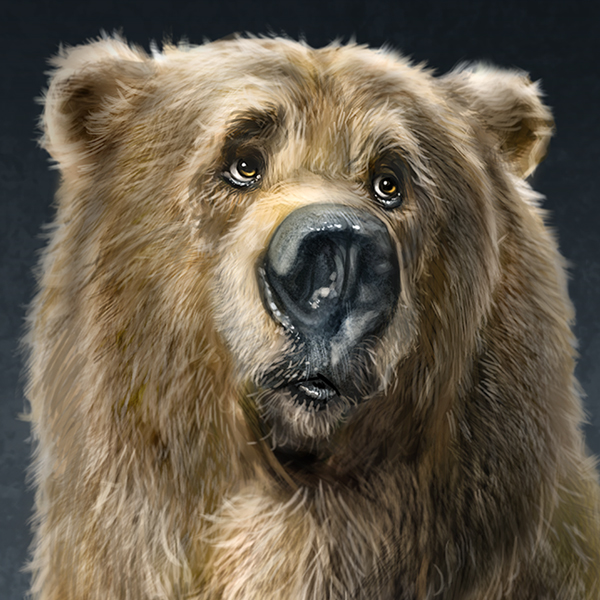
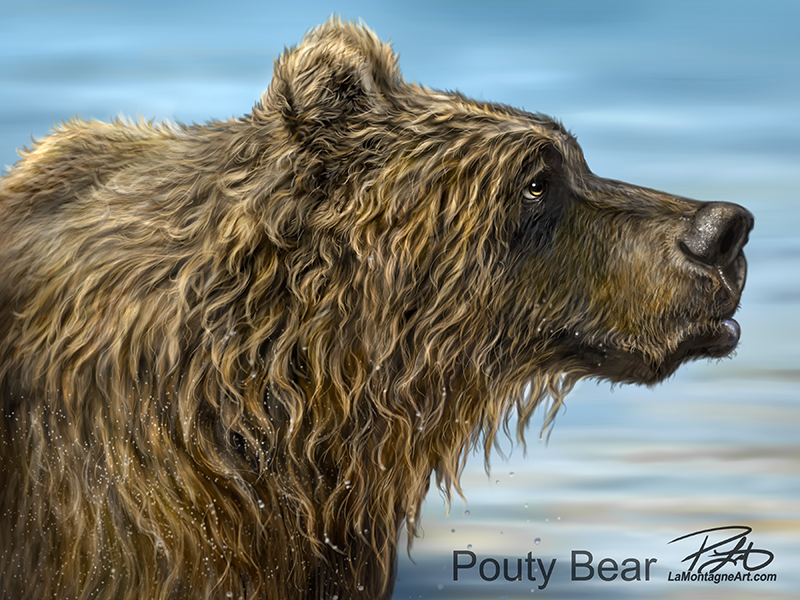
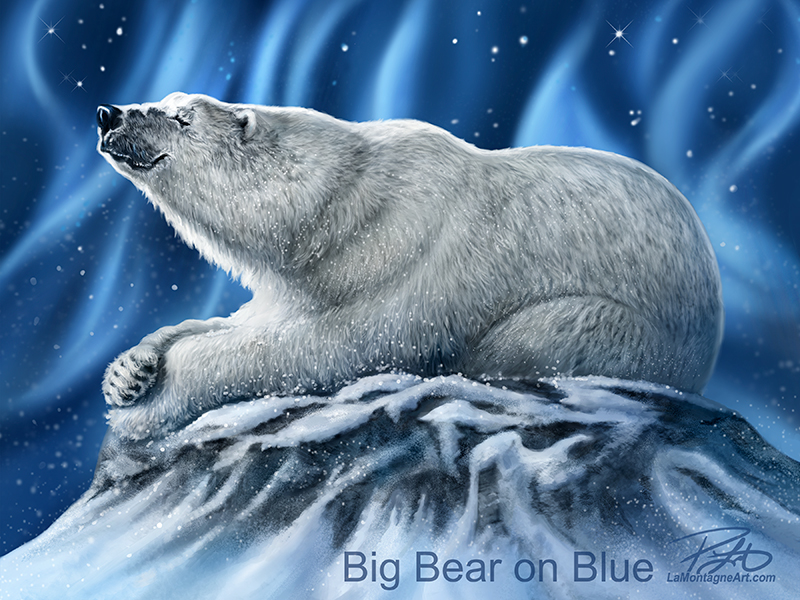
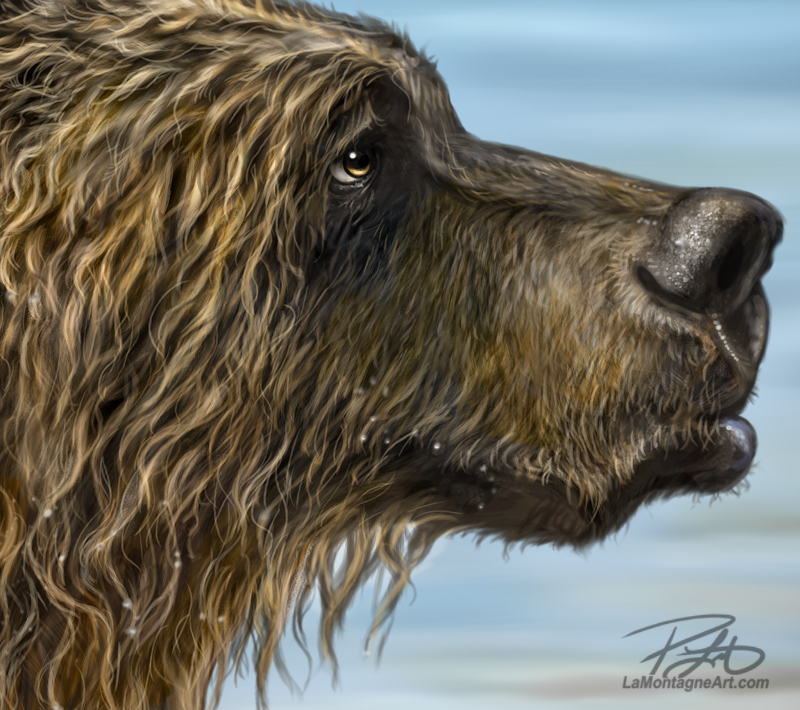
A post in three parts. Here we go. First, here’s a painting I just finished yesterday called Pouty Bear. Even though most of the animals I paint are smiling and happy, I occasionally change them up, even if I know that a different expression may not appeal to people.
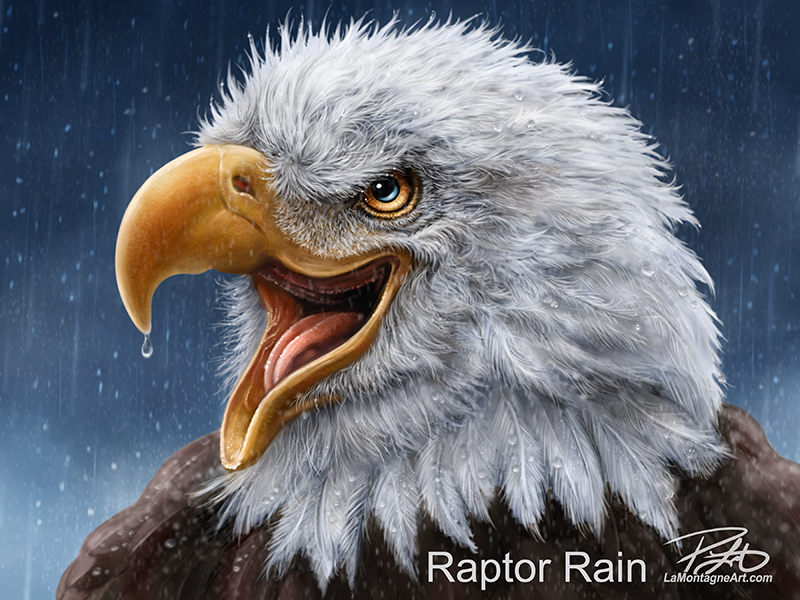
My Angry Bear painting is not popular, but it’s still one of my favourites because I enjoyed the work. The grumpy lion, on the other hand, is a pretty good seller, and that surprised me. The Ring-tailed Lemur creeps some people out but definitely has its fans.
Will this pouting brown bear connect with people? Time will tell. Commissions and Comic-Con
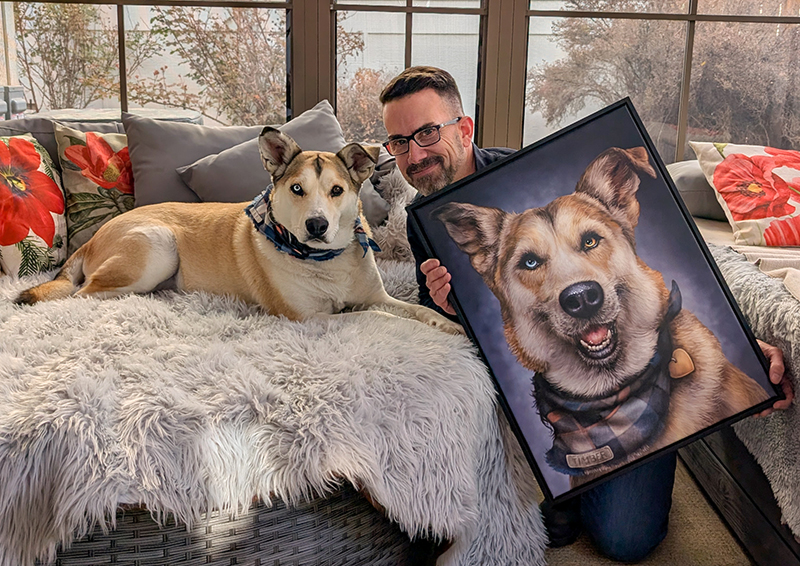
I’ve enjoyed most of the pet portrait commissions I’ve done. Each has a unique story. I like the back-and-forth with clients and am usually happy with the results.
I only paint two or three commissions a year, sometimes only one, so they’re not a big part of my work. I’m OK with that because custom paintings are labour-intensive. Each begins with initial client emails, vetting photos, and discussing expectations. This leads to the actual painting, printing and delivery, which takes several weeks at the best of times. That’s in addition to my daily editorial cartoons and paintings and running my business.
A whimsical wildlife painting takes several hours, too, but each of those paintings has the potential to become a popular print or licensed image that sells for many years. Although every commission advertises my skills to future clients, the painting itself is one and done. It’s unique and specific to the person who hired me. Very few people want a painting of somebody else’s dog.
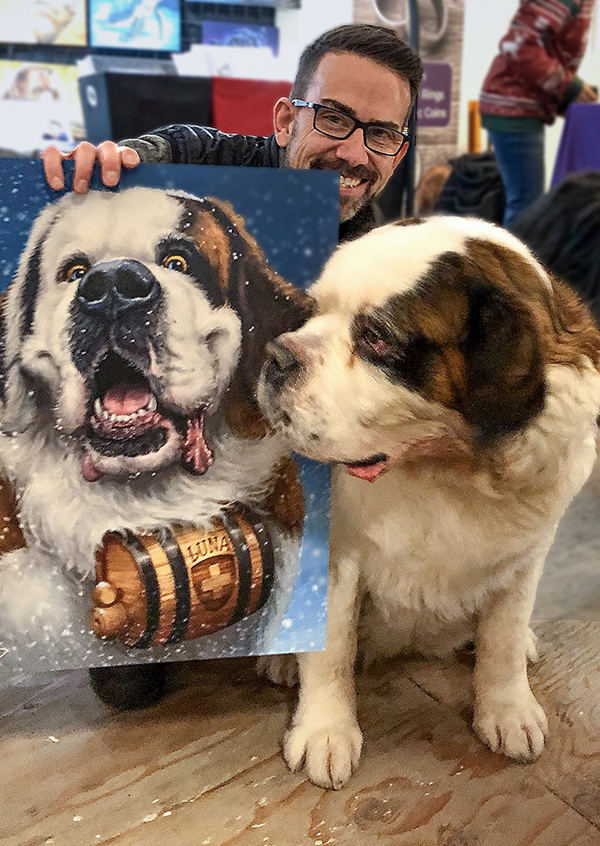
For my clients, a commission is not an impulse buy; it’s an investment in a very personal and meaningful custom painting. Most people hire me after following my work for a while and becoming familiar with my art style and process. They’ve had time to think about a commission, decide they want one, and only then do they contact me. At the Calgary Expo a few years ago, Jeremy asked me about painting his dog, Luna. It was several months later before he reached out and got the ball rolling for a Christmas present for his wife, Jenny. Luna is one of my favourite paintings. I enjoyed the experience and look forward to seeing them each year at the Expo. Jeremy and Jenny even visited the Banff Christmas Market this year and brought their dogs along. I am asked about commissions at shows all the time. For the past couple of years, I have displayed an 18” X24” metal print of Luna in my booth, with a little sign in the corner that reads, “YES, I DO paint commissions. Ask me for more info.”
Since advertising the service with Luna’s painting, I get a lot more inquiries. But here’s the thing: Jeremy was the exception to the rule. Almost nobody hires me for a commission after meeting me at shows. And I’ve realized that talking about commissions is usually the quickest way to get somebody to leave my booth.
Whether it’s at the Calgary Expo or the Banff Christmas Market, here’s how that usually goes. While they scan the metal and canvas prints hanging on the grid walls that define my booth, they see the Luna painting and the commission sign. They get excited that I might paint their dog, and the first question is usually, “How much would that cost?”
I’ve used various talking points to try to soften the sticker shock. I mention that a custom painting is an investment and personal to them. I explain how much work is involved, including printing and shipping/delivery. But as soon as I mention it’s $1900, the disappointed look on most people’s faces is unmistakable.
The price surprises those who are used to buying underpriced art on Etsy, which is often generated AI or photo manipulation. I don’t know how much they thought a custom original painting would cost, but it was much less than what I just quoted them. Because even though very few will flat out say, “I can’t afford that,” it’s evident in their reaction, and that makes them feel embarrassed, even though they shouldn’t. I don’t drop two thousand dollars on anything without planning and careful consideration, so I don’t expect anyone else to.
But now they’re uncomfortable. Their initial enthusiasm for my work, which attracted them to my booth in the first place, is tarnished, and they want to escape this negative feeling as soon as possible. They’ll often ask for a card and say they’ll be in touch, leave the booth, and I know I’m unlikely to ever hear from them.
They never got around to flipping through the 40-50 different prints in the bins, nor did they see the magnets, coasters, stickers, or postcards. I’ll never know how many sales I might have missed if the commission price hadn’t scared them away.
As much as I love showing off that Luna painting, I won’t bring it to shows anymore. I’ll still get commission inquiries at The Calgary Expo, but I won’t advertise them. I’m likely to say that I’m not taking any right now with my current workload.
Like a commission, The Calgary Expo and Banff Christmas Markets are big investments, which I hope will result in excellent sales and allow me to introduce my work to new people. And when they see my happy, smiling animals, along with the occasional pouty bear or grumpy lion, I want to invite them in and show them around my booth rather than give them a reason to leave.
If they sign up for A Wilder View, they can always look into a commission later and decide on their own time that they want to talk about it.
As with all self-employment, art-for-a-living is about adaptation. When something isn’t working, it’s time to make a change.
Tote Bags
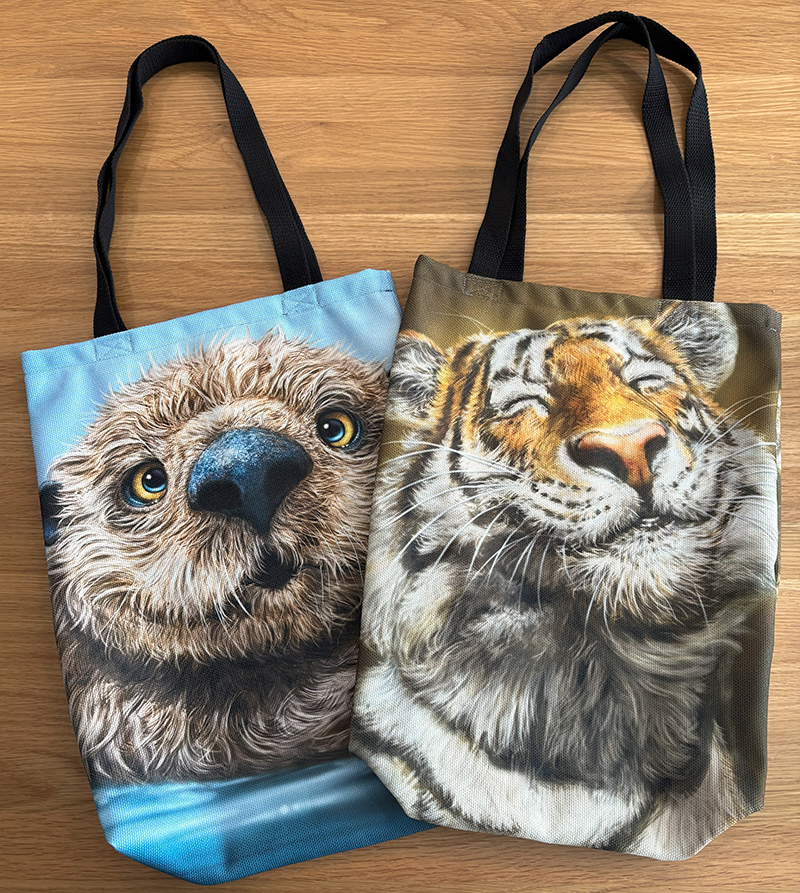
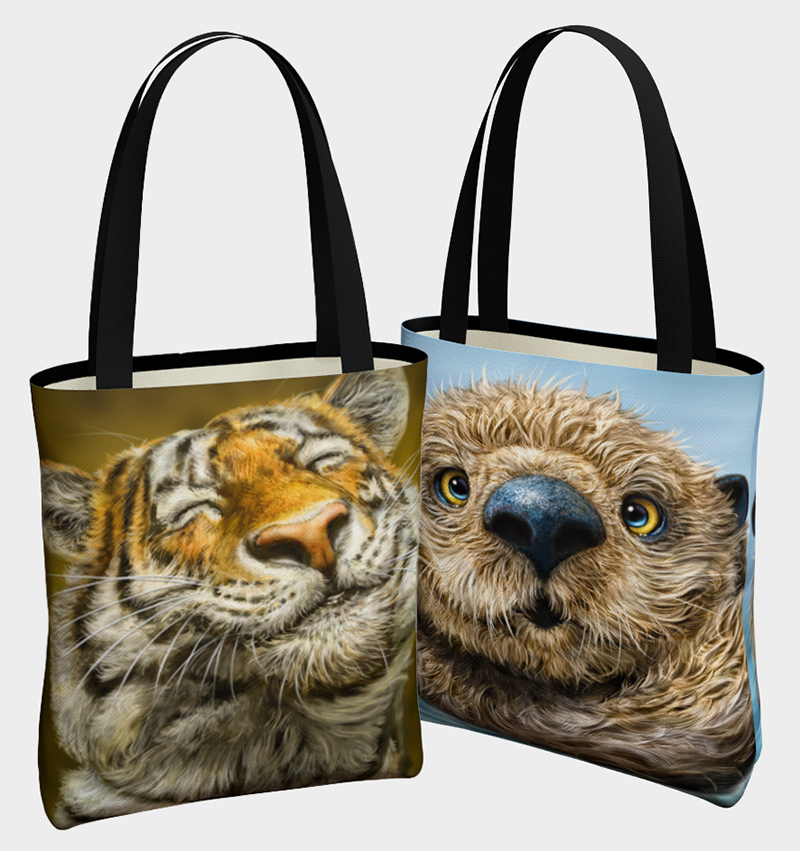
Thank you for all the positive comments and emails about the new Otter and Smiling Tiger tote bags I’m ordering for the Calgary Expo. These vibrant printed bags are 100% polyester textured canvas, machine wash and dry, and will withstand everyday use while looking great. Each measures 16” X 13” X 3”. Several people emailed me asking if I’ll have them in the online store. As with any new product, I must guess how many I might need for the show. Production and delivery timelines mean I won’t get these for more than a month, so I need to order them on Monday to have them in time for the end of April.
While I think they’ll do very well, they’re a significant investment, and I’m erring on the side of caution, which means I hadn’t planned on ordering extras for the online store until I see how they do. And if I added them to the store first and they do very well, I won’t be able to order more in time for Expo. But I’d love to hear your thoughts.
At $29 plus $5 shipping (in Canada) for one bag, would you buy one if I stocked them on my site? Depending on the feedback, I may increase how many I order tomorrow to accommodate online sales. Please let me know in the comments.
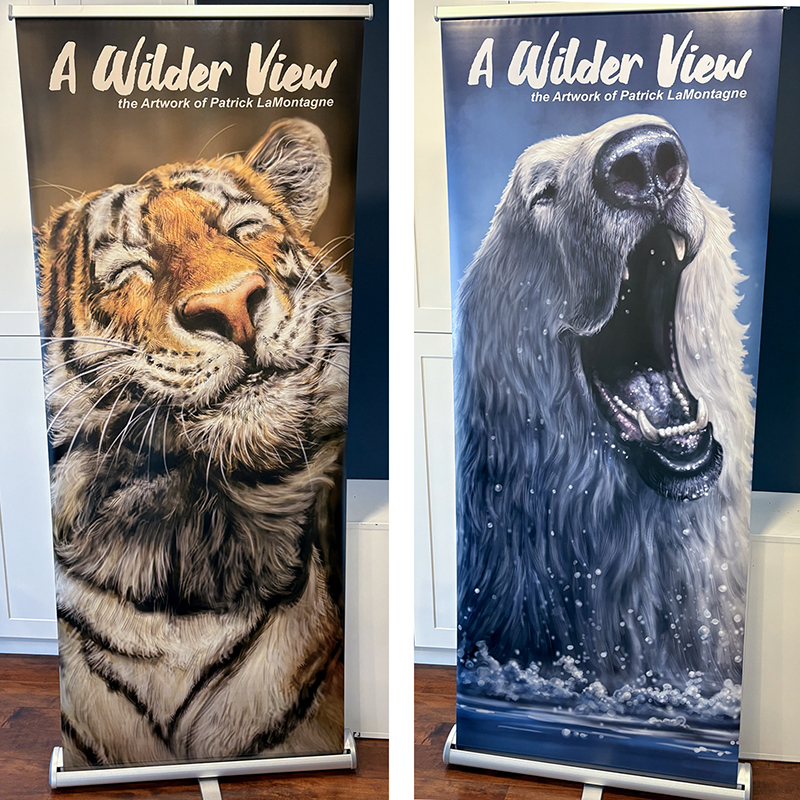
For years, I’ve been using the same vertical banners at the Calgary Expo, featuring my Smiling Tiger and Rat paintings. While the old banners are still in good shape, they have my old website on them, www.cartoonink.com. And even though I rebranded to LaMontagne Art some time ago, I haven’t worried about the other address, because it will still take you to my site. I also know that most people aren’t looking at my banner and going to my site while standing right in front of me at my booth. In hindsight, it wasn’t necessary to ever include that info on the banner.
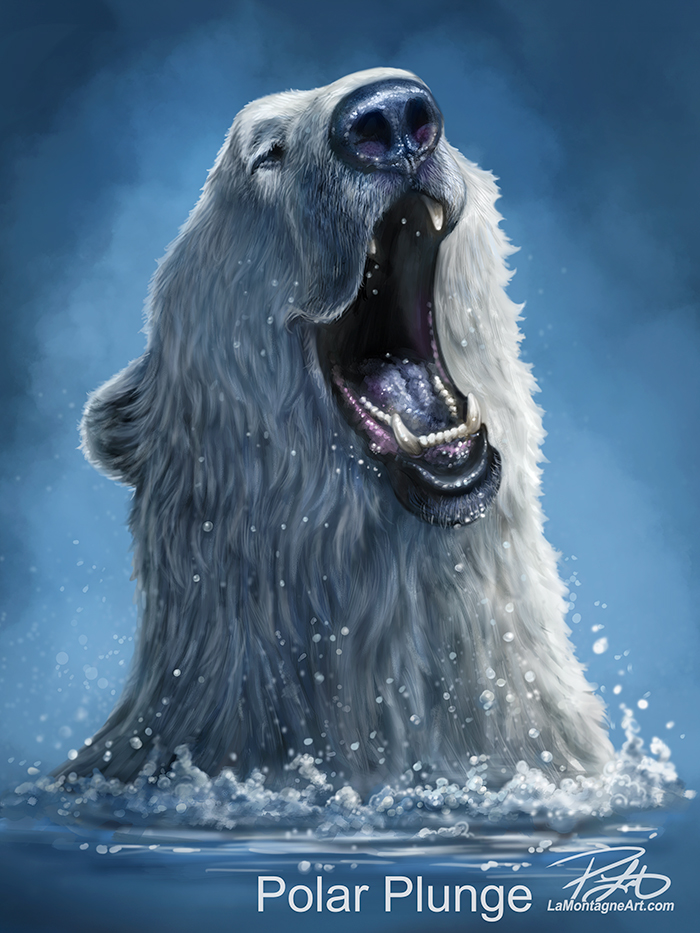
The banner stands I’ve used for years are made of heavy steel posts, cross beams and a base. They’ve done the job well, but they take extra time to set up and are awkward to load into an already packed car. This year, I have replaced them with these retractable banner stands which are more compact and set up in seconds. While I could have gone with new images for both banners, I opted to keep the Smiling Tiger. It’s still one of my bestselling images, but more importantly, it’s part of my Calgary Expo booth and brand identity. People tell me they look for that banner. For the second image, my Rat painting is now retired, and I was happy to use my new Polar Plunge painting in its place. I think it fits this format well.
I had these printed at Vistaprint Canada and I’m pleased with how they turned out.
Shonna has been urging me to get tote bags for a long time, but I’ve never been enthused with the idea. There are many different products on which I could print my art, but that would mean buying, storing and transporting them as well. Having too many products gets expensive and complicated, and I wasn’t sure if tote bags would be the best investment.
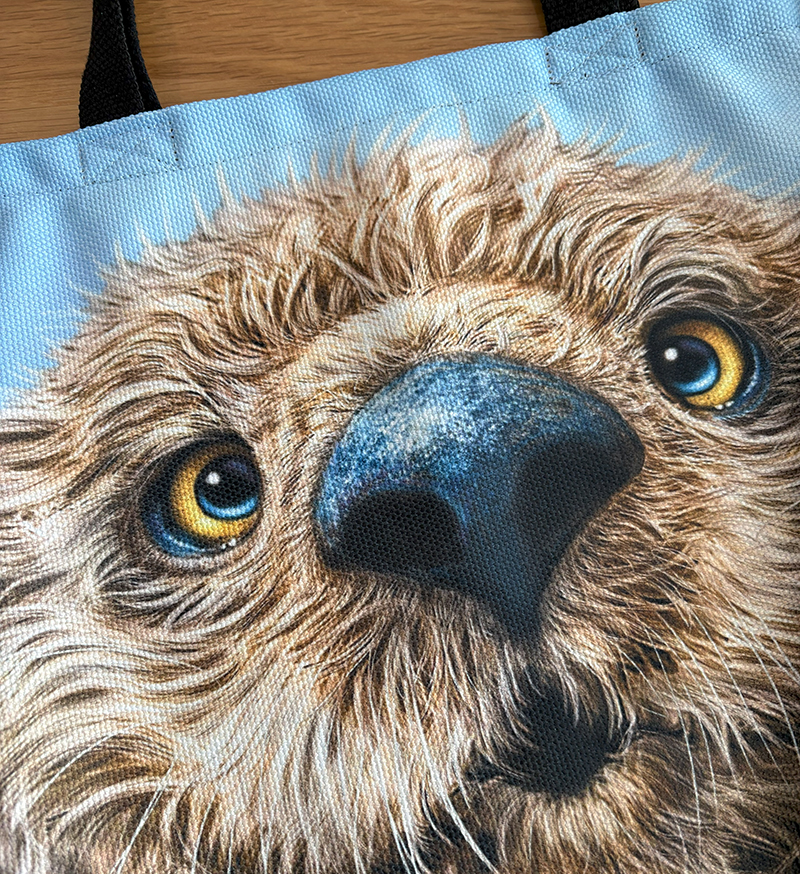
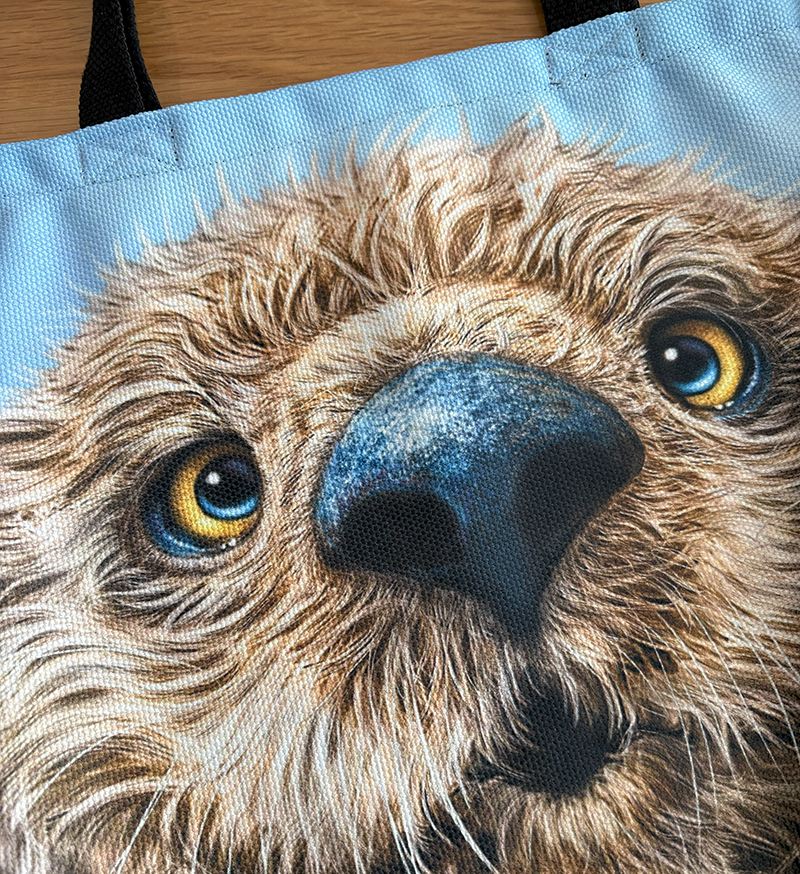
At the Banff Christmas Market this year, I made a point of arriving early some days to check out other vendor booths. One vendor I know had her artwork on canvas tote bags and I was very impressed with the printing. She told me they sold well and I asked where she had them done. She generously shared the details for the Montreal company and said they were great to work with. I created these designs for two of my bestselling paintings, and I am thrilled with how great they look. The print quality is better than I could have hoped, as is the construction and stitching. This vibrant printed bag is 100% polyester textured canvas, machine wash and dry, and will withstand everyday use while looking great. Each measures 16”X 13” X 3”. I designed each bag as a wrap; the same image on both sides, with no text or advertising. I’ll have these two bestselling painting designs, my Otter and Smiling Tiger, available for this year’s Calgary Expo. I haven’t yet decided on how many I’ll bring, but they’ll retail for around $30.
Some paintings come together easily. A reference photo may immediately inspire an idea, I’ll sit down and mock up sketches, and it will almost feel like the image creates itself.
This was NOT one of those paintings.
I’ve had more than a few frustrating experiences painting where the work didn’t seem to want to come together. I’ve beaten myself up about it, wrung my hands and thought, “Well, I used to know how to do this; I guess I don’t anymore.”
Eventually, I’ve made it through, and some of those paintings became bestsellers. This painting has been something entirely different. Even though I had a clear idea of what I wanted it to look like, I couldn’t get it to feel right. It was inspired by a photo I took at the Calgary Zoo, and I even had the name of the piece before I painted the first brushstroke.
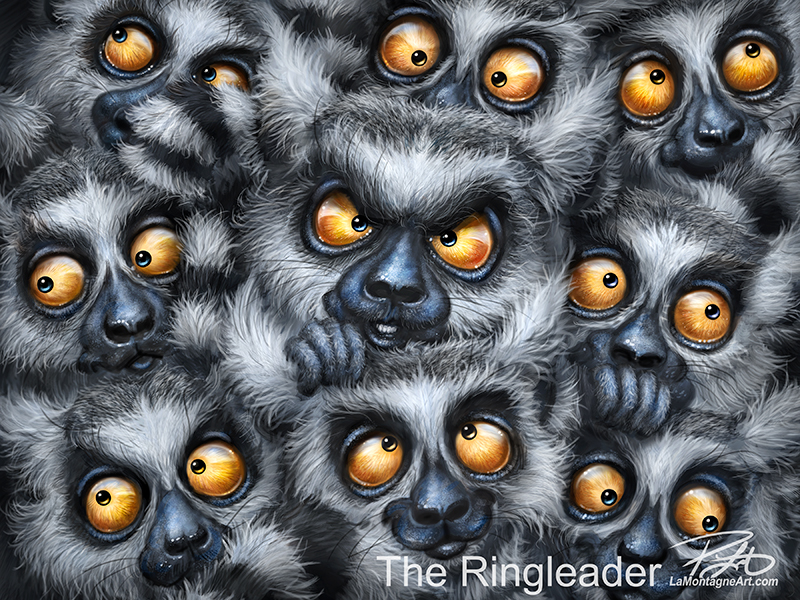
I came very close to calling this piece finished a couple of months ago. But I showed it to my artist friend Derek, who kindly told me what I already knew. It wasn’t working. The faces were laid out too uniformly, like a tic-tac-toe grid, and the personality wasn’t there.
So I went back to the beginning, discarding dozens of hours of work to start over again. The difference this time, however, was that I looked at it as one piece containing several characters rather than several characters I created separately and then assembled into one piece. The first go round, I used a specific reference for each lemur I painted and drew them all individually. Even after I assembled them, I kept going back to the individual references for each, and it wasn’t easy to keep track of it all. I made it far too complicated.
When I started over, I abandoned the individual reference. I focused on the expressions and characters without worrying about making each look like a specific reference because I didn’t need it. Lemurs are lemurs; they don’t look all that different from each other. As long as the central character had the most personality, the others were the supporting cast, even though their details were still necessary. The key to getting this piece back on track was to stop painting individual trees and just paint the forest. Even though this was a challenging painting, with a lot of redrawing and direction changes, I learned from the frustration. These kinds of lessons always contribute to better work in the future.
On Marc Maron’s WTF podcast this week, director James Mangold talked about lessons he has learned in filmmaking. He said that even though you need to start with a plan, if you hold it too tightly, you don’t leave any room for discovery in the process.
The finished piece still doesn’t quite match my original inspiration and vision. And while there are still the same nine lemurs as before, they’re more dynamic in their placement, different angles, placed higher and lower. There are more tails here and there, and I added hands for the ringleader as the central character.
But when I spend too much time with a painting, I can’t see it with fresh eyes anymore, so I don’t know if it’s any good.
What’s worse is that January and February are tough for me, as they are for many people. We’ve been enduring a period of bitter cold the past couple of weeks, and that always sucks the life out of me. I’ve forced myself to go for a few hikes and bundled-up bike rides to get out of the house and exercise, but it’s been a slog.
It’s also a time of year when I spend a lot of money on my business. From the final 50% booth installment for The Calgary Expo, the deposit for registering for the Banff Christmas Market, my first quarterly tax installment, paying for new promotional items, test prints for new products, plus restocking prints for anticipated spring client orders and Expo, and all the materials that go with that, it’s a part of self-employed stress I never get used to. It’s a maxim as old as time that you must spend money to make money, but nothing is guaranteed, so it’s always uncomfortable.
Finally, with the editorial cartoon side of my work, I must follow the deluge of bad news that breaks daily because he-who-shall-not-be-named continues his insane barrage of verbal and economic attacks on Canada. As much as I’d like to turn off the news to preserve my sanity, I can’t do that and still do my job.
All of this, aside from the 51st-state bullshit, is business as usual for this time of year. But when it piles on, it usually puts me in a pretty dark place. Under these circumstances, my perception of how any finished piece looks is distorted. I have no idea how I feel about this painting and probably won’t for a while. I feel more relief that it’s finally over than satisfaction with the result.
I’ve done several paintings in my career where I’ve felt indifference for them upon completion but grew to love them over time. Maybe this will be one of those, but I have no way to know. Artists tend to put too much pressure on themselves and make more out of their work than they should, and I am no exception. Ultimately, it’s just a painting of some funny-looking lemurs, and I have spent enough time on it.
“Art is never finished, only abandoned.”
Nobody knows if Leonardo da Vinci really said it, but it’s an oft-repeated quote because of how much it resonates with artists, that there is always room for improvement, and perfection isn’t possible.
With that in mind, I’m moving on and will start a new painting in a day or two.
Rich and Jill have been coming to the Bow Valley from their home in the UK every year for over a decade. While I don’t remember our first encounter in 2010, I had delivered an out-of-stock print of my first wolf painting to them at the Two Wolves gallery in Canmore.
I miss that place. The owners gave my whimsical wildlife work a shot at the very beginning, when I had only painted a handful of them and knew nothing about this part of the business. (Hi, Andrea!)
During other trips, Rich and Jill bought my art prints in Banff at About Canada under the previous owners. In those days, I offered black matted giclée prints on consignment, which means I supplied them to the gallery, and they would pay me when they sold. These days, my wholesale customers buy my prints outright, and I no longer offer matted prints.
But Rich and Jill liked that look and still wanted the giclée prints in that same size. So, in recent years, they have kept up with new releases through A Wilder View. And before they come to Canada to ski, they place a special order for the prints they want to take home. They order in the fall so I have it ready when they get here in December or January. I provide the prints in a roll and they have them framed in the UK.
This year, Rich told me in November that they wanted some coasters and a special order print of Spa Day in the usual 11″ X14″ size. He joked, “We just bought a larger house, mainly so we had more wall space for your pictures.”
But he also said, “Ideally, we would get a large format of the grizzlies, but I guess that’s not finished yet.” Up until then, the above work-in-progress image was all they had seen. I had shared it in August, along with an unfinished series of sketches. That they wanted to order the painting before they’d seen the finished work was flattering and a little frightening.
Even though there was no pressure, I suddenly wanted to have that print ready for them, especially since this was the first time they wanted larger than the usual size.
After the Christmas markets, I focused on The Grizzlies and finished it for New Year’s Day. Rich and Jill decided on an 18″ X24″ print, giving me three weeks before they arrived, which was plenty of time. This was the first time I’d seen the new painting in print and I was pleased. While I’m proud of my poster prints and Art Ink Print in Victoria does a great job, a giclée fine art print has a texture to the paper that often results in richer colours and enhances the detail. The photos here don’t do it justice. I met them at a local brewery for a drink to deliver their order this weekend. We haven’t had time for anything more than a short exchange on previous deliveries due to weather or distancing during the pandemic, so it was nice to sit and chat with them.
With this most recent delivery, they now have 16 prints of their own, plus trivets, coasters and prints they’ve bought for friends. As a self-employed artist, there is no bigger compliment than somebody who enjoys my work that much.
I’m grateful for anyone who buys my art, whether it’s a sticker, magnet, coaster, calendar, print or commission. Still, there are a handful of collectors whose ongoing support is sometimes overwhelming. Hopefully, I have told each of you how much it’s appreciated.
Because I had a little more time to get to know them on Saturday evening, I asked if they had any requests for animals I hadn’t yet painted. Though they own several other animal paintings I’ve done, they said they’re happiest with the bears, and I assured them there’s no chance I will stop painting those anytime soon. But Rich also took the opportunity to say, with an implied wink and a nudge, that he’d really like to buy a copy of my book.

 I’ve been working on a commission of three cats, and it’s coming along well. The client has provided some valuable feedback on the images I’ve shared so far. I’ve also recorded a bunch of the process, written the video narrative, and I’m still working on that video and the painting itself.
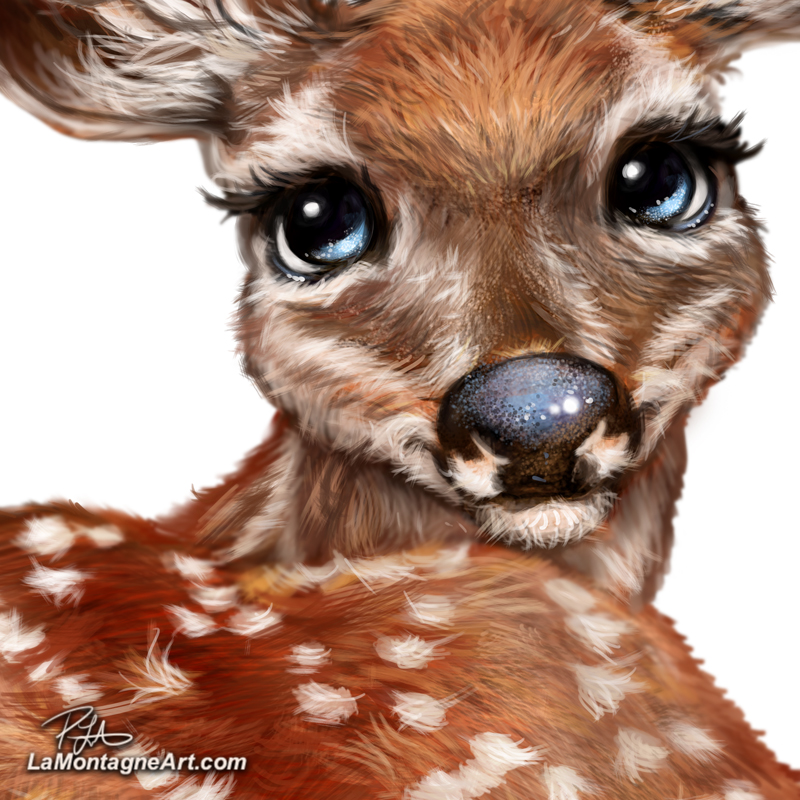 I based this little fawn on reference I shot at Discovery Wildlife Park about three years ago. It’s still rough around the edges. I could add more detail and background, but for now, I’ll leave it and return to the commission.
 But even that’s not as comforting as it used to be. The wildfire threat has been weighing heavy. After Jasper’s nightmare last year, it feels like everyone in our part of Alberta is bracing for our turn. Banff and Canmore have done prescribed burns for years, but now they’re also logging to create larger fire breaks. Nobody’s complaining.
 I’ve been working on a big
  Meanwhile, I haven’t finished a new wildlife piece in a while, and that’s eating at me.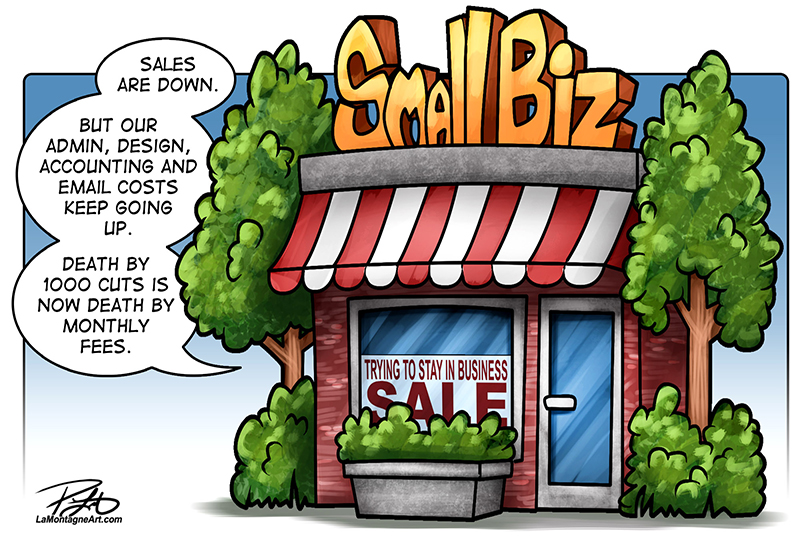
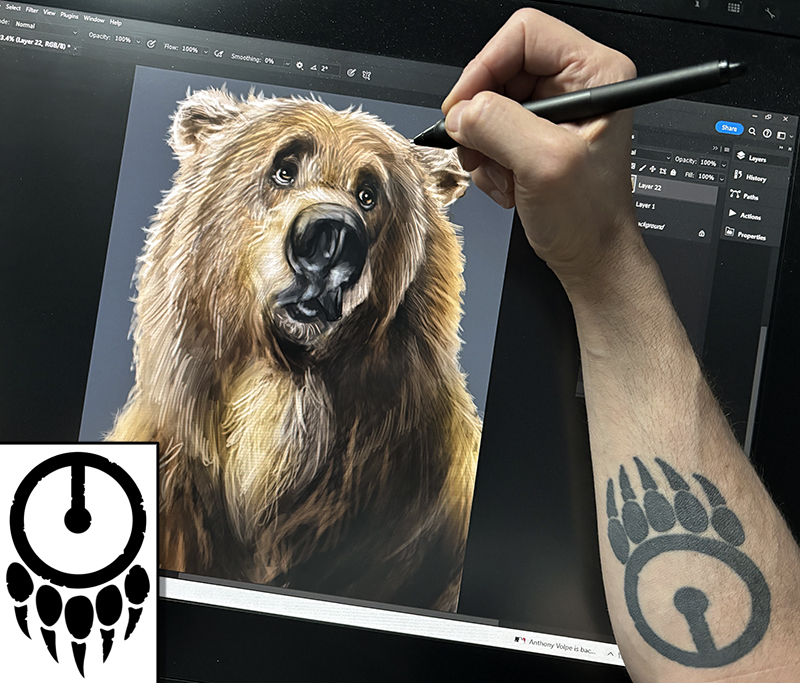 People often ask what it means. If I’m that solitary dot in the middle, my best chance of connecting with others is through my artwork, represented by the bear claws. But just as important is the reverse, where nature, wildlife and the world around me deliver the inspiration to create more art.
 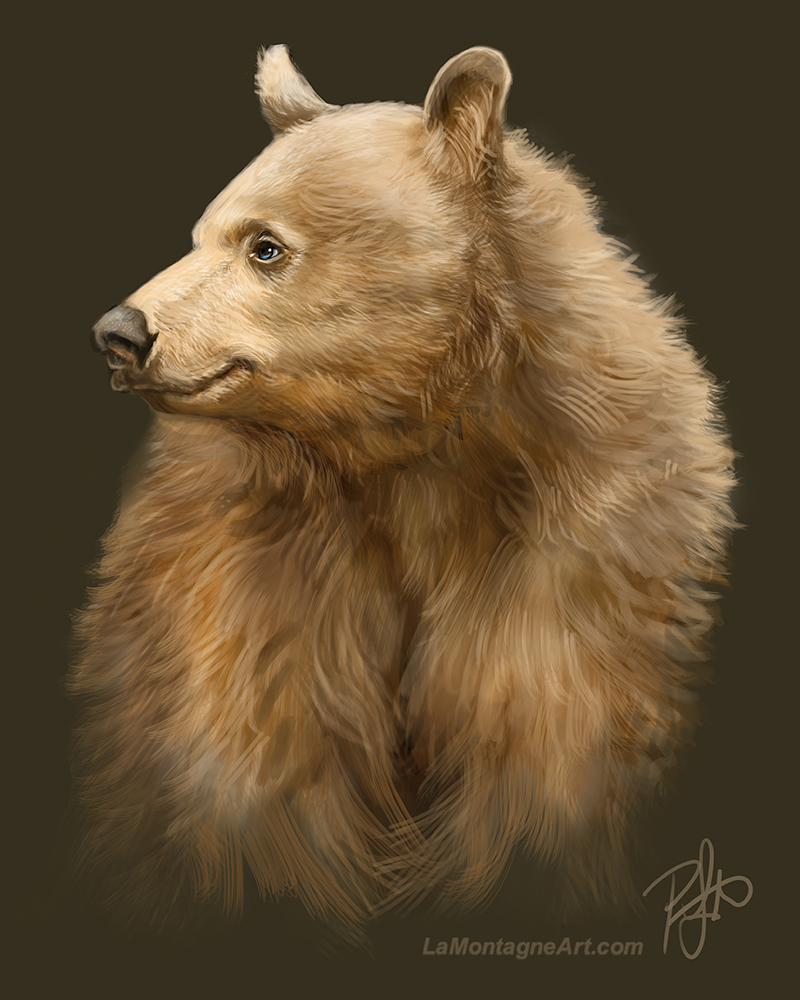 I have been frustrated the past few years that it seems I can never get as much done as I would like to, still failing to find traction. I have too many ideas, too much ambition, and little time to do it all. As fiction writers need to aggressively edit and ‘kill their darlings’ to make for a better story, I must abandon some things to make progress on the ones that mean the most to me.
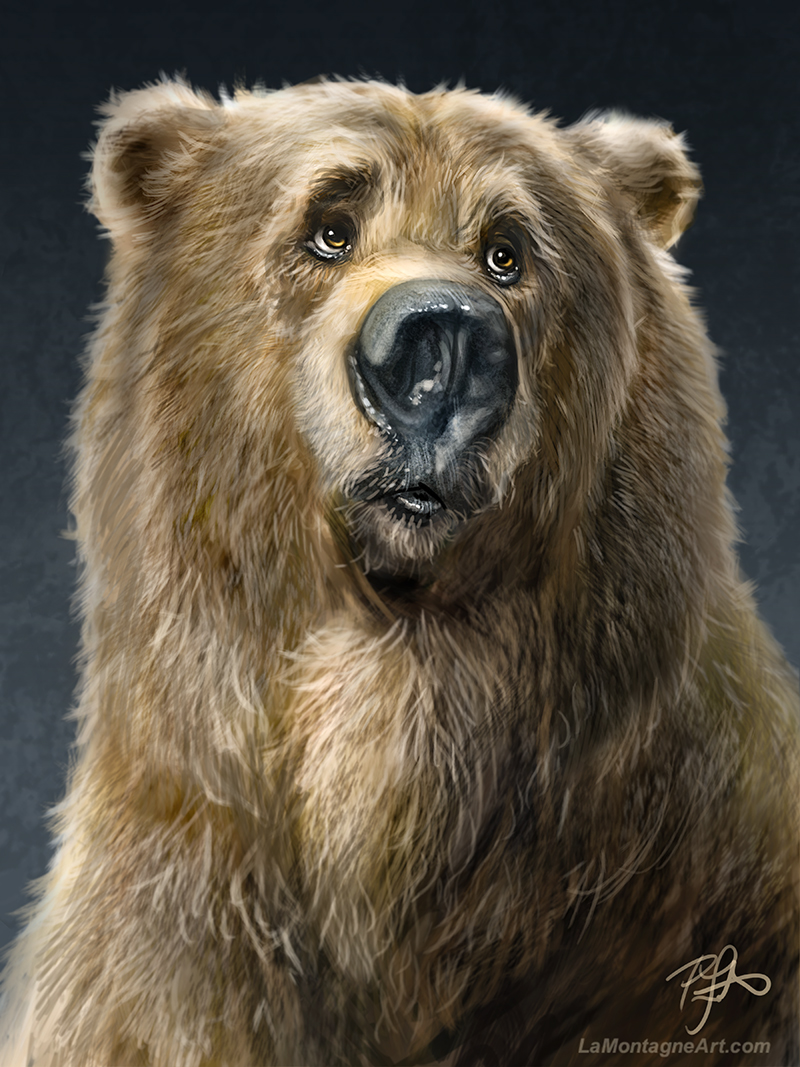 I haven’t painted anything in a month and needed to get back into the groove. These were supposed to be rougher sketches, but it’s difficult to stop once I get going. These are neither sketches nor finished paintings, but somewhere in the middle.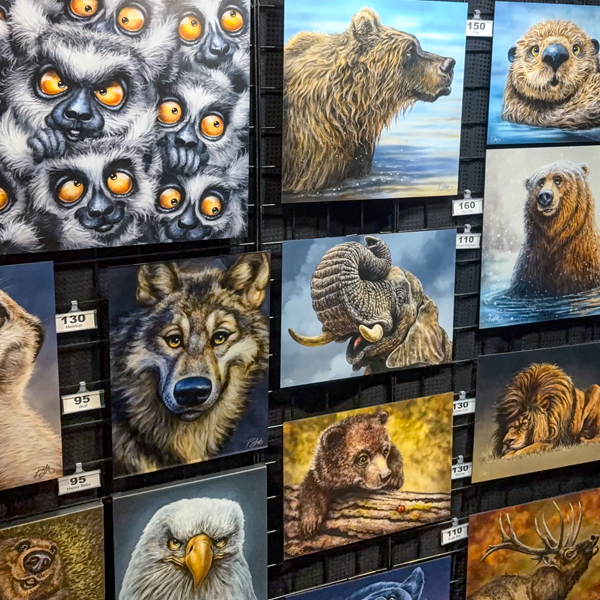
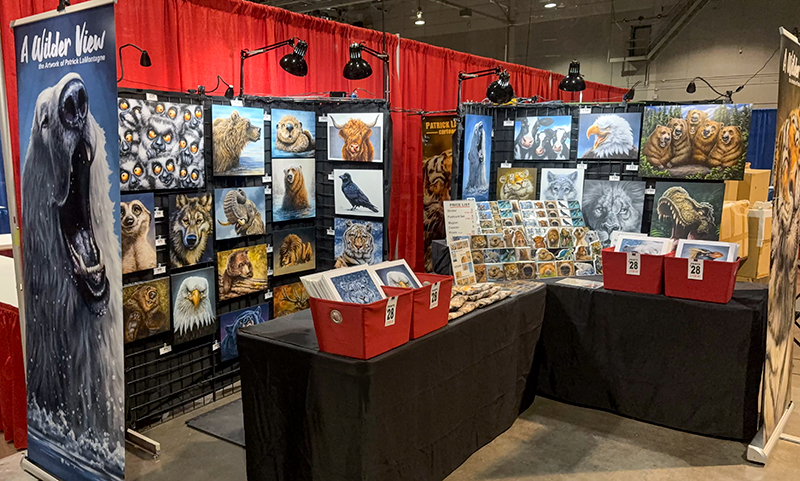
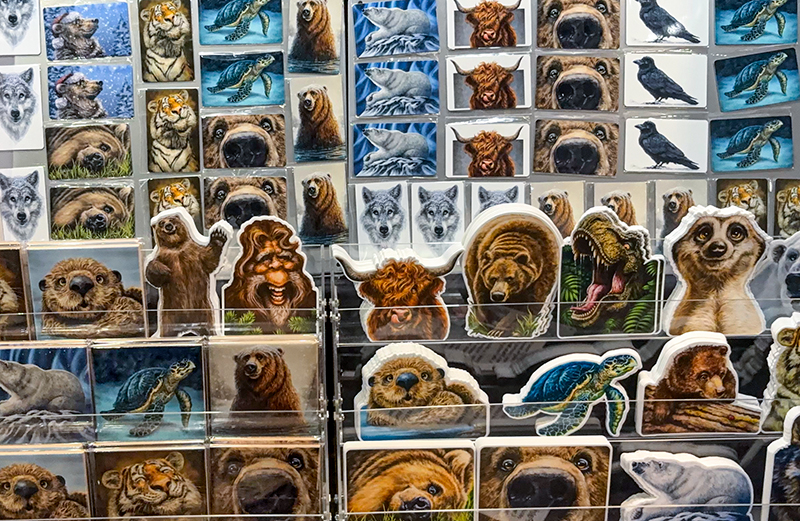 At the show’s end, tearing down took about an hour and a half. But the line-up of cars to access the loading docks was ridiculously long. I have a sturdy hand dolly that transforms into a robust cart. It was quicker for me to haul my booth out in three trips through two large halls to the other side of the building where I had parked my car. That took another hour, but it was better than sitting in a long line of vehicles for all that time.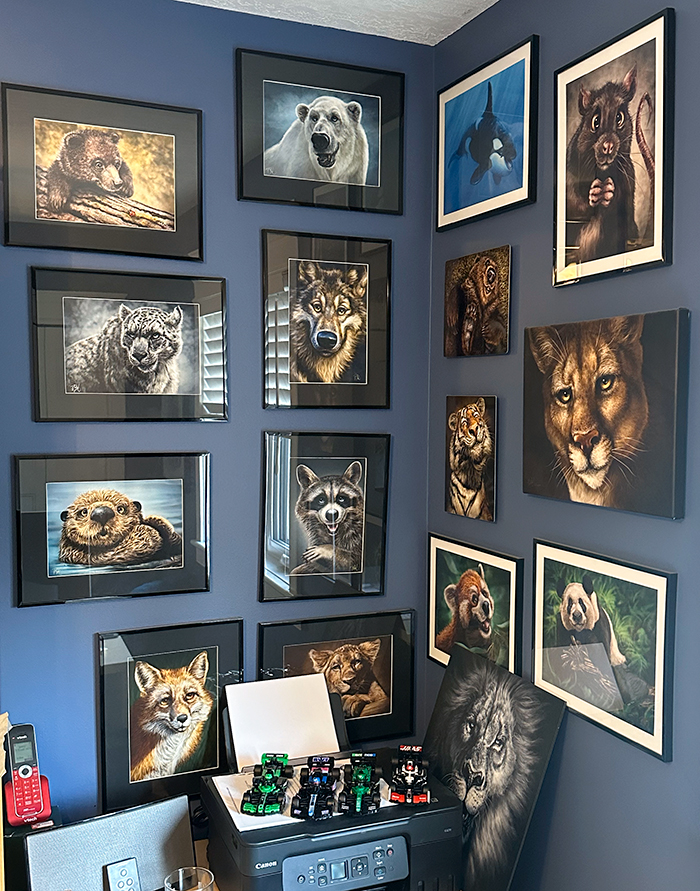
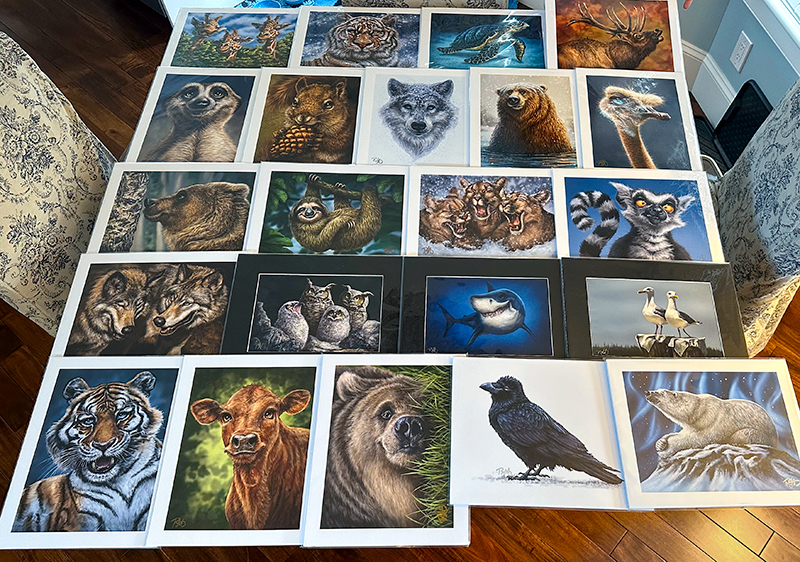
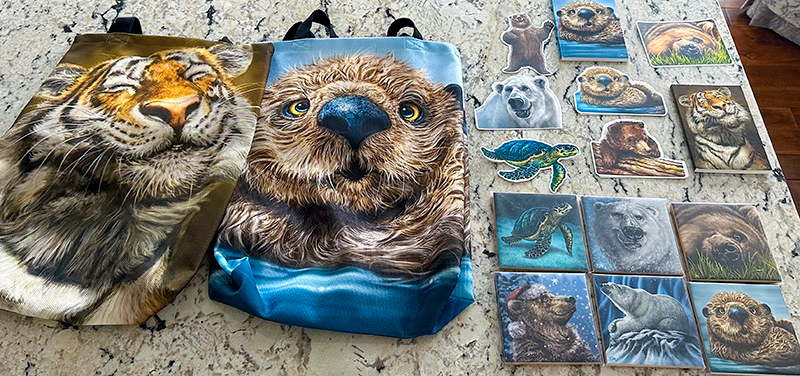 Though I saw them all weekend, Tracy and Sheldon took these photos of their collection Saturday night and shared them by text. They rotate their prints in what they call Critter Corner. When I saw these photos, I joked that I felt like a drug dealer and it might be time for an intervention, especially since they bought more
 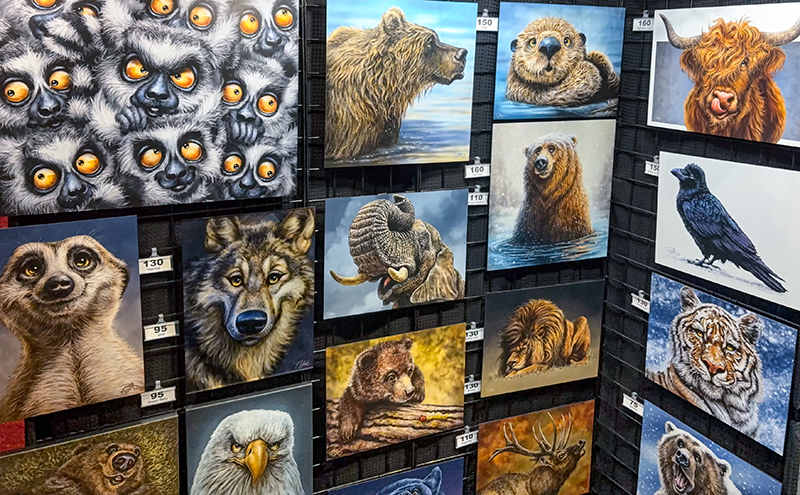 Long-time collectors also bought canvas, metal and acrylic prints this weekend. I have more of those orders to fill this week. I talked with former commission clients and ones whose paintings I’m just about to start. I got the usual gentle pressure about the book, which I never seem to gain traction on, and a few offered welcome suggestions on which animals I might consider painting next.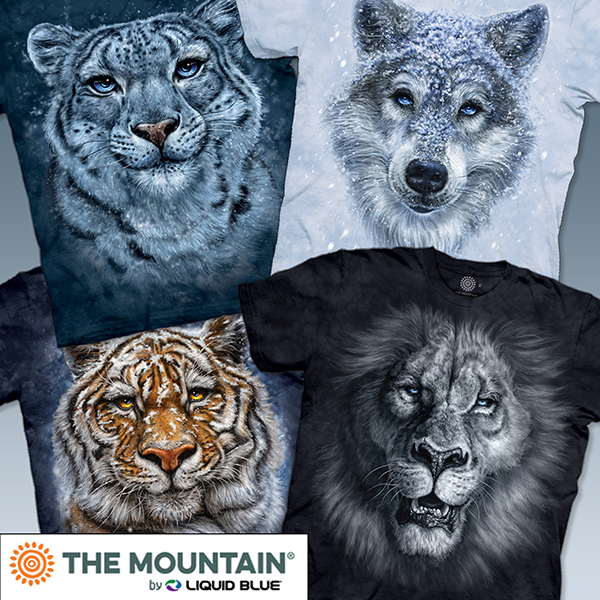

 Fortunately, everything I need for Expo is already here or on the way. I placed a large print order earlier this week to fill orders for
  Additionally, the next three weeks will be some of the busiest of my year, and the bags won’t even be here for another week. I don’t have the room to add hours and days of shipping and delivering tote bag orders on top of all the prep and drawing cartoons.
 But every year, even if they follow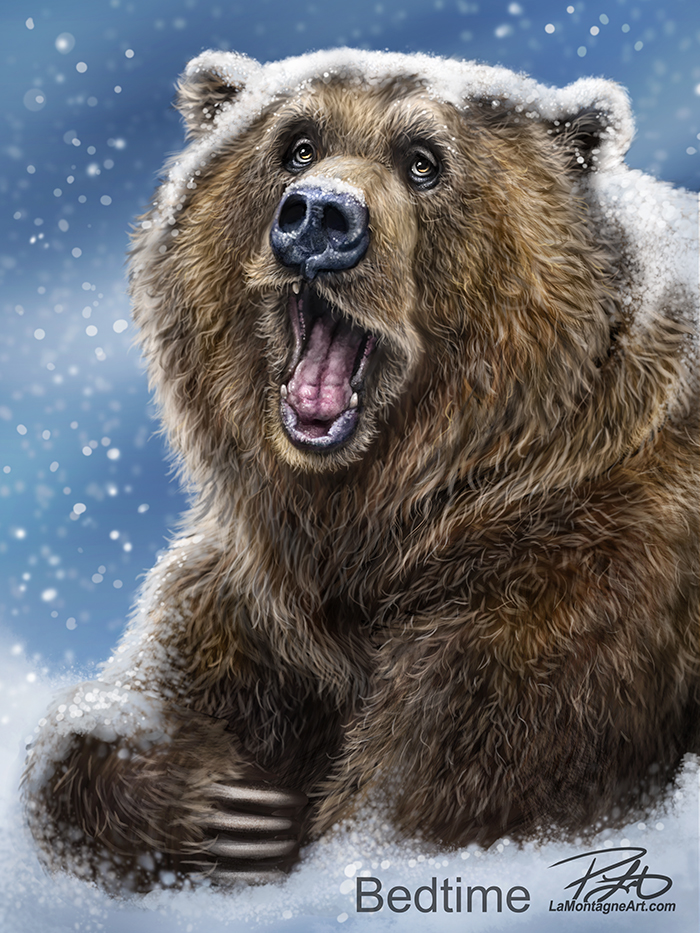
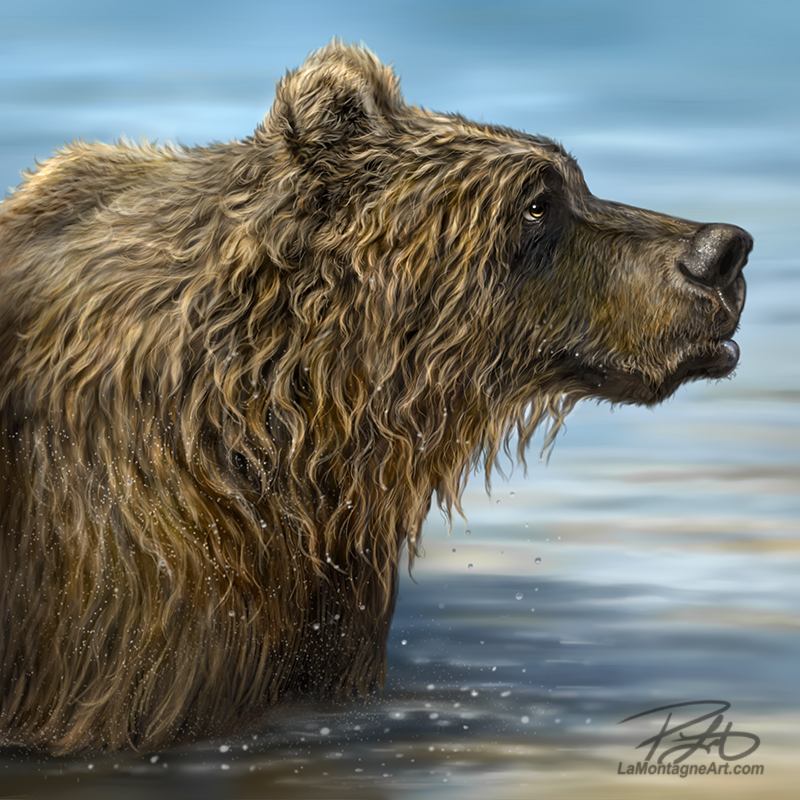 First, here’s a painting I just finished yesterday called Pouty Bear. Even though most of the animals I paint are smiling and happy, I occasionally change them up, even if I know that a different expression may not appeal to people.
 Commissions and Comic-Con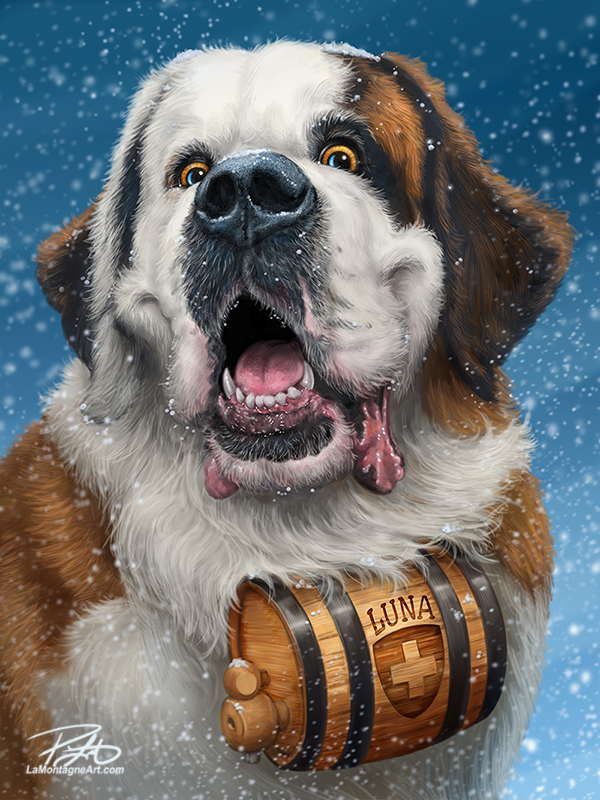
 Several people emailed me asking if I’ll have them in the
  But I’d love to hear your thoughts.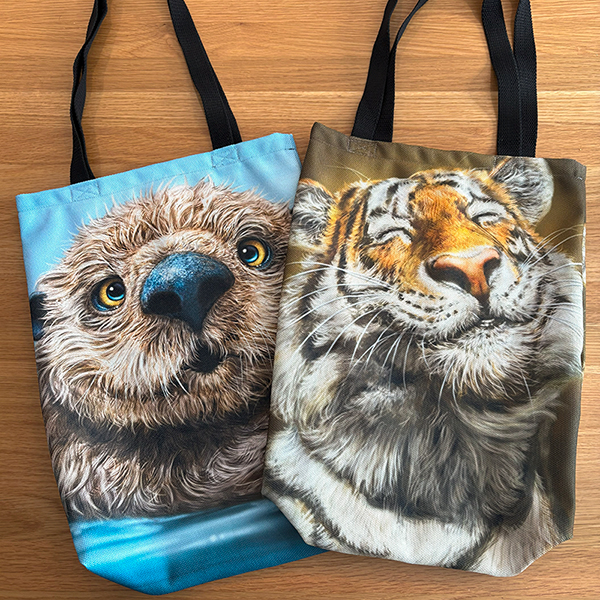
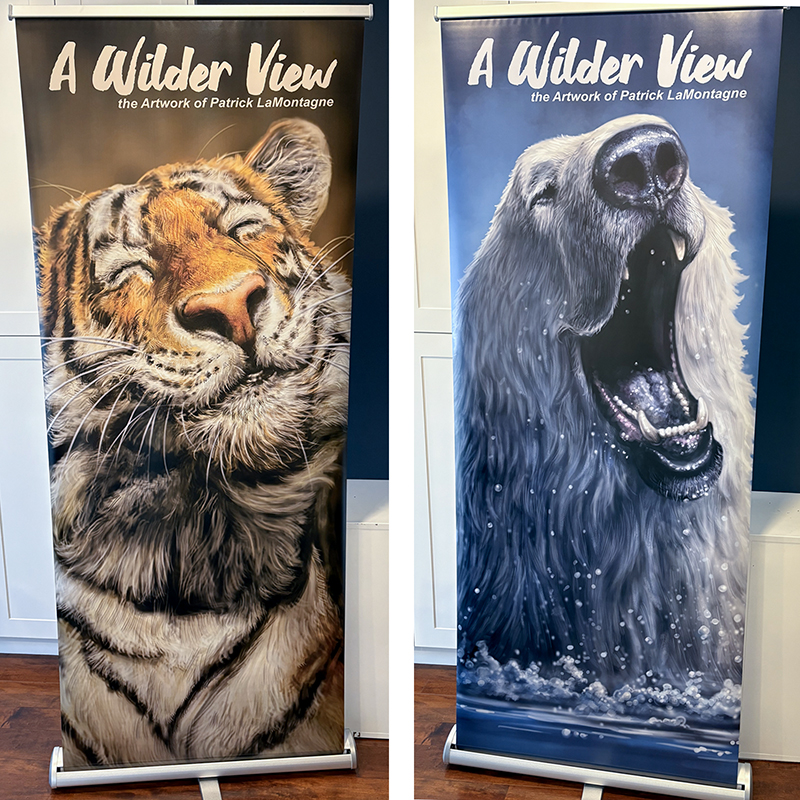 This year, I have replaced them with these retractable banner stands which are more compact and set up in seconds. While I could have gone with new images for both banners, I opted to keep the Smiling Tiger. It’s still one of my bestselling images, but more importantly, it’s part of my Calgary Expo booth and brand identity. People tell me they look for that banner. For the second image, my Rat painting is now retired, and I was happy to use my new Polar Plunge painting in its place. I think it fits this format well.
 Shonna has been urging me to get tote bags for a long time, but I’ve never been enthused with the idea. There are many different products on which I could print my art, but that would mean buying, storing and transporting them as well. Having too many products gets expensive and complicated, and I wasn’t sure if tote bags would be the best investment.
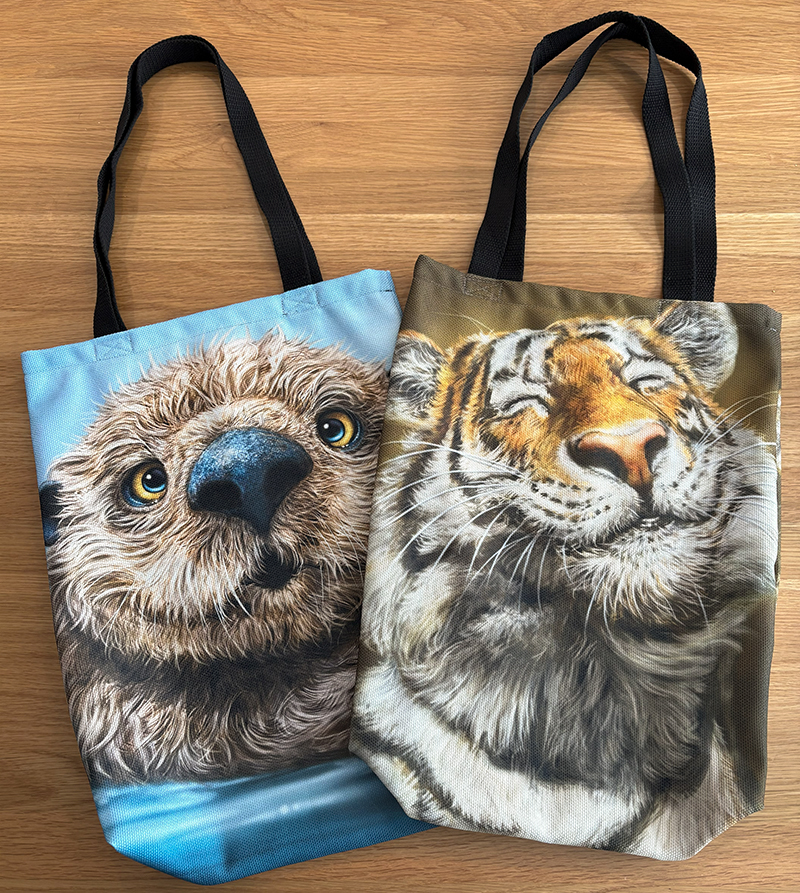 I created these designs for two of my bestselling paintings, and I am thrilled with how great they look. The print quality is better than I could have hoped, as is the construction and stitching. This vibrant printed bag is 100% polyester textured canvas, machine wash and dry, and will withstand everyday use while looking great. Each measures 16”X 13” X 3”.
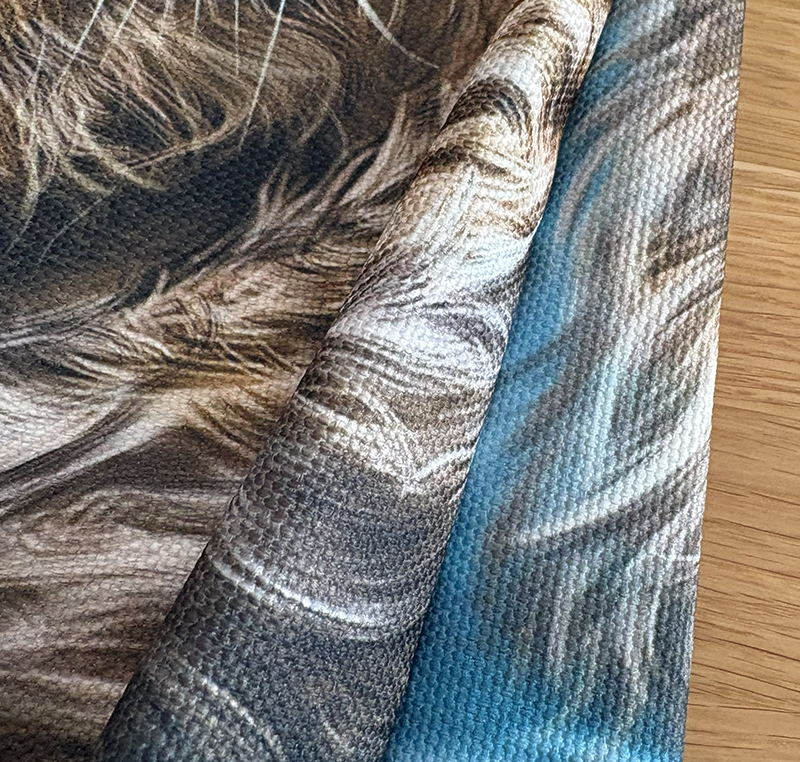 I designed each bag as a wrap; the same image on both sides, with no text or advertising. I’ll have these two bestselling painting designs, my Otter and Smiling Tiger, available for this year’s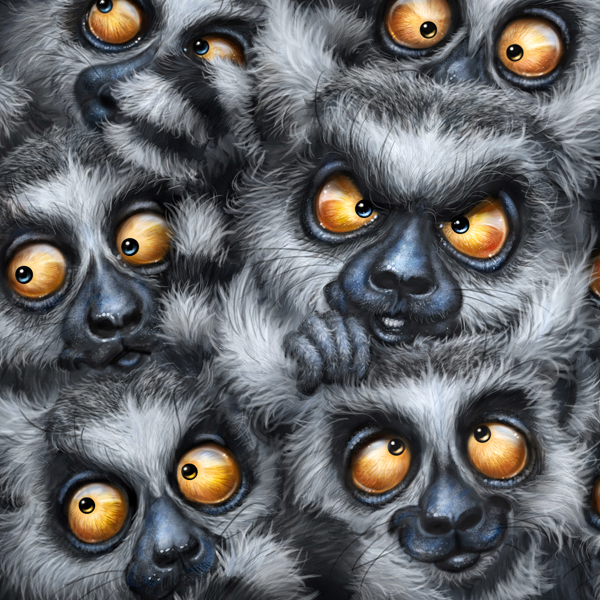
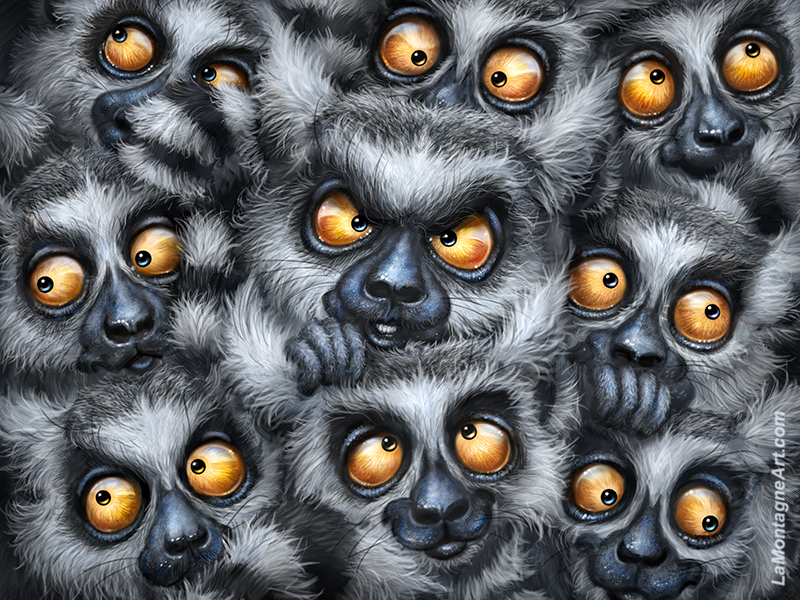 Some paintings come together easily. A reference photo may immediately inspire an idea, I’ll sit down and mock up sketches, and it will almost feel like the image creates itself.
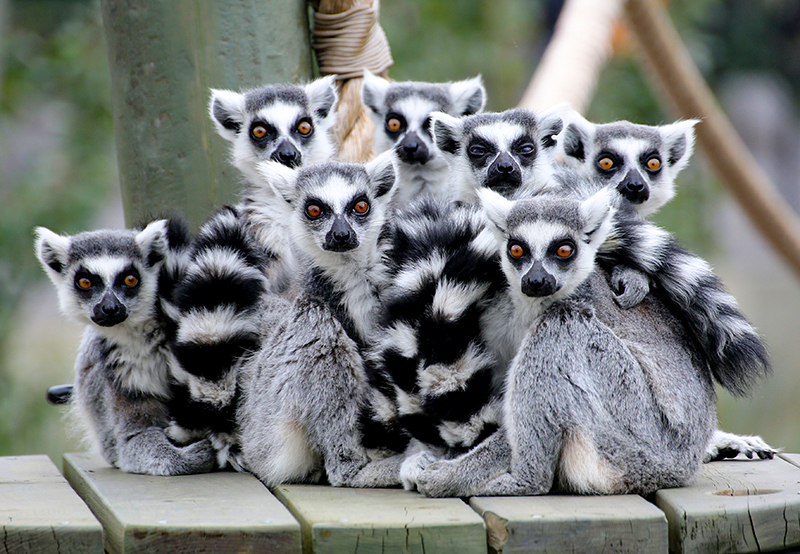 This painting has been something entirely different. Even though I had a clear idea of what I wanted it to look like, I couldn’t get it to feel right. It was inspired by a photo I took at the Calgary Zoo, and I even had the name of the piece before I painted the first brushstroke.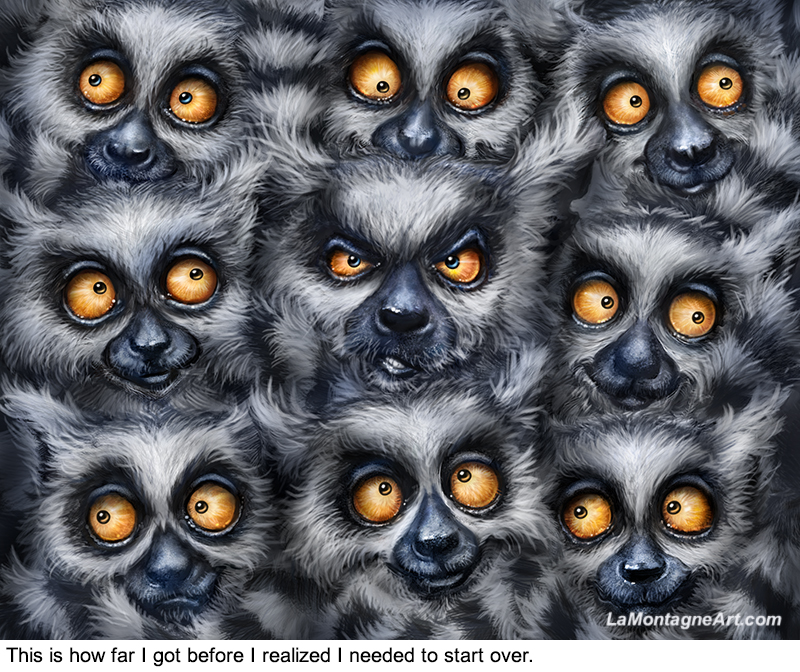
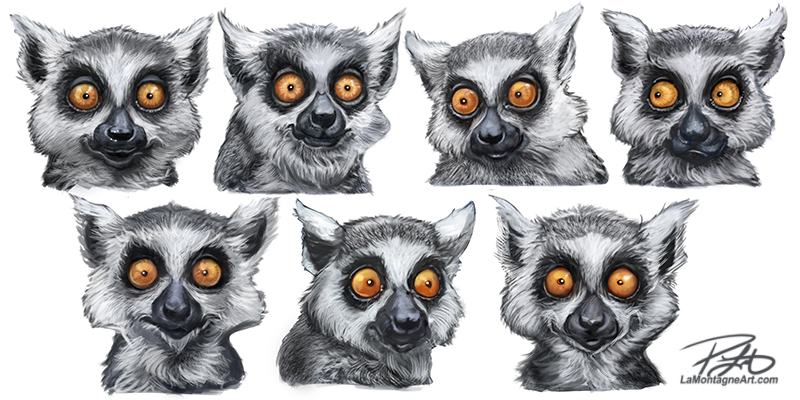 The first go round, I used a specific reference for each lemur I painted and drew them all individually. Even after I assembled them, I kept going back to the individual references for each, and it wasn’t easy to keep track of it all. I made it far too complicated.
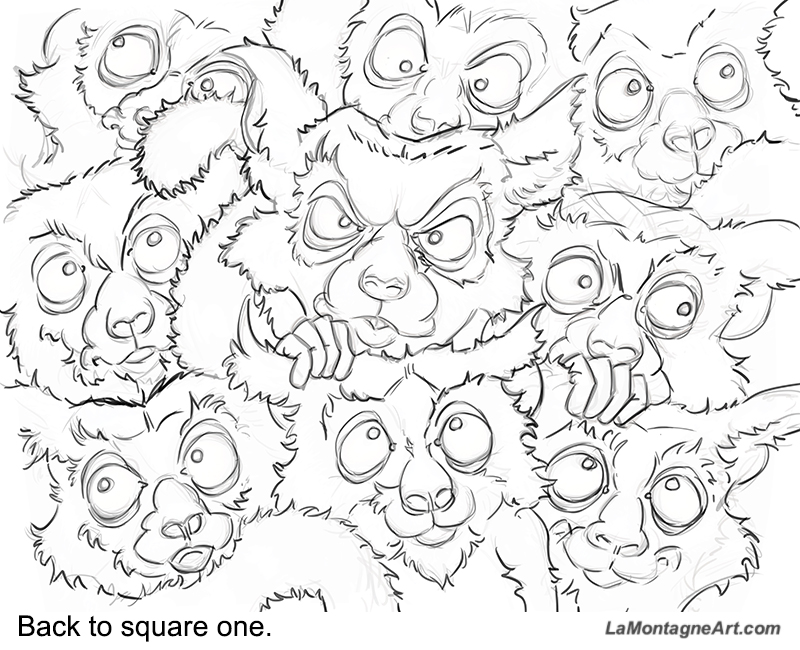 The key to getting this piece back on track was to stop painting individual trees and just paint the forest. Even though this was a challenging painting, with a lot of redrawing and direction changes, I learned from the frustration. These kinds of lessons always contribute to better work in the future.
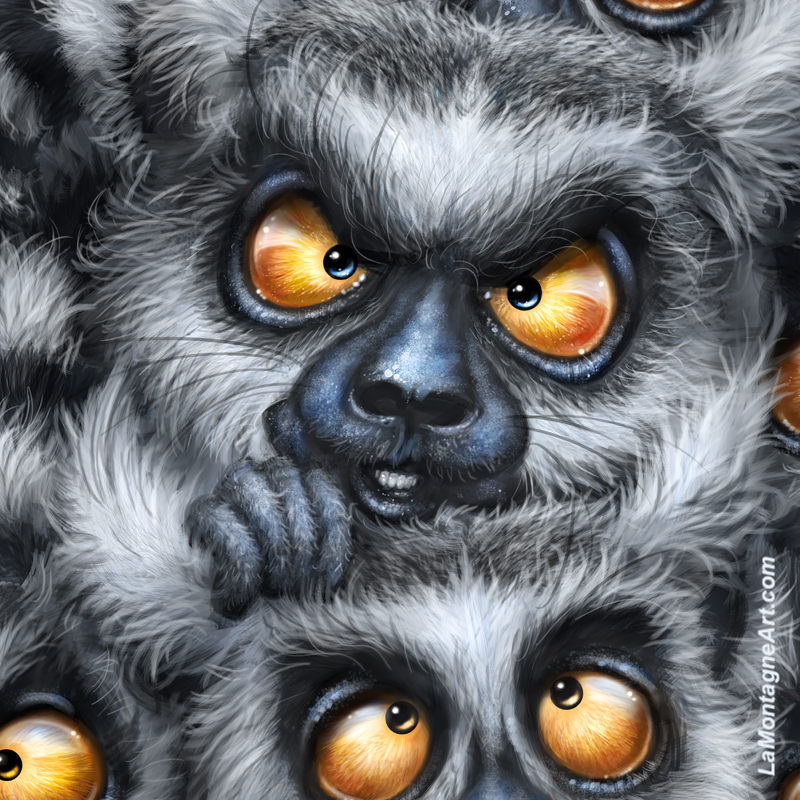 Under these circumstances, my perception of how any finished piece looks is distorted. I have no idea how I feel about this painting and probably won’t for a while. I feel more relief that it’s finally over than satisfaction with the result.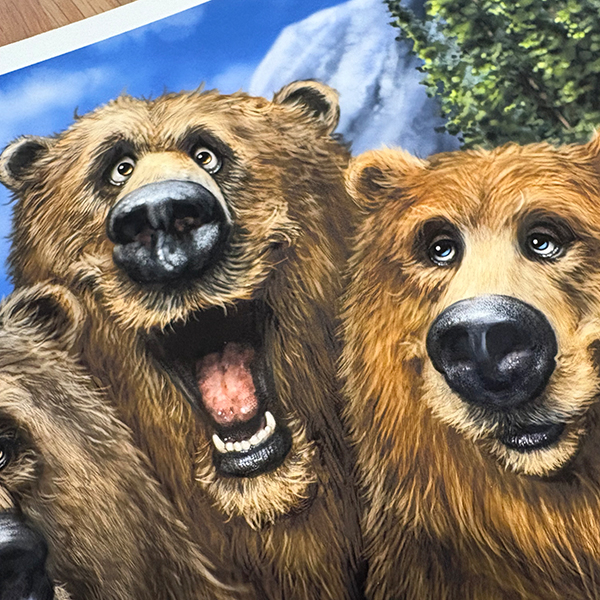
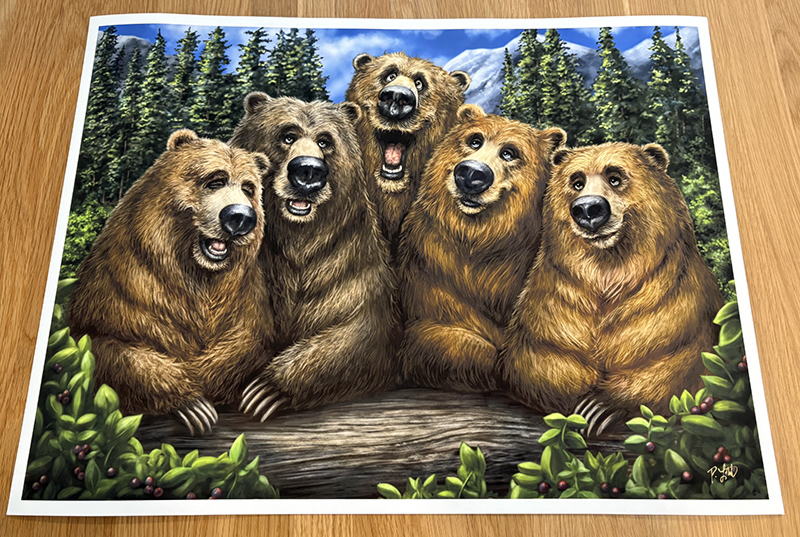 Rich and Jill have been coming to the Bow Valley from their home in the UK every year for over a decade. While I don’t remember our first encounter in 2010, I had delivered an out-of-stock print of my first wolf painting to them at the Two Wolves gallery in Canmore.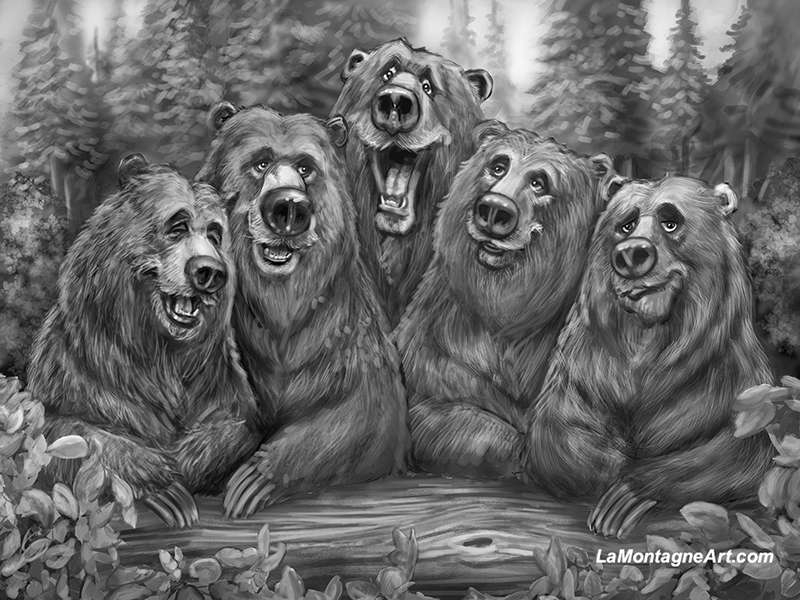
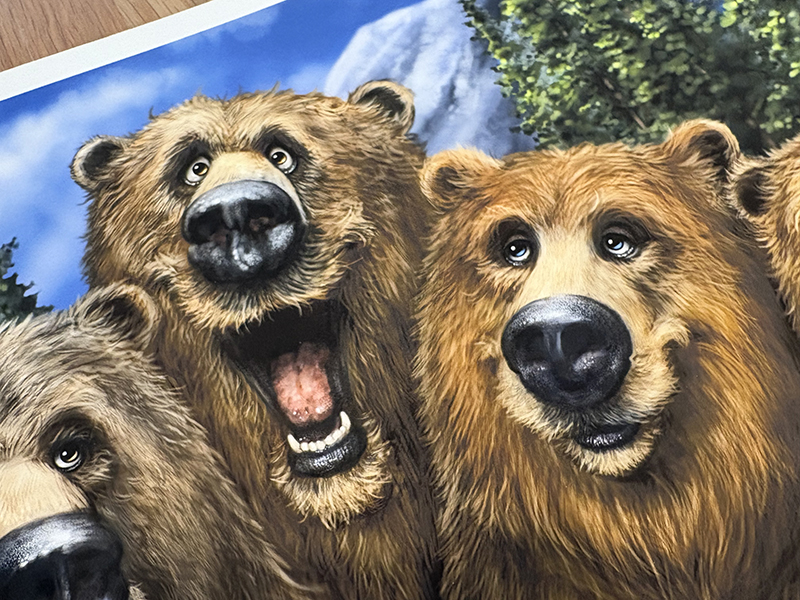 I met them at a local brewery for a drink to deliver their order this weekend. We haven’t had time for anything more than a short exchange on previous deliveries due to weather or distancing during the pandemic, so it was nice to sit and chat with them.