
Here’s a video gallery of the critters I painted this year, set to music.

Here’s a video gallery of the critters I painted this year, set to music.
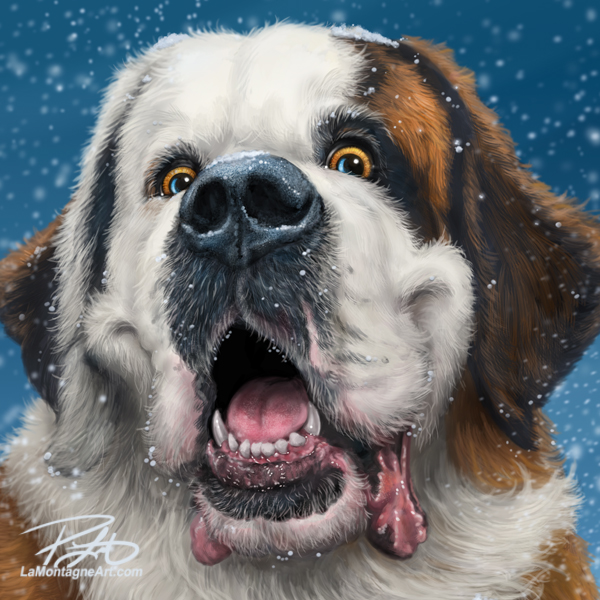
 While commissions are a small part of my overall work and business, I’ve enjoyed the pet portraits I’ve painted over the years. All have been challenging, either the artwork or managing client expectations. Though I have my personal favourites, I’ve learned something valuable from each.
A couple of years ago, my friend and marketing guru David Duchemin suggested my rates were too low. Artists are notorious for undervaluing their skills, often attracting the wrong clients, those more interested in a bargain than the artwork.
A commission is a custom portrait requiring consultation, preparation, printing, and shipping/delivery, plus many hours of actual painting. Unlike my whimsical wildlife portraits, which can be sold as prints and licensed, a commission is an original work created for one client.
David asked me to consider whether I would rather have more clients at a lower rate or fewer clients at a rate more appropriate to the years I’ve put into my skills and the unique look of my critters.
I took that to heart and raised my rate because when I’m painting a commissioned piece, that’s time that can’t be spent painting anything else.
On my site, I’m upfront about pricing, the photos I need for reference, and the details a client needs to make an informed decision without making it awkward if the price is out of their range. I’m happy to answer inquiries, but with my daily editorial cartoons and new whimsical wildlife pieces, the commission work is welcome when it comes in, but I don’t actively market it.
My first and last paintings of 2022 were pet portraits, both thoroughly enjoyable experiences with great clients, nice bookends for the year.
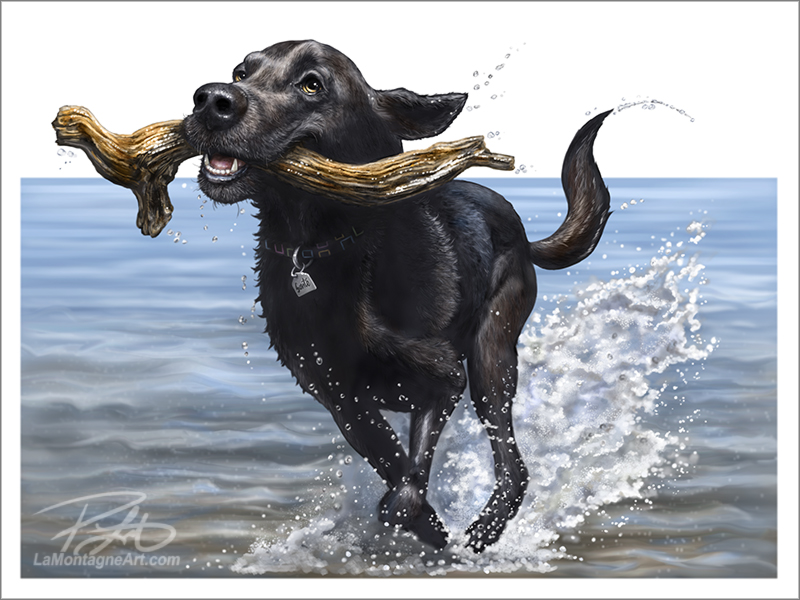 Santé was a memorial piece. Suzanne wanted my whimsical style and a full-body action pose, something I hadn’t yet painted in a commission. She wanted the painting to portray the active and joyful full life that Santé led and had the photo reference to back it up. While difficult, it stretched my skills, and I was pleased with the result. Click here to read more about that experience in the original post.
Near the end of October, I got an email from a man in Calgary asking me to paint his dog Luna, a gift for his wife. He’d read the Commissions page, knew what he wanted, and even included some initial reference photos. Talk about a good start.
We’d briefly discussed a possible commission at the Calgary Expo in April, but while I get several inquiries at that event, this is the first one that has resulted in a hire.
Given the time of year, I assumed this was a Christmas present. However, when I asked, he replied, “not a huge rush, if we got it for Christmas it would be a great surprise, but I’m not overly concerned if we don’t get it until the new year.”
I thought that if we could reach an agreement quickly, I would make that surprise happen.
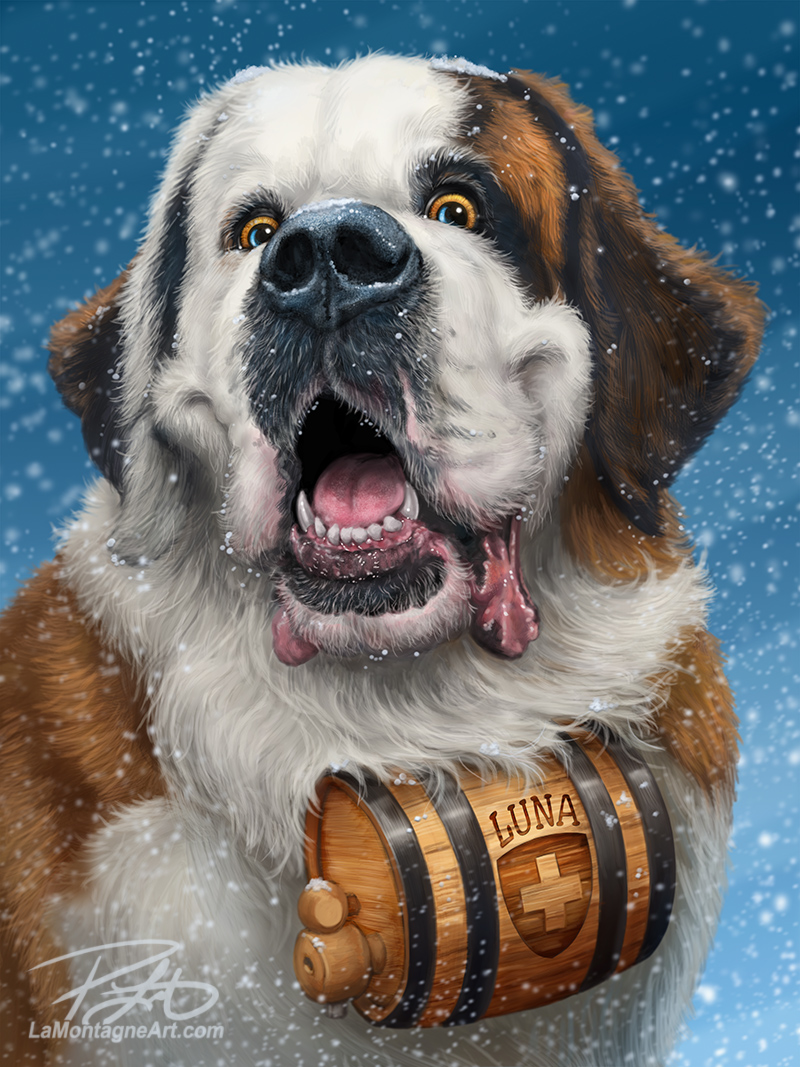
I asked if he could take more photos for me, offering a little guidance on what would be ideal. He got right to it and I ended up with great bunch of reference. In one of them, I noticed she had a little brandy keg around her neck, and I asked him if I could paint her in a winter scene with that keg. Sure, it’s a cliché image of a St. Bernard, but it was too perfect a fit, and I could see the painting in my head. Jeremy liked the idea and said that Luna loves the snow.
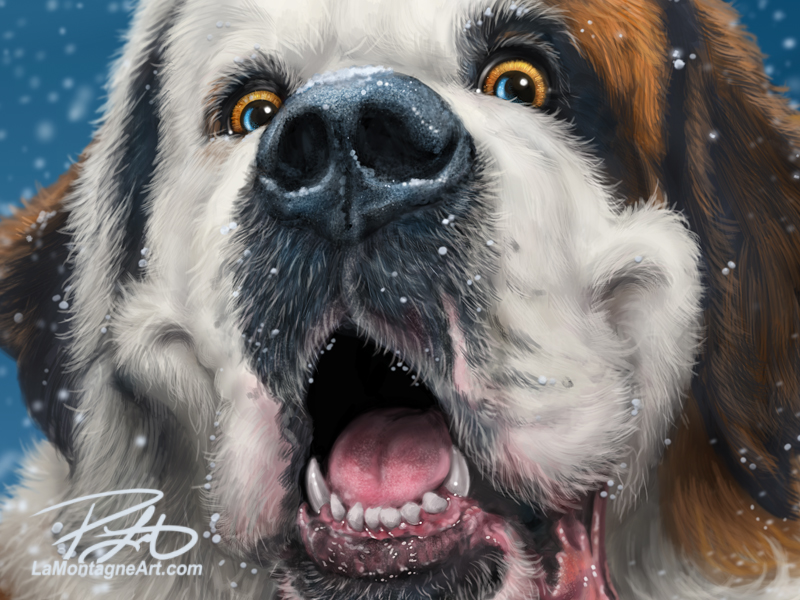
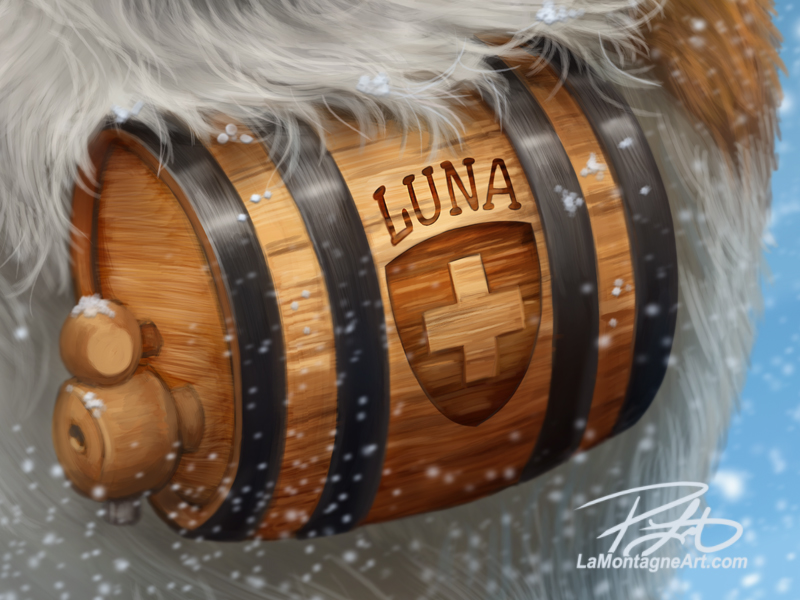 At the beginning of December, I sent him the finished piece for approval before it went to the printer. Of the options I offer, he had initially chosen an 18X24 canvas, and while that would have looked great, I talked him into going with the same size matte metal piece instead. With the bright, vibrant colours in this painting, I knew it would pop a lot more on metal.
I’ve been having my metal and canvas prints done by Posterjack for over a year now. Everything is always well-packed, and this was no exception. The colours and quality of the Luna print were stunning.
But you can imagine my disappointment when I noticed some slight damage in the bottom right corner. There was no damage to the box and it was wrapped well inside. In their busy season, somebody likely knocked it during production and failed to notice before packing it. It was a tiny dent, only noticeable on close inspection.
I put some foam wrapping around the corner and gently bent it back into place with some pliers. Then I took a white paint pen, blended it with a little blue and smudged over the corner with a Q-Tip, blending it as best I could into the sky and snow background. It was the only corner of the painting where this could have worked. I did a pretty good job of it, too, but I could still see the damage.
While setting up and working at markets, no matter how careful I’ve been, I’ve dinged a couple of these myself in the same way. I might bump one, and it falls off the gridwall, that sort of thing. In those cases, I’ll offer a discount to anyone interested in that piece, which is usually acceptable. It’s almost always barely noticeable and this was the same type of subtle damage.
But this was a custom commission.
I told the client about it; said I’d still drive it in the next day and see what he thought. He wasn’t too concerned, but I wasn’t comfortable with his settling for a damaged print. But at least he’d have the piece to give to his wife for Christmas, and I could replace it afterward.
I sent Posterjack a photo of the damage, and they immediately offered a replacement. However, since I wasn’t sure it would arrive before Christmas, I delivered the print I had.
Of course, while preparing to deliver the piece, I had to ask, “do I get to meet Luna?”
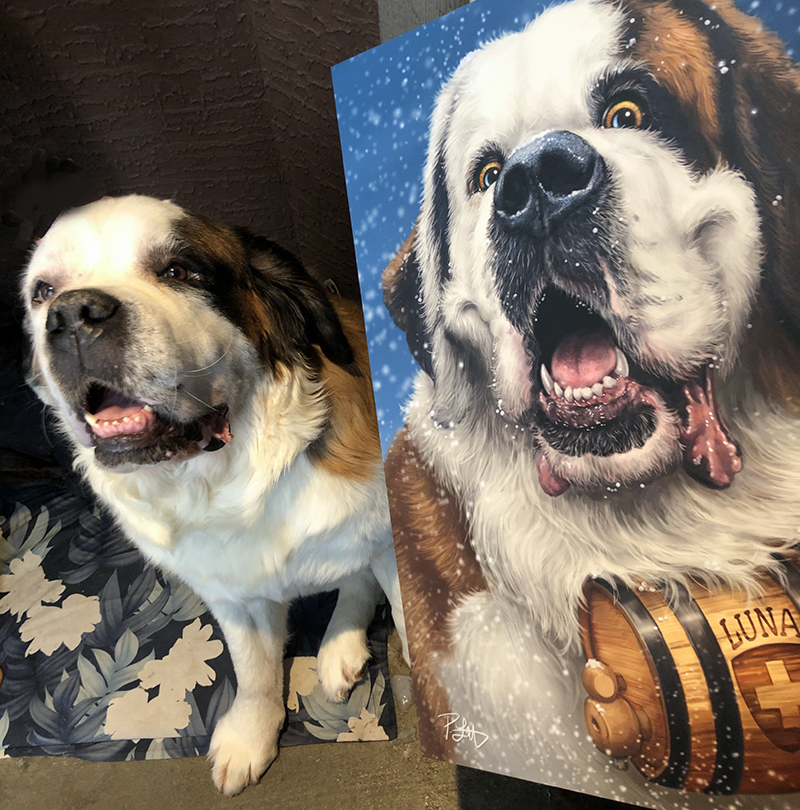 She’s exactly as you’d expect, a big slobbery friendly St. Bernard with the sweetest face and lovable eyes. I would have liked to have taken a better photo with her, but Jeremy and I met in their enclosed front porch, with Luna and her Newfoundland sister, Sally, between us. As they’re both BIG dogs, it was a little cramped, but Jen was home, so there was a risk of ruining the surprise.
The replacement print arrived five days later. I inspected it and wrapped it back up right away to keep it safe. I sent my Posterjack contact an email thanking them for standing by their product. Nothing secures my loyalty more than great service. Too many companies have forgotten that.
In ideal conditions, I could have gone to Calgary again to replace it before Christmas, but our weather turned incredibly nasty, temperatures between -30 and -40C every day all week, right after the starter in my car began to grind intermittently. Not the safest set of circumstances for a trip into the city.
With the starter replaced last week and this cold snap departed, I’ll soon arrange to make the exchange. I plan to display the original print at Expo in April, a full-size example to point to for any commission inquiries. In the meantime, I’ll hang it in my office because I do love it; such a fun piece to paint.
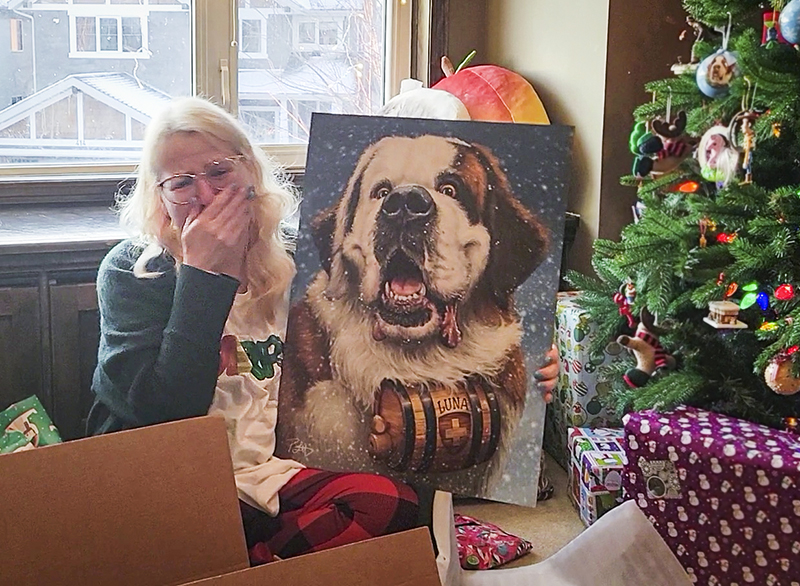
 As for Jenny’s reaction, Jeremy sent me some pictures Christmas morning. Let me tell you, tears are the best compliment I ever get.
Click here for more information about pet portrait commissions. If you have any questions, drop me a line at patrick@nulllamontagneart.com
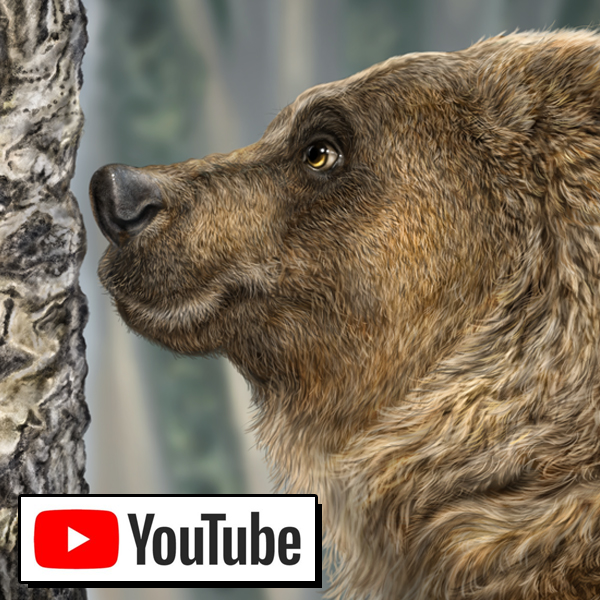
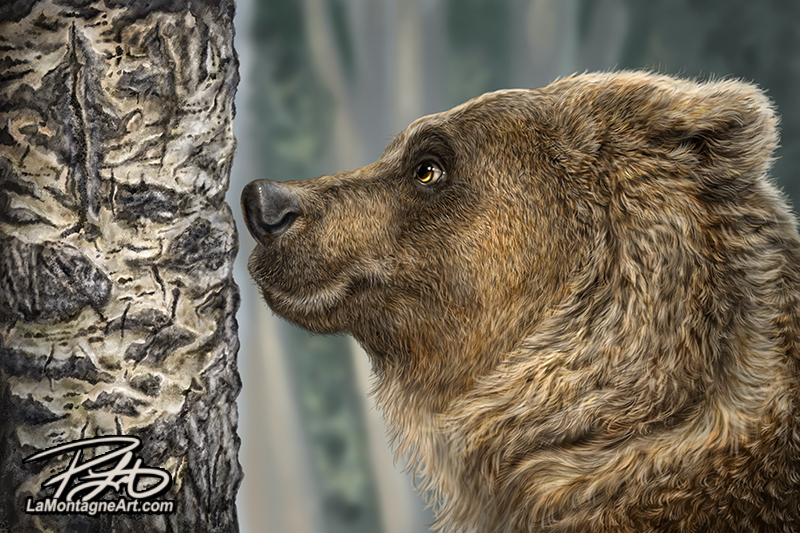
Here’s my latest piece. I call it ‘Staring Contest.’ This is another painting of Berkley from Discovery Wildlife Park. I took the reference a couple of years ago, the same day I did for one of my favorite pieces, Grizzly on Grass. I love painting this bear. Spending time with her was, and continues to be, a highlight of my life. I’m forever grateful to Serena and her staff for that privilege. Below is a time lapse video of this piece, from start to finish, along with narration to go with it. The text for the voice-over is below the video if you’d rather read than listen to it. Thanks for being here.
Cheers,
Patrick
Every artist is familiar with imposter syndrome. It has now become a cliché that’s right up there with the overshared quote about doing the same thing over and over again and expecting different results.
We compare ourselves to other artists and not only feel like we don’t measure up but that we never will. It’s easy to fall into the headspace that an art career is a zero-sum game, that when another artist wins, you lose. It can be somebody you’ve never met with whom you have no connection, but when they’re making headlines and you’re not, it feels like you’re failing.
Worse, news of other people’s successes is front and center all the time. As a result, we now compare ourselves to everyone else on the planet.
So-and-so exceeded their Kickstarter funding by $50,000. And there’s the guy who makes his entire living from his Patreon subscribers. That woman over there makes six figures from YouTube videos, and that other person has thousands of followers on Instagram.
That artist made millions on NFTs. Somebody else just published their 4th book. His course went viral. She’s featured at Comic-Con. That big company sponsored this guy, and that girl scored a five-figure art grant.
Some kid’s painting video goes viral, and now he’s making movies with James Cameron? He’s 18. That girl’s not even out of art school and got a gig with Disney?
Suddenly I have to start dancing on TikTok to sell my art.
What the hell?
That’s the problem with attention. You’ve got to keep coming up with something new to get more of it and find a way to stand out in a crowd of millions doing the same damn thing.
When you’re not chasing the spotlight, you need to pay the bills.
I’ve been making my full-time living as an editorial cartoonist, illustrator and digital painter for nearly twenty years, plus several years part-time before that.
And yet, I wonder if I’ll still be able to do this for a living in six months.
I’ve had that worry every month since I quit my full-time job in 2005. It has never gone away. Good stuff has happened in my career, a lot of it. But when it does, that little voice always reminds me not to get comfortable. Because as soon as you stop and smell the roses, you get a thorn up your nose.
There are plenty of articles that try to talk you down from the comparison ledge. I know, I’ve read them. Hell, I’ve written some, though I felt like a fraud while doing it.
The worst part is the longing, that feeling that you could be so much more than you are, but you somehow missed that critical memo everybody else got because they seem to know what they’re doing, and you’re the idiot still looking for the light switch in a dark room. It’s that failure to live up to your own perfectionist personal potential, that dark cloud of not being good enough that will rob you of most of the joy of creating art.
Then there’s the shame that comes from not being more successful, feeling like a joke to your friends and family, as if they’re reluctantly indulging this phase you’re going through, just waiting for you to come to your senses and get a real job.
I can’t tell you how many acquaintances I’ve run into, people I hadn’t seen for years, who ask, “Oh, you still doing that art thing?”
“Good for you.”
All that’s missing is the pat on the head.
Now, this is the part where I’m supposed to tell you to let it all go, enjoy the ride, stop trying so hard and making yourself miserable. Comparison is the thief of joy. But then I’d be a hypocrite because I’m 51 years old, and I haven’t figured out how to accept any of that.
Not long ago, I watched that ‘Light and Magic’ series about the creative minds behind ILM. For a movie and art nerd like me, it was exciting stuff. The contrast between what they created in the ‘70s and what it has become today is remarkable. From little plastic spaceship models and whole camera systems they had to invent to bring Star Wars to life to later making dinosaurs real in Jurassic Park, it’s practically sorcery.
On the one hand, it was incredibly inspiring that they just made stuff up, and it worked. But, on the other, it triggered a sense of desperation that nothing I’ll ever create will ever be that good.
I paint funny-looking animals. How important is that? It’s not! But you know what? Neither is modelling toys and playing with space aliens. But those people changed movies forever. Those people changed the world
What I liked best about the story was how those people talked about each other 40 years later. They were like family. It was the kind of workplace everybody wants but is ultimately very rare. They gambled on a dream and turned it into reality.
It’s easy to quote, “Be bold, and mighty forces will come to your aid.”
But chances are better than average that they won’t. For every ILM lightning-in-a-bottle story, there are a hundred others we’ll never hear about, featuring creative types who dreamed just as big and worked just as hard.
This artist’s life delivers more than its fair share of torment, uncertainty, and feeling unoriginal like it’s all been wasted time. I wonder if I’ll still be able to draw when I’m older or if age will rob me of my dexterity and eyesight. I worry I haven’t saved enough for retirement because I’ve invested more into this creative life of risk than my financial security.
And yet, for all the fear I feel every single day, and the shame for not knowing how to make all the right business moves, it’s still one of the very few places in my life where I’m allowed to touch something magical and unexplainable. In the work is a sense of connection to something greater than myself, even though I can’t define it. It’s a feeling outside the five senses, a well I’m allowed to draw from but not one I own.
It doesn’t come in the first moments I sit down to paint, nor does it show up even an hour into it. I’m still distracted by random thoughts, checking emails, and going to YouTube to answer a question that just popped into my head, leading to three more videos. And finally, an hour later, I must remind myself to get back to painting.
Once immersed in the work, a couple of hours into a session, something happens that reminds me why I’m spending so much of my limited time on the planet painting little hairs around a silly little grizzly bear’s ear.
It just feels right, that it’s where I’m supposed to be. It quiets the angry, critical, unkind voices in my head. It’s an escape, something good in a world I’m convinced is not. It’s a fleeting thing, only sticks around for a little while, but it comes and goes in waves.
Over the years, chasing those moments, that connection, those little hairs became a painting, then another, then a portfolio, and a body of work. Before I knew it, it was a career and life as an artist.
If you are lucky in a creative profession, you never stop learning and trying to become a better version of the artist you were yesterday, which is the only comparison that matters. I thought this painting was done, but then I realized that the bear’s muzzle wasn’t long enough. Most people wouldn’t care one way or the other, but once I’d seen it, I knew I’d forever look at the painting and wish I had changed it.
So I did some cutting and pasting, a little warping and nudging, and spent a couple more hours repainting that section. It was frustrating, but I’m more content with the finished result and glad I didn’t rush it. And though it’s done, it’s still not quite good enough. I can do better, and I’ll try again on the next one.
Because that is the hardest part of being a professional artist, making peace with the fact that you will never be good enough for your own expectations and will spend a lifetime reaching for that carrot on the stick, knowing you will never get it. Even if you did, it wouldn’t be what you thought it was.
So is it all worth it? I don’t know.
Ask me in another twenty years.
 ____
____
©Patrick LaMontagne 2022

 We’ve had fantastic fall weather this year in the mountains. The leaves took a long time to change, and there are still plenty on the trees. It’s been almost like summer, right up until last week, with our first snowfall. A warming climate is a growing concern, but it has been hard to see that big picture lately while still biking in shorts in the middle of October.
And yet, despite the excellent weather, I’ve been depressed and angry. I’m not the type to put my fist through a wall or throw things; instead, I hold it all in and ruminate. One could argue the latter does more damage in the long run.
This melancholy happens to me this time of year, but usually a little later. I suspect it’s a combination of several things.
I’m weary from the last three years. But, unfortunately, rather than getting easier, this difficult period in our collective history seems to keep compounding. As if we all haven’t had enough, inflation is up, spending is down, and even more financial stress is on the horizon.
Then there is the constant deluge of negative news. Editorial cartooning, the other half of my business, requires I turn my daily focus to bad actors with nefarious agendas, lying and cheating their way into powerful positions. Around the world, people dissatisfied with their current leaders seem content to vote for any alternative, even when a second’s reflection quickly reveals that the new boss is far worse than the old one. Most of these button-pushing zealots’ plans stop at ‘get the power.’
I’m not sleeping well, I have no appetite, and under all of it is a growing sense of futility, especially as a self-employed artist. More than once in recent days, I’ve considered chucking it all and going back to a real job. Last month, a complete medical checkup revealed I’ve no physical health issues. All numbers are in the green, with no red flags.
Mentally, however, I’m struggling.
This is not a ploy for sympathy because, seriously, who among us hasn’t got reasons to feel blue and lost lately? Another local business closed last week. A friend had two close family members die this year, one after another. So everybody is struggling in one way or another.
What weighs most heavily on me is how so many are taking it out on each other. Thankfully, I don’t have to see it on social media anymore. Killing those platforms was one of the best decisions I’ve ever made. But people are becoming bolder and more abrasive in real-world interactions, and I find it profoundly disturbing.
Anyone who takes out their frustration over a long lineup, on the grocery store clerk who actually showed up for work, should have to return to the back of the line.
Ironic that so many of us hated the lockdowns, being told we couldn’t go anywhere or socialize. Now that everything has opened again, I’ve found I prefer to stay home and avoid people by choice.
No, I’m not special. Neither are you. We’re all going through some tough shit.
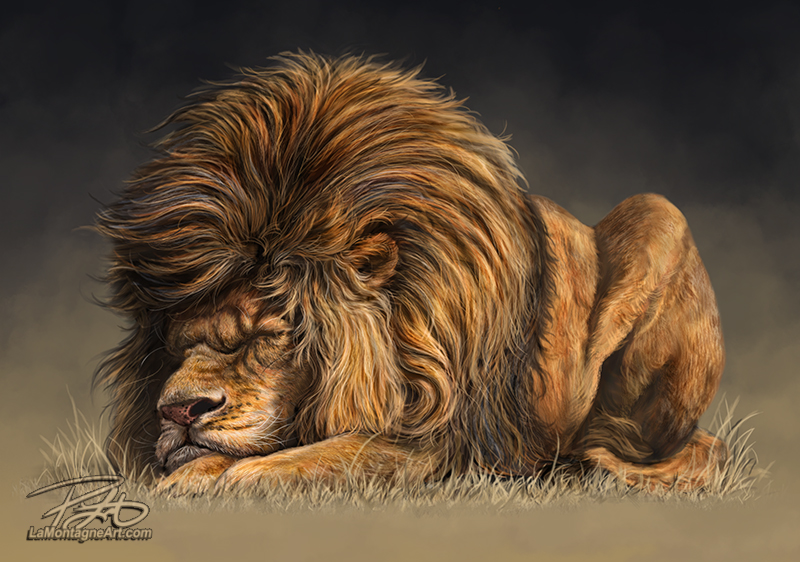
I’m just explaining the source of this latest painting.
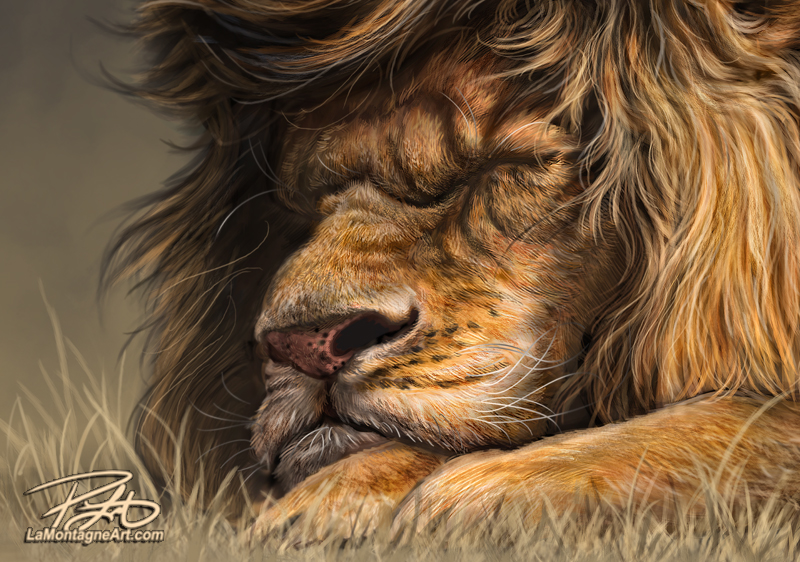 I have been working on another cute, happy painting of a grizzly bear for the past couple of months. I’m recording the process and writing a narrative to go with it. These videos take a lot more time than a regular piece. Recording the painting, writing the text, recording the voice-over, selecting the music, and editing it all add hours to the work.
I don’t want to rush it, but I didn’t want to go too long without a new painting to share and add to my licensing. While perusing my extensive library of reference images, looking for a subject to paint, the happy, genial photos weren’t resonating with me.
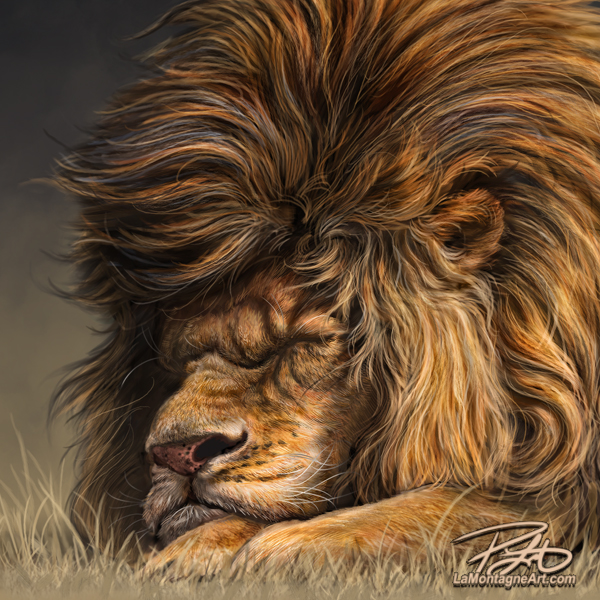
Then I came across a series of photos I’d taken of Griffin, a lion at Discovery Wildlife Park. In a couple of shots, he looked a little annoyed. Considering my present dark cloud perspective and frustration, it felt right.
Naturally, I exaggerated the expression to make him look downright grumpy, hence the title. The more I painted, the more it felt like a self-portrait.
I know that people who buy and license my work are looking for happy, whimsical wildlife paintings to make them feel good. I also know my role in this relationship, and I’m delighted to play it most of the time. I get a lot of satisfaction and joy from my work, and I’m glad many of you enjoy it, too.
But art is often cathartic and a means of expressing our emotions, whether for the person creating it or those it touches.
Though this lion’s expression isn’t happy, I can still see some comedy in it. But make no doubt about it. He’s pissed off, unimpressed, and wants to be left alone.
As with every painting, once released into the wild, I have no control over how people feel about it or whether this grump will connect. But I have a couple of other paintings that aren’t so happy and cheery, and they’ve found their audience, so who knows?
When I’m at the Calgary Expo or a Mountain Made Market, people often repeat the same lines I’ve heard dozens of times. So I’ll confess to having a few stock responses at the ready. It’s impossible to avoid once you have phrases you know connect with people.
While standing at the booth or table, gazing at the wall of paintings before them, some will say, “they’re all so happy!”
I’ll agree with them but offer, “Well, maybe not the Ostrich. He’s got a bit of an attitude problem.”
Or I might advise caution around the Ring-tailed Lemur. “He’s not quite all there.”
Sometime down the road, I’ll undoubtedly have some more advice if I stock prints of this latest painting. “Careful around that grumpy lion. He’s having a bad day.”
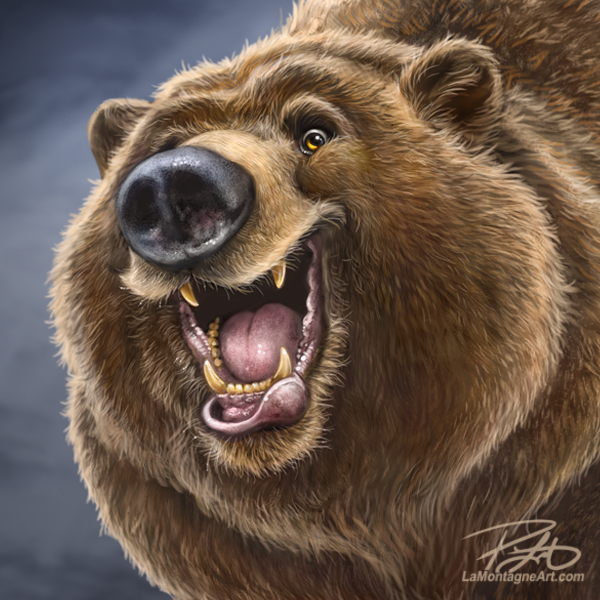
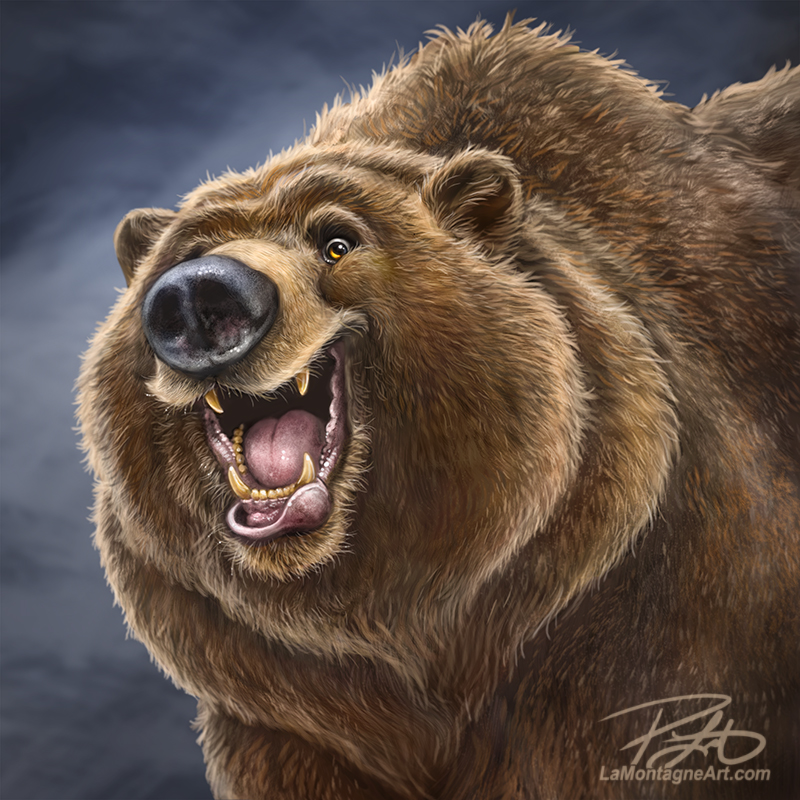 Part of living in bear country is knowing how to be safe when hiking or exploring. It’s important to learn how to react should you encounter a black bear or a grizzly in the woods, and sometimes even in your neighbourhood.
While bear spray within easy reach is more than just fashionable, the best policy is to avoid an encounter, making noise to alert any bears to your presence. Most of them don’t want to encounter humans, so they’ll scurry off before you even see them.
Certain times of the year, however, it’s not so simple. If she’s got curious cubs, Mom will stick around to protect them because they don’t yet know to avoid people. In the fall, bears are eating as much food as possible, preparing for hibernation, and it’s not easy to distract them or get them to leave a bush full of berries.
You can buy bear bells all over the place around here, but they’re ineffective. The noise doesn’t carry; it’s too soft to be heard over the wind or through trees. The same goes for banging sticks or rocks, as those sounds occur naturally.
The best noise is the unmistakable human voice. A conversation among a group of friends will usually convince a bear to seek life elsewhere. Sure, constant yapping goes against the pursuit of natural peace and quiet, but ambulance sirens are worse. Pick your poison.
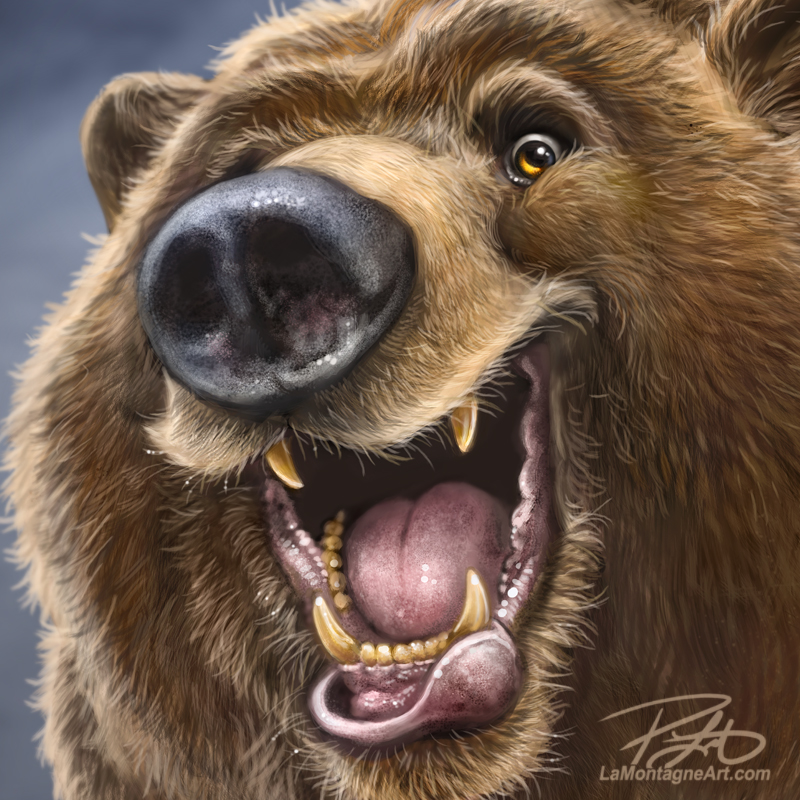 When it’s tough to get a group of people together for a hike, or you just don’t like that many people in the first place, you can sometimes identify solitary hikers by their familiar call of, “Hey Bear!”
I’ve heard this call more times than I can count in the 20+ years I’ve lived and hiked in this area and have used it myself. But it always strikes me funny because, last I checked, bears don’t speak English.
As far as they’re concerned, you could yell anything, and it would still accomplish the same goal. To a bear, there’s really no difference between yelling “Cleanup Aisle 4” or “Flip Flop Hula Hoop” or “Blah, Blah, Frickety, Blah Blah!”
You might amuse other hikers, though.
And if you happened to yell, “Hey, Elk” or “Yo, Squirrel,” it’s not like a grizzly will continue to go about her business, thinking, “oh, that’s for somebody else.”
I don’t know why this occurred to me while painting this bear, but it made me snicker. I thought of walking through the woods, getting that familiar ‘it’s quiet, too quiet’ feeling and calling, “Hey, Bear!” only to have a massive grizzly pop its head up out of a nearby bush and answer, “Hey!”
Cleanup Aisle 4.
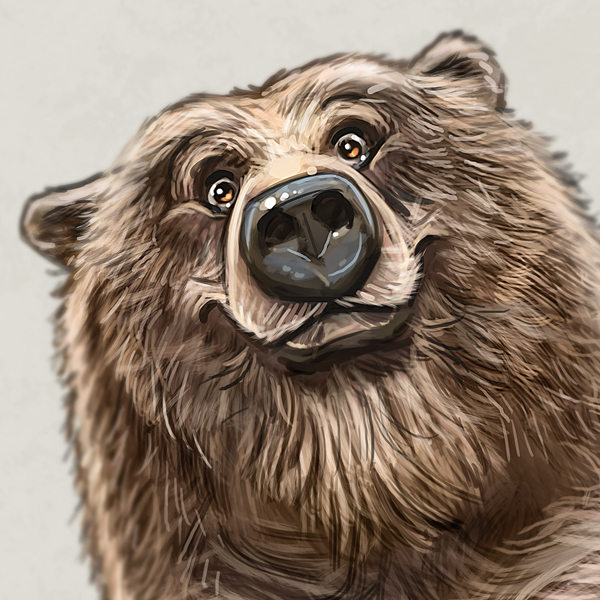
Here’s a painting I did late this week. Not a fully rendered piece, just something I did for fun. I’m still working on another bear, a more finished piece and video. I hope to have that one done in a week or so.
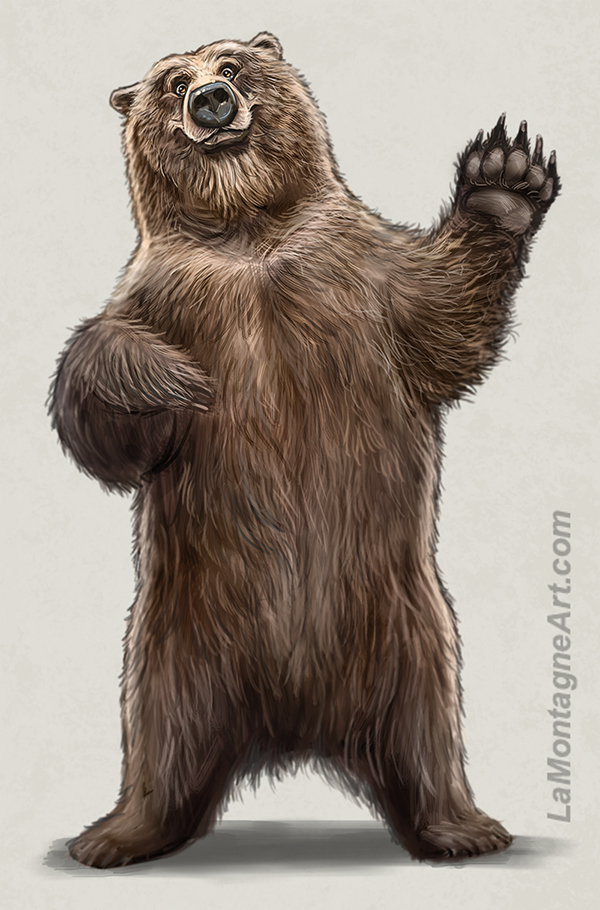 It’s not unusual to see bears in this valley, but it has been a strange season for encounters. The berry crop was poor this year, and bears have been spotted all over town for weeks.
When people fail to pick the ripe fruit from the trees in their yards, it attracts bears. Dog food, bird feeders, dirty BBQs, and garbage will too. Bears have an incredible sense of smell, and they’re attracted to anything that gives off an interesting odour. Dirty diapers will attract bears.
All it takes for a bear to become spoiled and dangerous is too many opportunities to associate people with food.
Shonna and I bought our townhouse condo in 2001. It’s in a well-defined complex with single road access and a couple of other walking entries on the opposite end. We’ve occasionally had elk inside the complex, but in the 21 years we’ve lived here, I’ve never seen a bear on the property.
A couple of weeks ago, while checking the mail, I noticed a sizeable pile of scat six feet from our front door. If you’ve never seen bear poop, it’s unmistakable.
At the end of our street, nowhere near a wilderness area, a well-used gravel path passes beside a daycare. A week before, as I rode my bike around the building heading for downtown, I was surprised to see a mother black bear and two cubs in my way. I hit the brakes, breathed something like “oh shit,” and slowly backed up, wondering what she would do.
She and her cubs looked right at me, but I got away without a confrontation. It was only a half block from home, so I called the Bear Report Line, as did several others.
Still on the phone when I got home, I stepped onto our kitchen balcony to see the Mom and cubs walking by on the street below. It was just after noon.
Many in town have seen this bear and her two cubs, another black bear and her three cubs or several other single black bears looking for food in suburban neighbourhoods.
I recently had a cable internet issue requiring a service call. The tech who came to sort it out lives in an apartment-style condo building near the other end of our street. While walking his dog one evening, he saw a grizzly in his parking lot. Others in his building have seen it too, and warnings are now posted around the property.
Last Sunday, our next-door neighbour Chris sent me a text warning at about 9:15 pm that the black bear and three cubs were spotted walking down a long road that leads to the top of our condo complex. Shonna would be biking home an hour later from her part-time job at Safeway.
Here’s a late-night photo Chris took from his balcony at the end of August.
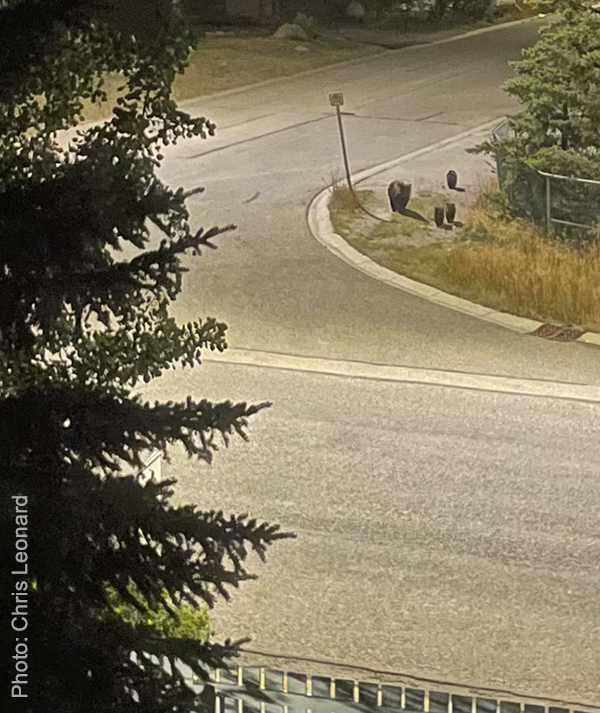 I called Shonna to warn her and said I’d keep an eye out. She takes well-lit main roads to get home, away from the current bear sighting. But this year, they can be anywhere, including downtown.
A half-hour later, Mom and cubs were walking down the road inside our complex, straight toward our front door. Four people stood in front of our place, taking pictures and videos with their phones. I warned them from my open living room window that they were in a dangerous spot and should leave.
They were dismissive and waved me off, a typical tourist response. But I think these were locals who should have known better. Shortly afterward, my neighbour was more blunt when he warned them about their poor choices.
Chris and I were more concerned about harm coming to the bears. When stupid people trigger an encounter that forces a bear to defend itself, the authorities shoot the bear and orphan her cubs. All for an Instagram post.
Fortunately, this bear was more intelligent than those people. She turned around and went back the way she came. The four humans finally left as well, their departure significantly increasing the average IQ of our neighbourhood.
Though the bears were no longer in sight, I knew they’d still be close.
Shonna called before she left Safeway, and I told her I’d be waiting. Bear spray in hand, I stood at the open front door until I heard her repeatedly hitting her bike bell as she drove into the complex. I opened the garage door as she turned the corner so she could go right in, ending our evening’s excitement.
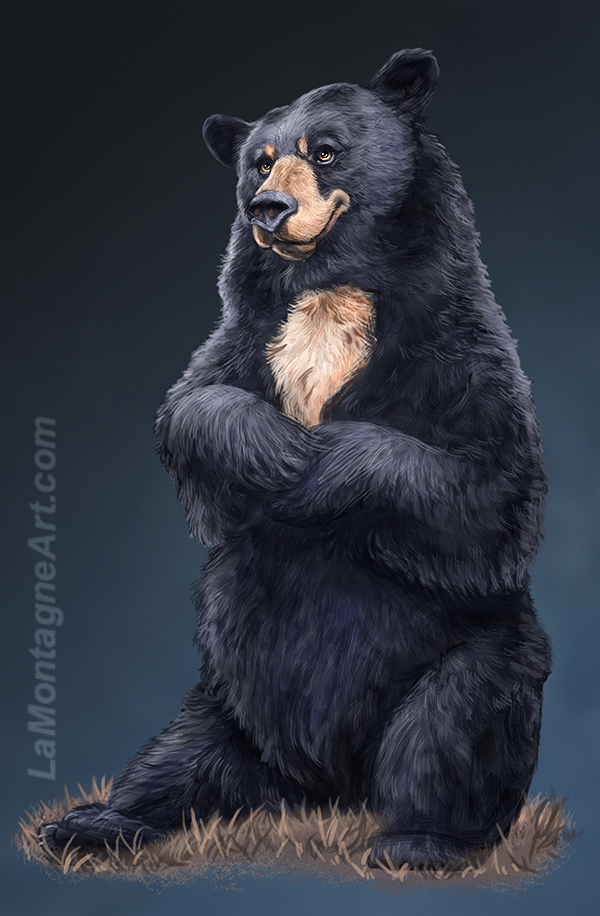 I have a complicated love-fear relationship with bears.
The first whimsical wildlife critter I painted in 2009 was a grizzly bear, and I’ve painted more bears than any other animal. I’ve spent countless hours at Discovery Wildlife Park, having close encounters with their rescued orphan bears, especially a favourite named Berkley. I’ve painted her quite a few times.
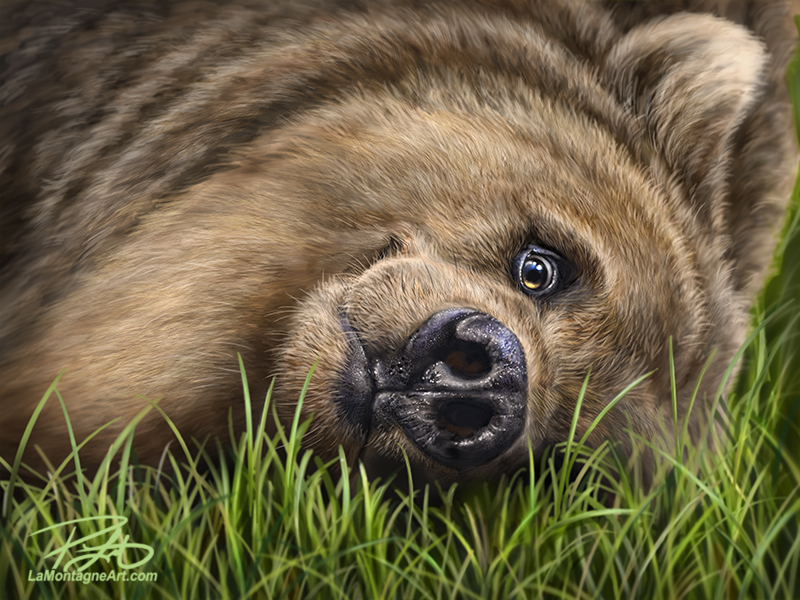 On the flip side of that coin, I am unreasonably terrified of bears. For years, I’ve tried to get used to camping in a tent in bear country.
Bears are more likely to avoid people than seek them out. I know that if you keep a clean campsite, don’t bring any strong smells into the tent with you, and sleep away from where you cook, you’re unlikely to attract bears.
I know what to do if I encounter a black bear or grizzly. I make noise while out in the woods, carry bear spray and know how to use it. I know that bears have far more to fear from us than we ever do from them, that bear attacks are almost unheard of and usually defensive, prompted by a human doing something foolish.
Bears don’t kill people. People kill bears.
And even with that knowledge, I’ve never been able to shake the phobia while camping or hiking in bear country. Every noise is a bear, especially from dusk ‘til dawn. My camping companions have taken great delight in mocking my bearanoia, despite having phobias of their own.
Am I having fun yet?
After countless camping trips, not sleeping well, annoying others with my nervousness, and living with the shame of not being able to talk myself out of it, I’ve given up camping in tents in the Rockies. I return home more pissed off than relaxed.
Besides, a cabin is much more comfortable, especially when it rains.
Strange that I had no concerns on our recent kayaking adventure on Vancouver Island, living in a tent in an area with a dense population of black bears. I slept great every night. Is my fear geographical?
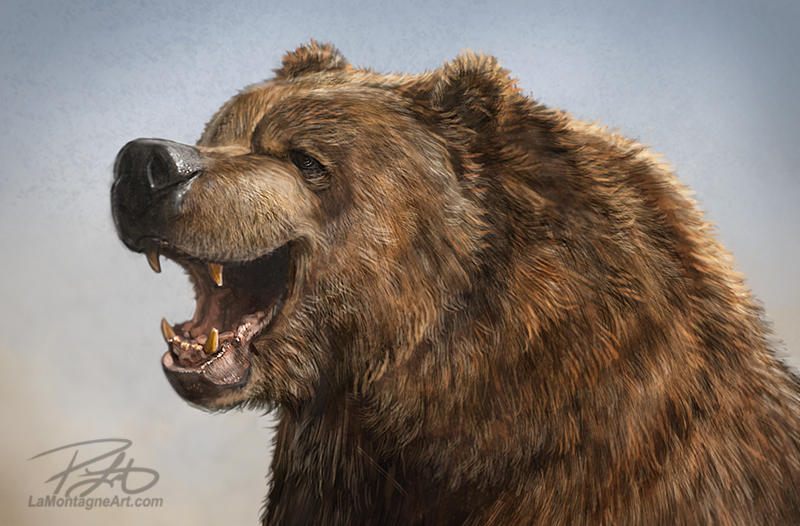 The most remarkable recent bear encounter was at the September 3rd Mountain Made Market when a black bear tried to walk into the Civic Centre in the middle of the day, about forty feet from my table. Fortunately, the Town building monitor, Maurice, a genial and helpful gentleman, stood at the door waving his arms and making noise, convincing the bear to seek a different path. There’s a man who’s good under pressure.
I’ve enjoyed my market experiences over the past year. Decent sales, close to home, and I get the same great location in the Civic Centre each time. Connecting with other vendors and my customers, I always learn something new.
This market was especially fun because Alexander Finbow occupied the next table. He owns Renegade Arts Entertainment here in Canmore. Alex has been ready to publish an art book of my work since 2016. He has been very patient, is still interested and we talked more about it.
Alex figured out that I’ve been making too big a deal out of it, trying to put together one big book instead of a smaller one. He suggested that rather than try to cram my whole career into one volume, I make it more specific, and pick stories and artwork that fit a theme. Then if the first book does well, there will be more books on other parts of my work in the future. That not only relieves a lot of pressure, but it’s a sound business plan as well.
Sometimes you just need somebody to point out the obvious.
The first art book is about bears. Perhaps it always has been.
 When a company needs artwork for a product, they’ll often contract an artist to use their work in exchange for a future royalty percentage on sales.
Depending on the product, percentages can be small. But if the company sells a lot of that product, it can add up to a significant portion of an artist’s income.
This is licensing.
Some artists don’t like licensing because they think they’ll lose control of their art and it will be stolen. That has happened to me more than once, and to every professional artist I know. Sometimes you don’t even know about it until long after the fact, and most of the time, there’s nothing you can do about it except tell them to stop.
Most of the licensing companies I’ve worked with are professionals. They use the art how they say they will, pay me regularly, and it’s a mutually beneficial relationship.
They don’t always use the images I want them to, or as many of my paintings as I’d like, but that’s not my call. They’re running their own businesses, and my art is often a tiny part. Once they license the work, it’s theirs to market how they see fit if they keep to the spirit of the agreement.
Harlequin Nature Graphics licenses a handful of my images on T-shirts. DecalGirl offers several of my paintings on cases and decals for electronic devices. A dozen other companies around the world have licensed my art through an agency for cross-stitch, fabrics, canvas art, and other products.
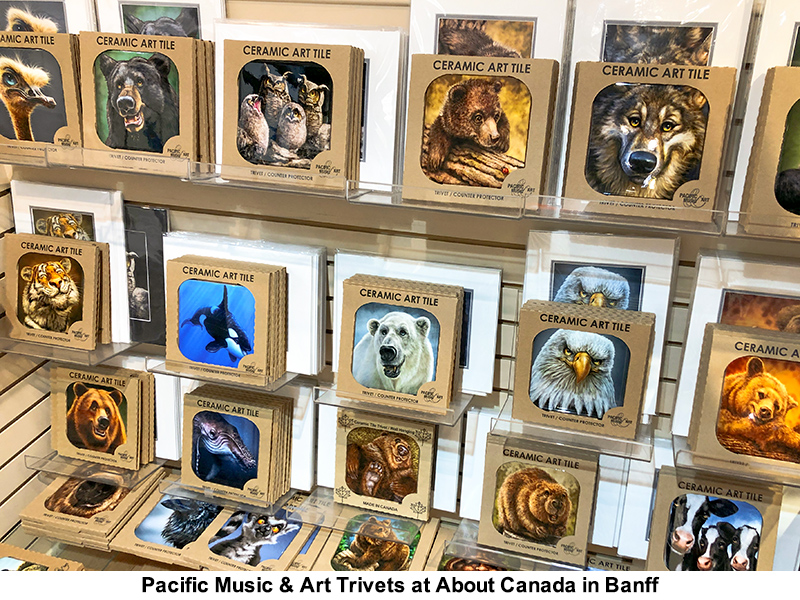 My most significant license, of course, is Pacific Music & Art out of Victoria, BC. Thanks to Mike and his staff, my work is on coffee mugs, water bottles, calendars, art cards, magnets, coasters, trivets, notebooks, and more. During the first year of the pandemic, his foresight to put my work on face masks was a welcome flotation device when other parts of my business were under water.
I regularly encounter people who tell me they’ve bought some of my art at stores I didn’t know existed in towns I’ve never visited. One local friend recently returned from a trip to Vancouver Island and told Shonna, “Pat’s art is everywhere!”
At the Calgary Expo this year, a very nice woman came into my booth and loudly proclaimed, “That’s my otter!”
I laughed and replied, “I beg to differ, Ma’am. That’s MY otter!”
She had bought the image as a framed art card in a BC store more than a year ago, and it hangs in her kitchen.
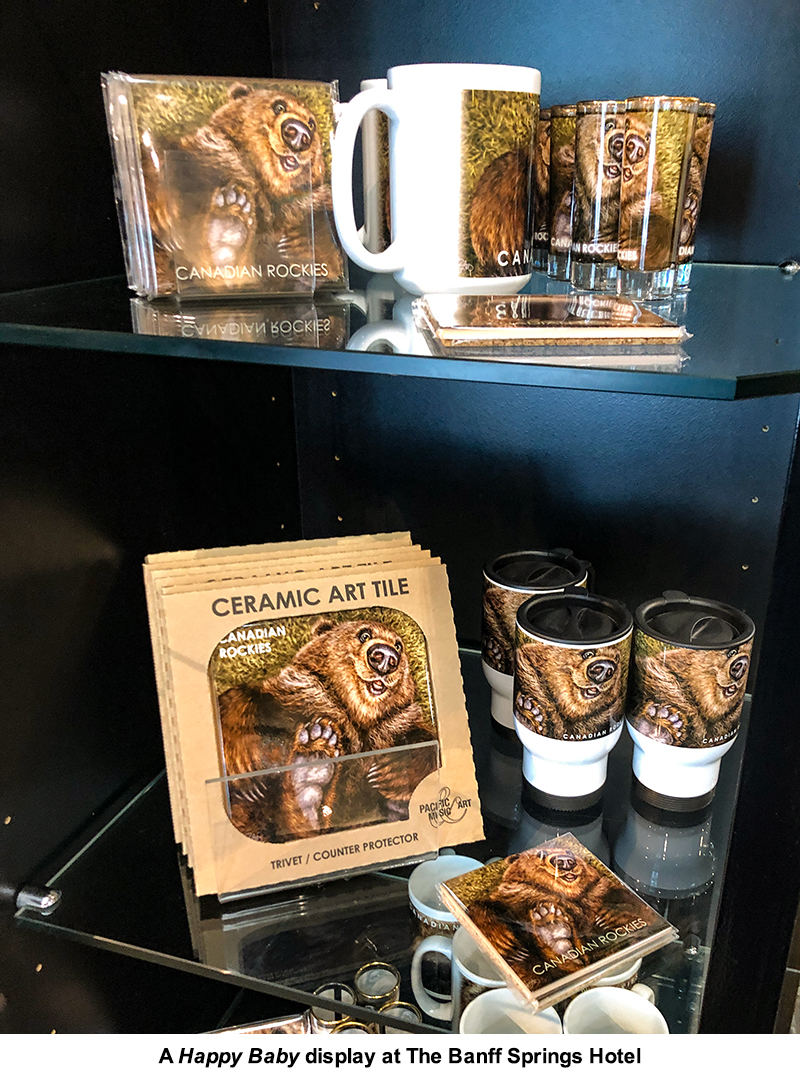 I get my licenses in three ways. The first is through an agency. They will contact me and propose a contract with a client. I have first right of refusal on every deal, and I have politely declined the opportunity a couple of times. They represent many artists, so it’s not a very personal relationship.
I look up every company in every proposed agreement. Sometimes it conflicts with an existing license; other times, their site looks unprofessional, I don’t like the product, or it’s just not a good fit. But most of the deals they send me are worth a try, and I give them the go-ahead.
Sometimes I look for a license because I think my work will fit a product or I like a specific company.
The third way is that a company will reach out to me. They’ve seen my work somewhere, looked around my website, saw images they liked and want to talk about a license.
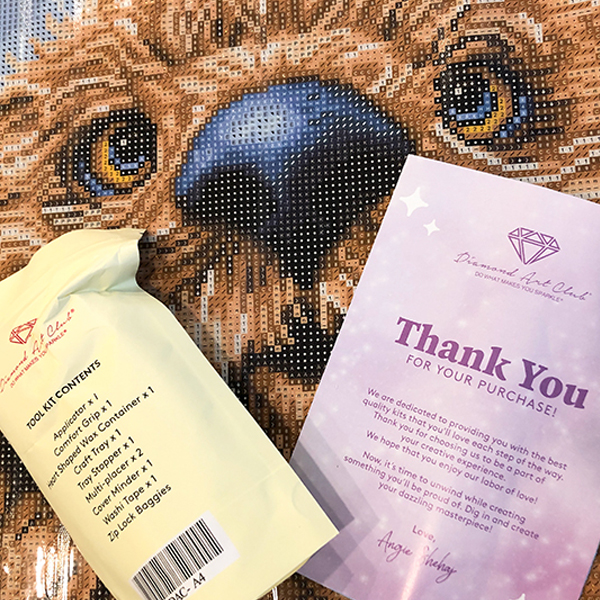
About a year ago, Diamond Art Club contacted me to discuss access to my catalogue. The contact was professional, sent me a great information package for prospective licenses, and they were upfront about their royalties and payment schedule—no red flags.
I looked through their professional site and was impressed with how many high-end brands and artists they have under license. There’s no credibility question when a company has the official DC Comics and Harry Potter licenses.
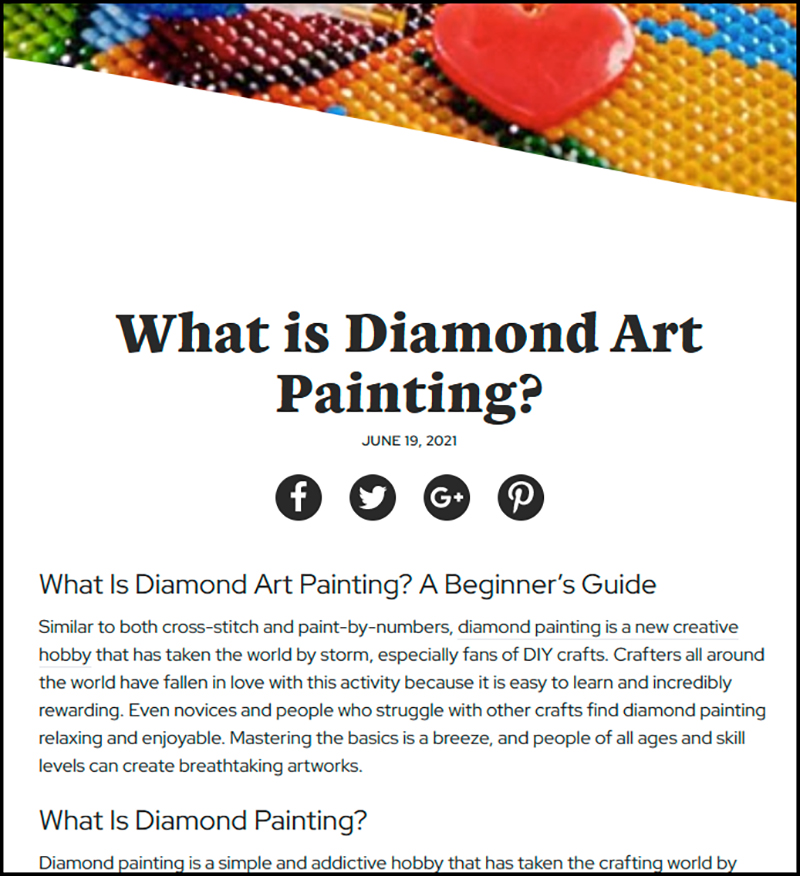
I had heard a little about diamond painting kits but didn’t know much about the hobby, nor how massive it is. The simplest explanation is that it seems to be a blend of paint-by-numbers, cross-stitch and a little bit of the classic lite-bright toy. So rather than butcher the explanation, I’ll refer you to their site’s excellent description. Click here or on the image below.
 After a couple of weeks back and forth with contracts and questions, I uploaded my art to their servers and tried to put it out of my mind. They were clear that nothing would likely be available until the end of the year. Licensing is often a long game, depending on the product, and each company’s lead time is different.
The production pipeline on these kits is extensive. First, there’s research with customers and retailers to determine which images to produce, then assigning an image to a designer who will turn a piece of art into a kit. Following that, the kit must be manufactured in large quantities and shipped. It’s more involved than most products I’ve encountered.
I don’t know the timeline for when the world is normal, but I was forewarned that it is much longer under the shadow of the pandemic.
It has been a year since I signed the contract with Diamond Art Club. I checked in with them every couple of months, and they were friendly and accommodating as they explained the different stages of delay. And I’m just one new artist. They no doubt have hundreds of other pieces in the pipeline, all affected by the same delays every company in the world has faced these past couple of years.
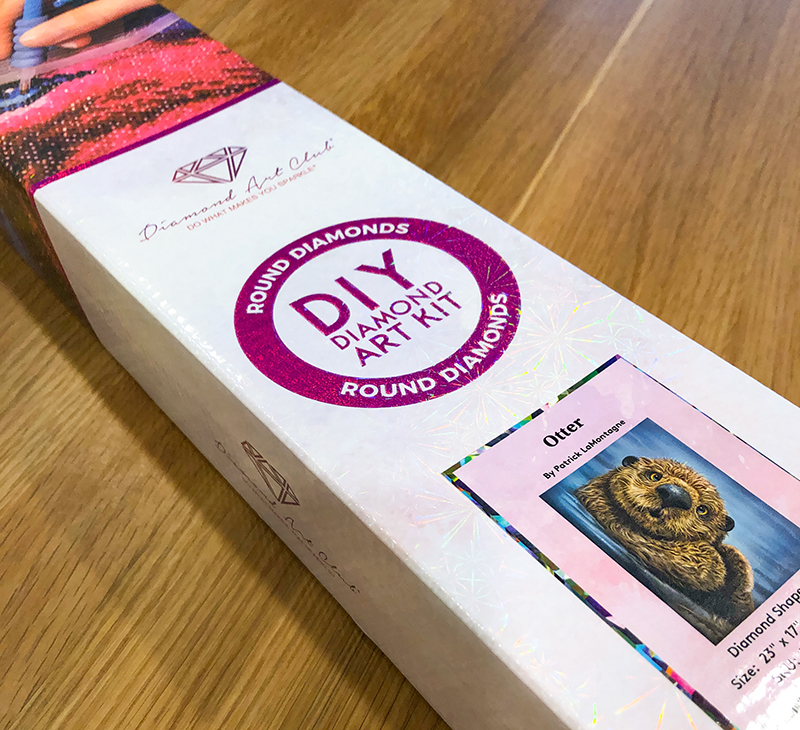
The first image Diamond Art Club put into production was no surprise. My Otter is one of my top two bestsellers everywhere, a close tie with the Smiling Tiger.
I’m glad they started with that one because if it does well, there will no doubt be more of my images on these kits in the future. Given the popularity and quality of these kits, I certainly hope so.
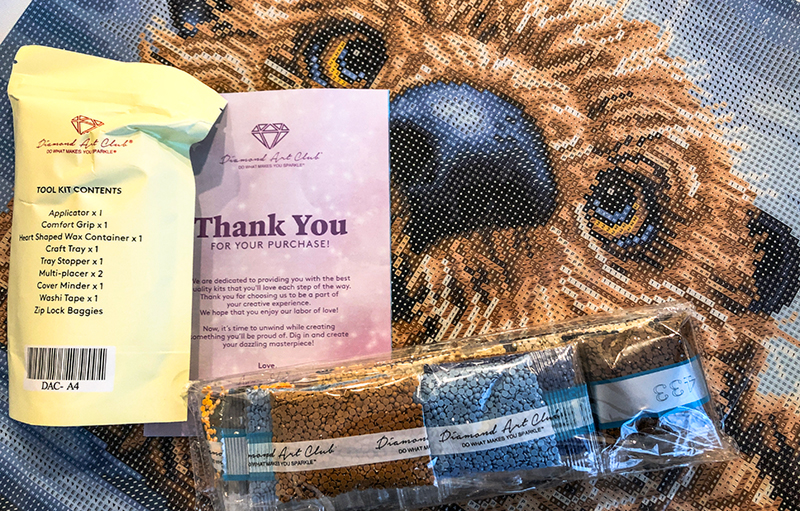 My sample arrived this week, and I was eager to open it. The first thing I noticed was the fantastic design of the packaging, both outside and in. The tools and pieces are well organized and labelled. The quality of the otter image on the canvas is superb, and there’s nothing about this kit that looks cheap and thrown together. At 23″X17″, it’s a fairly large image.
If I were into this hobby and bought one from Diamond Art Club, I would feel like a valued customer. As a licensed artist, I feel my work is represented well, and I’m pleased to be involved with this company. I hope it’s for a long time.
I’ve learned about licensing, however, that I have no clue what will do well or for how long. Certain paintings may be incredibly popular with the people who like them, but will a new product find a new audience? I have no idea.
So, while I wait and see, I let these companies do what they do best, and I’ll keep painting new portraits of whimsical wildlife for their future consideration.
Because that’s what I do best.
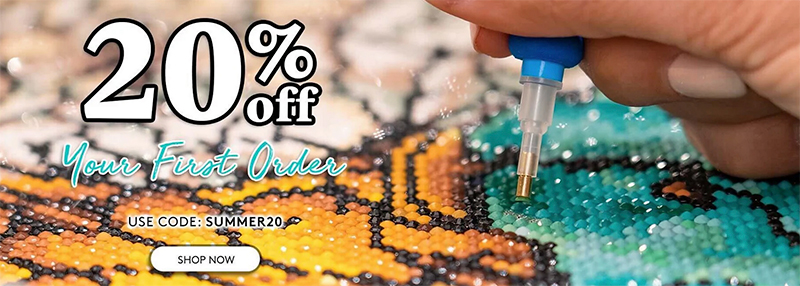 If you’d like to learn more about Diamond Art Club, head to their site and check it out. Right now, you can get 20% off your first order with the code SUMMER20. While they have a large assortment of fantastic art, might I suggest a certain Otter as your first piece?
Cheers,
Patrick
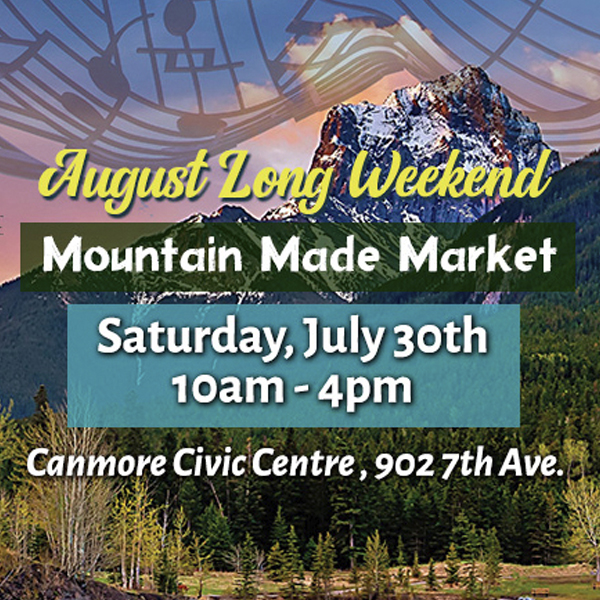
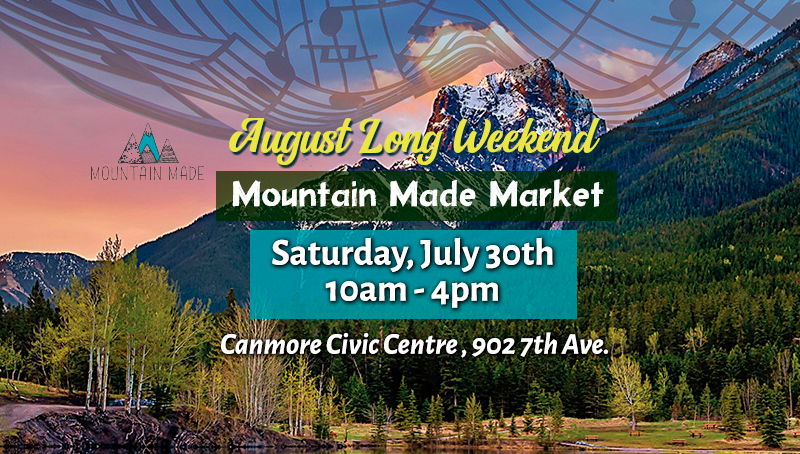
It’s that time again, another long weekend Mountain Made Market this Saturday at the Civic Centre, downtown Canmore. There will be 25 vendors inside and out, specialty foods, arts & crafts and live music. The Canmore Folk Fest also returns this weekend, so downtown will be a hopping place. With Main Street closed for the summer to motor vehicles, there’s plenty of room to move about, see the sights and enjoy the atmosphere.
As I don’t do the regular market circuit, I haven’t got a big tent, so you’ll find me just inside The Civic Centre in the main foyer. I’ll have plenty of prints, including the latest releases, 2023 calendars, coasters, magnets, aluminum art, canvas, stickers and more. So come on down and support local art and artists!
Hope to see you there.
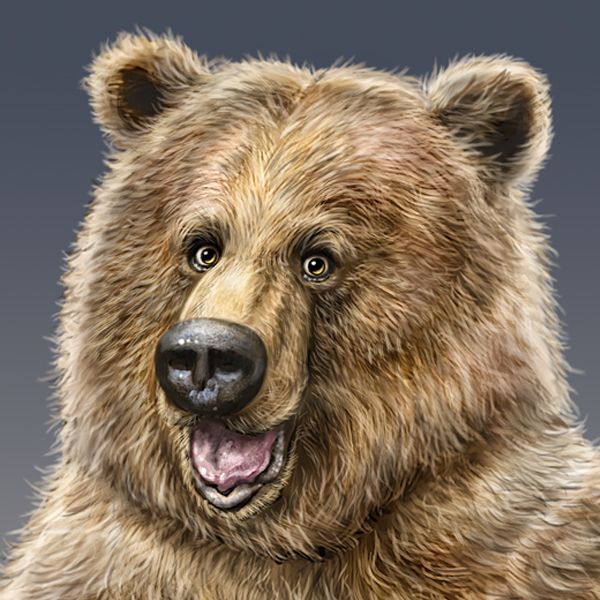
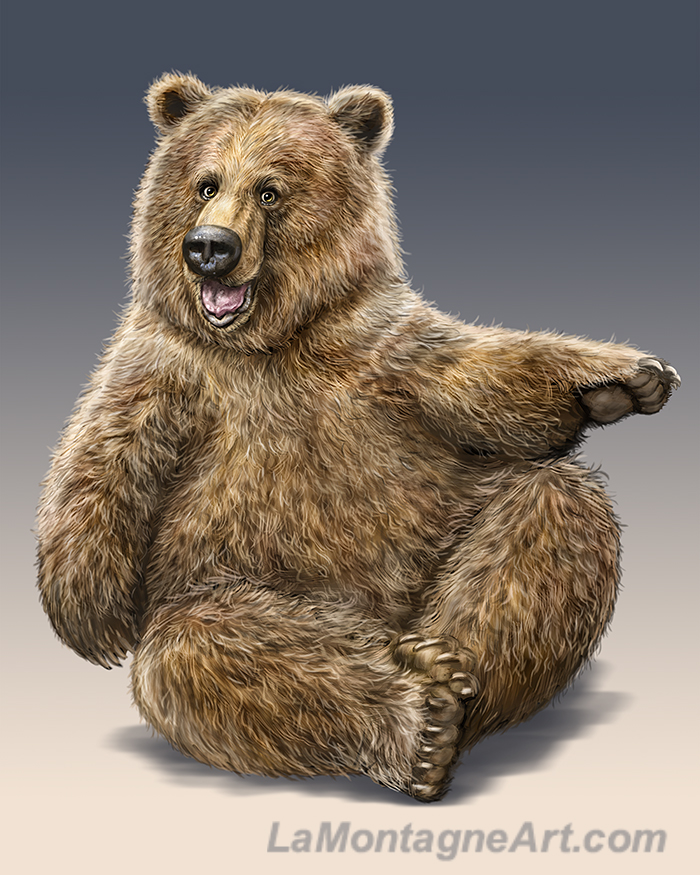
Here’s a painting of one of the younger bears at Discovery Wildlife Park. I took the reference in September of last year, but because there were two bears the same age, and I don’t know them as well as I do Berkley, I didn’t know which one I was painting.
I sent the finished piece to my friend Serena, the head keeper at the park, and she immediately said it was Bos (rather than Piper), which I took as a compliment that she could identify the bear from my painting. Another keeper also knew which as well, so it felt pretty good that even with my whimsical style, I got the personality and likeness right.
Serena reluctantly mentioned an anatomy issue with one of the paws/claws and said the claws looked more like a black bear than a brown bear. I asked for more clarification and spent some time repainting the problem area.
When it comes to unsolicited criticism, the kind most people offer is a glib comment that costs them nothing, so they speak before thinking. Unfortunately, it can often be unkind, malicious, or personal, which usually says more about the critic than that being criticized.
One of the pillars supporting social media is that we’re all so sure of our clear view from the cheap seats. It has always been easier to tear somebody down than build them up.
Constructive criticism, however, is a valuable resource, and artists need to cultivate relationships with people who genuinely want to see them create better work. For example, my buddy Derek and I have often sent each other paintings in progress, asking for critique.
Another tattoo artist friend sent me a beautiful sea turtle painting he’d completed the other day and asked my opinion. I loved the piece and enjoyed seeing it but had no suggestion for improving it, which isn’t unusual.
Most of the time, we’ve each scrutinized our work to death already before we request a second look.
But staring at a painting too long, sometimes you miss what’s right in front of you until a trusted friend and colleague points it out. Then you wonder how you ever could have missed it. Or you make the suggested change to see the results and agree it was a better choice.
When you do get an honest critique from someone whose intentions are genuine, be grateful. That person took the time to help you improve your work.
Serena’s not a painter, but when it comes to animal anatomy, I trust her eye, and I’m glad she saw what I missed. Better still, I’m happy she said so, rather than worry that I would take it personally.
From time to time, however, the creator of a piece might consider a critique and still disagree. That’s fine, too. Every artist sees things differently, and ultimately it comes down to making your own choices. I’ve had plenty of well-intentioned suggestions over the years, both on specific pieces and my business in general, that I decided weren’t right for me.
You never know, however, when somebody might offer a solution to a problem you didn’t know you had. For example, my buddy, Darrel, casually suggested vinyl stickers a while back because he saw a few on vehicles and thought my work would lend itself to those. I’m glad he did because my stickers are now doing well in a few retail stores, and I’m actively seeking more resellers.
But then, I also get a lot of people suggesting I create children’s books, and it’s just not something that interests me.
This painting was supposed to be a practice sketch. But my obsessive nature and perfectionist tendencies don’t seem to allow me to stop if I can just paint in a little… more… detail. So, this became a finished piece. I think it will make a nice sticker, too, and possibly a print later.
Regardless of where it ends up, I consider any time painting bears to be time well spent.
Cheers,
Patrick
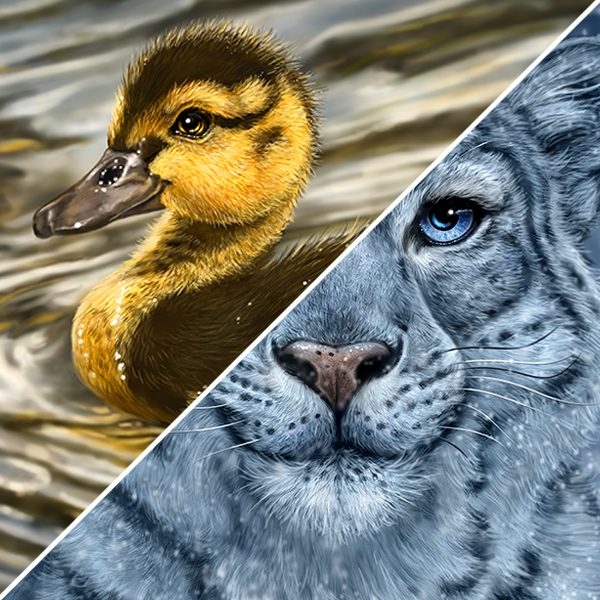
I’ve painted over 100 animals since 2009, and I can’t keep them all in stock. Even five of each is a lot of inventory. So whenever I bring in new ones, I’ve got to retire some. Some paintings seem to be perpetual best sellers, while others have their day in the sun for a few years and then wane in popularity.
To ensure a reasonable price from my supplier, I have to order prints in volume. So when a print plays out its best days, it’s no longer worth ordering a large amount. That’s a good indication it’s time to let it go and give a new one a chance.
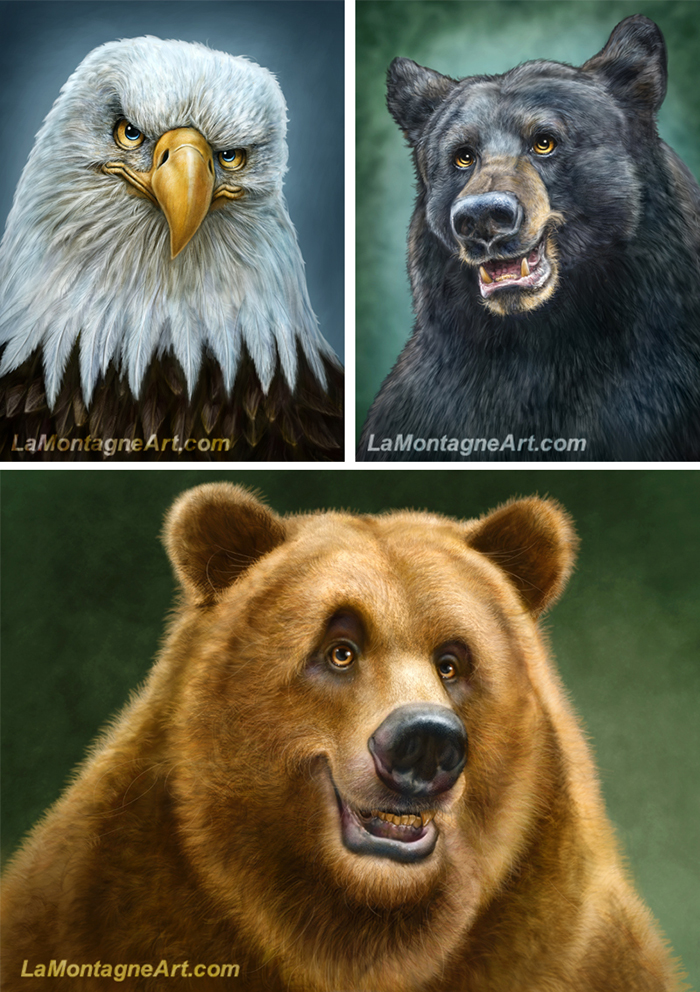 Today, I’m retiring three prints. The Bald Eagle, Black Bear and Grizzly have been removed from the store. They’re still popular on other items through my various licenses, but not as much as prints in my online store. I get attached to these paintings as each has a story and takes many hours to paint. This round of retirees is especially bittersweet as this Grizzly was the first animal I painted in my whimsical wildlife style, the bear that started it all. But I’m always painting new grizzly bears and black bears, so there’s no shortage of that subject.
As much as I like my Bald Eagle painting, I’ve taken many excellent references at The Birds of Prey Centre in Coaldale, Alberta in recent years, and I’m looking to paint a new one.
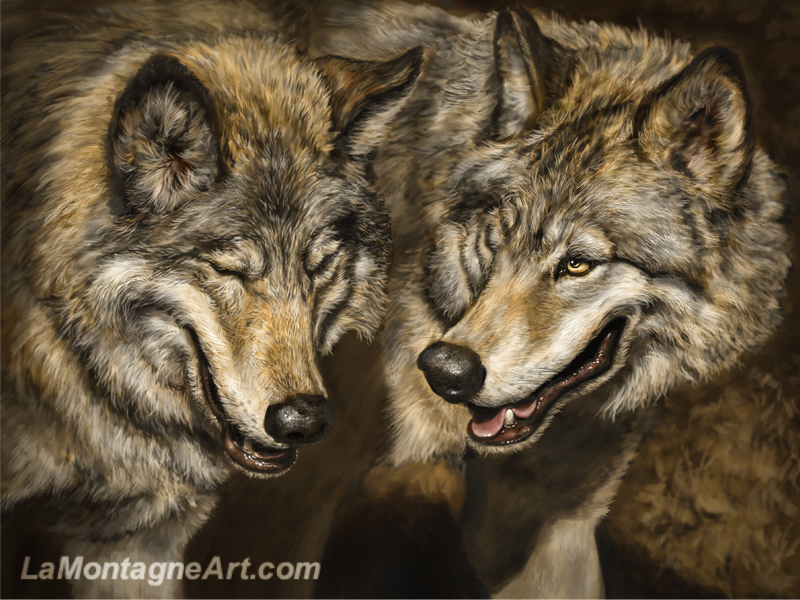
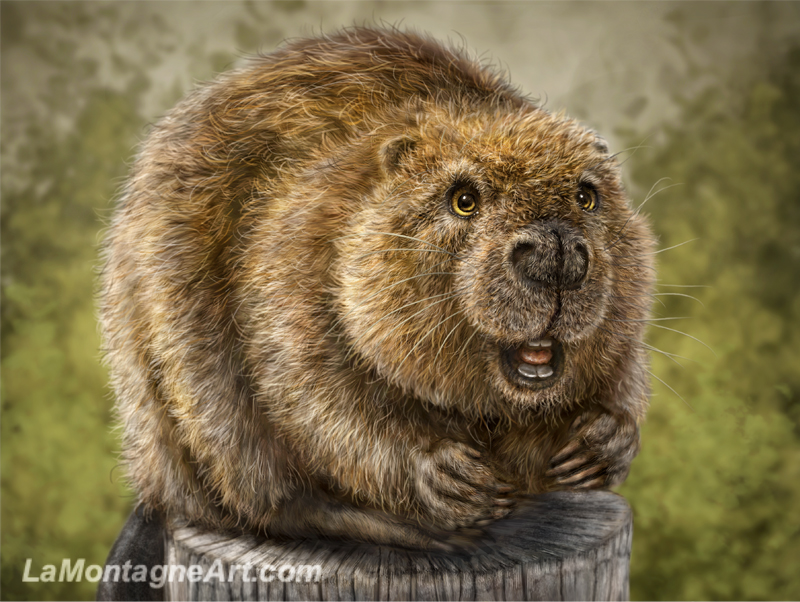 With a new print order just arrived, the Beaver and Two Wolves are back in stock, so if you’ve been waiting for those, thanks for your patience.
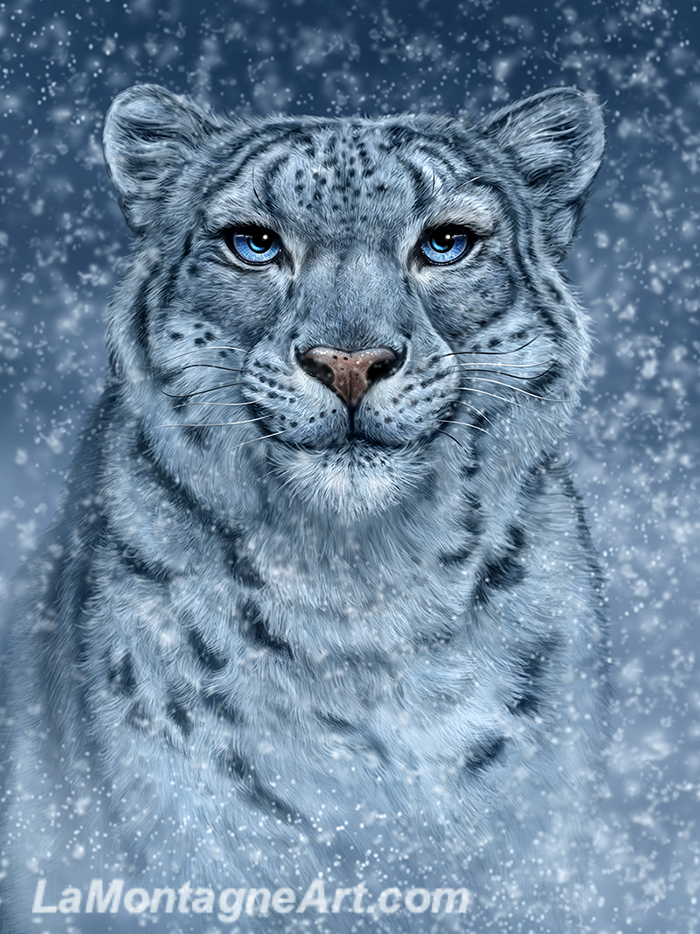
 Of course, no new order would be complete without some first-issue prints. My latest paintings, Snow Queen and Duckling, are now available in the store! I love seeing the first prints of a new painting; these were no exception. There’s just something about a print that makes the work complete.
 .
.
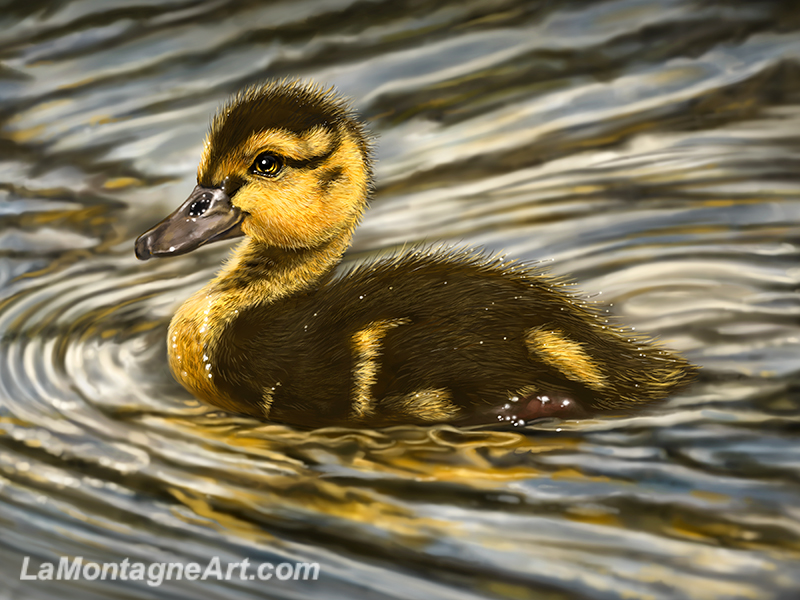
All prints are 11″ x14″ with a white border, and it’s easy to find an off-the-shelf frame as it’s a standard size. In addition, each is hand-signed and comes with a backer board and artist bio in a cellophane sleeve.
If you have any questions about the available prints or vinyl stickers, feel free to drop me a line, and I’ll be happy to answer. Otherwise, take a browse through the available paintings and see if there’s one that catches your eye. And a reminder that all images (even the retired ones) are available via custom order, as canvas or metal prints.
Cheers,
Patrick